News Desk, Biggani.org | [email protected]
Imagine if the endless, frigid darkness you see when you look at the sky at night could one day be transformed into a power-generating device! Though it might sound like science fiction, scientists around the world have started turning this dream into reality. Researchers at the University of California, Davis have developed a small device capable of generating energy from the temperature difference between the Earth’s warmth and the intense cold of deep space. This remarkable study was recently published in the science journal Science Advances.
As you know, the Earth is kept warm by sunlight. During the day, soil, water, and air all store heat. On the other hand, deep space has a temperature of nearly minus 270 degrees Celsius—almost absolute zero. From this massive temperature gap, scientists came up with a novel idea: could this difference be used to generate electricity? That very question gave birth to this groundbreaking research.
At the core of the research is a special engine called a Stirling engine. Unlike other engines, it doesn’t run by burning fuel. No gas, diesel, or oil is used here. Instead, it generates mechanical energy based on the temperature difference between hot and cold. For example, if you place cold air next to a hot cup of coffee, it creates a temperature difference. The Stirling engine operates on the same principle. However, the truly innovative aspect of this research is that it uses the temperature of deep space as the source of cold.
Naturally, you might wonder, “How can we utilize the chill of space when it’s so far away?” Scientists have a simple answer—for this, they use ‘thermal radiation.’ Just as the sun sends light and heat to Earth, the Earth also emits heat toward the sky. This heat, though invisible to the naked eye, is radiated through infrared waves. By harnessing this natural process, scientists have created an invisible link between the Earth and space.
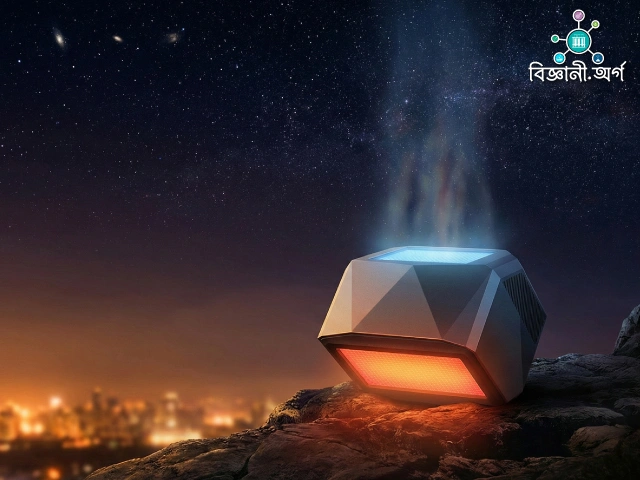
The device itself is ingeniously designed. One side of a square panel is attached to the ground to efficiently absorb the Earth’s warmth. The other side faces the night sky. This surface is coated with a special type of paint that can quickly radiate heat at specific wavelengths. These waves escape through an “atmospheric window” where the air offers very little resistance. As a result, the Earth’s heat rapidly escapes into space, chilling one side of the device. This hot-to-cold difference powers the Stirling engine.
The scientists carried out the test not in a lab, but in a real-world environment. For over a year, they placed the device outdoors and monitored it. The results were astonishing. After sunset, a temperature difference of about 10 degrees Celsius developed between the two sides of the device. From this difference, about 400 milliwatts of energy per square meter could be generated. While this may not sound like much, it’s enough to power a small fan or miniature electric motor.
The most remarkable part was a special experiment. The researchers installed the engine inside a small greenhouse to see if it could circulate air at night. A customized fan blade was connected to the flywheel of the engine. Surprisingly, the fan was able to circulate the greenhouse air sufficiently. This helped regulate the internal temperature and created a comfortable environment for the plants.
The researchers say this is just the first step. With further development, the device may one day provide healthy indoor air without using electricity or fuel. In schools, hospitals, parks, or greenhouses, this technology could help create optimal environments for plant growth. By controlling temperature, humidity, and carbon dioxide levels, it would be possible to increase crop yields.
Recognizing the importance of this technology, the University of California, Davis has already filed a provisional patent for it. The study notes that this technology promises not only a new path for energy generation but could also play an effective role against climate change—since there is no emission of smoke, waste, or carbon gases.
Currently, the device’s power output is limited. Researchers believe that with future improvements, it could generate up to 6 watts per square meter. While that’s still less than what solar panels can produce, its major advantage is that it works at night—when solar power isn’t available.
This discovery teaches us an important lesson—energy sources are not limited to coal, oil, or gas. Nature hides vast energy reserves that can be unlocked through the combination of science and imagination. When a small device on Earth can turn the chill of space into power, it’s clear there are no limits to scientific progress.
Your curiosity might be the key to changing the world of the future. The question in your mind today might one day form the basis of a groundbreaking discovery. Science isn’t just about memorization—it’s about understanding, exploring, and finding new pathways. This little device proves that sometimes, a small idea is all it takes for big change.