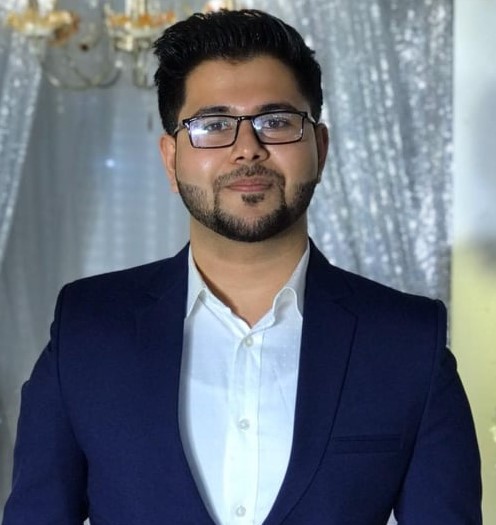
In our interviews with young scientists, this time we spoke with Mohammad Junayed Hasan from Johns Hopkins University. He conducts research on artificial intelligence and quantum computing. In particular, he is working on how these technologies can be applied in healthcare. Read his interview below:
Tell us a little about yourself.
I am Mohammad Junayed Hasan. I recently completed my undergraduate studies in Computer Science and Engineering at North South University. Currently, I am pursuing a master’s in Computer Science at Johns Hopkins University. My main research areas are the application of machine learning in healthcare, natural language processing, and quantum computing. As an emerging researcher, I am keen to contribute to human welfare through science and technology.
What is the subject of your research?
My primary research area is the application of artificial intelligence and machine learning in healthcare. Specifically, I use advanced language models to assist in clinical (disease-related) decision-making. This includes extracting important information from a patient’s medical notes (admission note or prescription), predicting patient conditions, and supporting doctors in making decisions. To make these models more efficient and faster, I use various technologies such as knowledge distillation, pruning, and quantization. My goal is to develop technologies that will make doctors’ work easier and ensure better healthcare services for patients.
How does your research benefit us?
Firstly, the use of artificial intelligence in healthcare is assisting doctors in decision-making, which is improving the quality of diagnosis and treatment. Secondly, by analyzing clinical notes, it is now possible to predict the condition of patients, which helps in preventing complications. Thirdly, research on making machine learning models more efficient is helping healthcare institutions serve more patients in less time and with fewer resources. Overall, these research efforts are contributing to improving the quality of healthcare and reducing costs, thereby enhancing public health as a whole.
Would you like to share any experience from your research work with us?
One day, I had a rather unusual experience. At that time, I was analyzing human smiles using artificial intelligence—to determine whether a smile was genuine or fake. Suddenly, it occurred to me that this research isn’t only important for robots; it could be extremely useful for people as well.
Imagine if a psychologist or a criminal investigator could accurately detect who is truly smiling and who is pretending! I became very excited. I worked day and night, and through transformer networks and analyzing subtle facial expressions, I developed a model.
When I successfully tested the model on various databases, I realized that we had not just created a tool, but a bridge—something that can connect human emotion and logic. This experience taught me that technology is not just about numbers; it can reach into the depths of humanity, if we work with the right perspective.
What qualities do you think a scientist should have?
I would like to compare a scientist to a versatile tree. The roots of this tree are curiosity—which drives a scientist to ask new questions and inspires the search for the unknown. The trunk is patience—which helps endure lengthy research and experimentation. The leaves are flexible thinking—which allows embracing new ideas and methods. The flowers are creativity—which give rise to new theories and discoveries. The fruits are analytical skills—which help draw meaningful conclusions from data. The shade of this tree is ethics—which keeps the scientist aware of the social impact of their work. And finally, the soil in which this tree stands is the spirit of collaboration—because no scientist alone possesses all knowledge.
A successful scientist, by combining all these qualities, not only expands the boundaries of their own knowledge but also enriches the field of knowledge for all humanity.
Do you have any message or advice for young students in Bangladesh who want to pursue science?
Dear young science enthusiasts of Bangladesh,
You are the future scientists of our country—those who will illuminate Bangladesh with the light of knowledge and science. My message to you is this:
Firstly, keep your curiosity alive. Do not be afraid to ask questions, because every question opens a new door to knowledge.
Secondly, do not be afraid of failure in experiments. Remember, every failure brings you one step closer to success.
Thirdly, do not confine yourself to book knowledge alone. Use nature as your laboratory, question the world around you.
Fourthly, understand the importance of collaboration. When we work together, we can go much further.
Above all, dream big. Remember, what seems impossible today will be made possible by the science of tomorrow. You are the heroes who will turn the ‘impossible’ into ‘possible.’
Use science for the welfare of Bangladesh’s land and people. Among you are the Nobel laureates of tomorrow.
May your journey in science be prosperous.
Your contact information:
junayedhasan100 @ gmail.com
Link to your research work
https://scholar.google.com/citations?user=QwIfzvgAAAAJ&hl=en&oi=ao