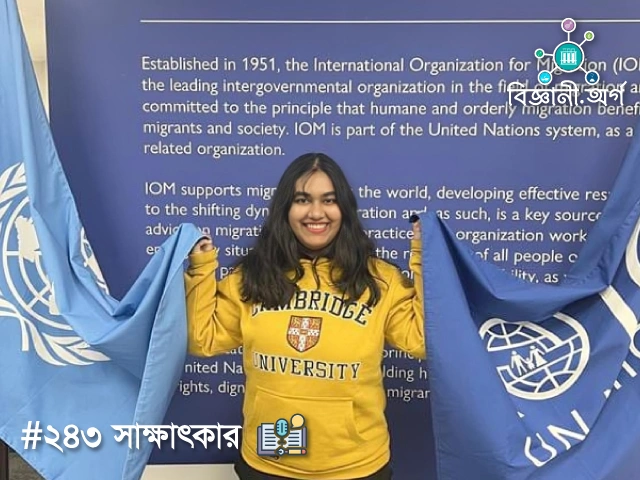
In this episode of our interviews with young scientists, we sat down with genetic engineering scientist Rojana Binte Azad. She is currently working at the Institute of Biotechnology and Genetic Engineering (IBGE). Read her interview below:
First, please tell us a little about yourself.
I am Rojana Binte Azad. I was born and raised in the town of Gurudaspur, Natore district. My father, Md. A.K. Azad, works as an Assistant Professor in the Economics Department at BCSS Government College. My mother, Rahema Khatun, worked as a school teacher. I am the eldest of two sisters. Both my school and college education were in Natore. Later, I completed my BS (Agriculture) degree from Bangabandhu Sheikh Mujibur Rahman Agricultural University. After that, I enrolled for an MS degree at the Institute of Biotechnology and Genetic Engineering (IBGE), where I am currently conducting my research work.
What is your research topic?
I am researching wheat blast disease, a fungal disease affecting wheat. Our main goal is to develop new high-yield wheat varieties resistant to blast disease. To this end, we are producing resistant wheat lines through artificial crossing between wheat varieties from cold regions (winter wheat) and our local wheat varieties (spring wheat). The blast-resistant Rmg8 gene from winter wheat is being transferred into the genome of local wheat, which already contains the 2NS Translocation chromosome segment that provides resistance to blast and other diseases. This method is called gene stacking. Currently, these resistant gene-stacked advanced wheat lines are delivering promising results both in lab and field tests.
How does your research benefit us?
Wheat blast is a new menace for Bangladesh’s agricultural sector. It was first identified in Bangladesh in 2016, and that year, many farmers lost their entire crops to this disease. The disease is now spreading across wheat-producing regions of the country. The alarming fact is that we do not have any durable blast-resistant wheat varieties in Bangladesh. Therefore, new, high-yielding, blast-free wheat varieties are extremely important for our agriculture. I also hope my research will contribute to ensuring the country’s food security.
What qualities do you think a scientist should have?
Pursuing science is like a form of devotion. Therefore, the most important qualities for a scientist are patience, a passion for learning, and the ability to think in new ways.
Do you have any messages or advice for young students in Bangladesh who want to pursue science?
I believe young minds are crucial for our research sector, because they are open-minded and energetic. Young people should create opportunities to think beyond conventional methods, and be open to any discussion or criticism. Out-of-the-box thinking is vital for any kind of innovation. Above all, research demands patience and curiosity for learning new things.
Your contact information:
Email: rojanaoyshi0111 [@] gmail
We wish scientist Rojana Binte Azad continued success in all her endeavors.