


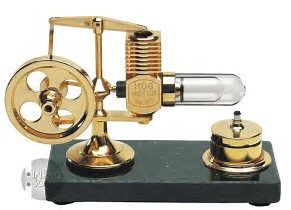
Introduction:
The Stirling engine is a type of heat engine that is completely different from the internal combustion engines used in vehicles. Robert Stirling invented this engine in 1816. Despite having much higher efficiency than gasoline or diesel engines, the use of Stirling engines is limited to special applications such as submarines, providing power for light boats, and so on. Although the successful commercialization of the Stirling engine has yet to be achieved, there is still a great deal of research and development ongoing.
The Stirling engine operates through the “Stirling Cycle,” which is different from internal combustion engine cycles.
Ø
The gas (working fluid) inside a Stirling engine is never expelled. There is no exhaust valve. There is also no combustion of gas inside the engine. As a result, the Stirling engine does not make any noise.
Ø
The Stirling cycle uses an external heat source, which can be anything from gasoline to solar heat. No combustion process occurs inside the engine’s cylinder.
The Stirling Cycle:
An ideal Stirling cycle comprises four thermodynamic processes.

Process 1-2: Isothermal expansion
Process 2-3: Constant volume heat rejection
Process 3-4: Isothermal compression
Process 4-1: Constant volume heat addition
A fixed amount of gas is filled inside the cylinder of a Stirling engine, making it completely airtight. Two unique properties of gases are utilized:
1. If a certain amount of gas is held at a fixed volume and its temperature is raised, its pressure will also increase.
2. If a certain amount of gas is held at a fixed volume and its pressure is increased, its temperature will also rise.
Let’s describe a simplified Stirling engine. Here is an example and operation explanation of a two-cylinder Stirling engine:
Process 4-1

By increasing the temperature of the engine’s gas (working fluid) at a constant volume, its pressure also increases.
Process 1-2

At constant temperature, the gas volume increases, causing the pressure to drop, and this expansion pushes the piston upward.

After this, all of the gas is transferred to the cold cylinder.
Process 2-3

By cooling the gas at a constant volume, its temperature drops, and therefore its pressure also decreases.
Process 3-4

The gas is compressed at constant temperature, so its volume decreases and pressure increases.

The gas is transferred to the hot cylinder.
The Stirling engine only produces power during process 1-2. This power generation can be increased in two ways:
1. By increasing the power output in process 1-2: Here, the pressure of the hot gas pushes the piston upward, doing work. If this pressure is increased, the output also increases. The pressure can be increased by raising the temperature.
2. By reducing the energy consumption in process 3-4: Here, the piston uses a portion of the energy generated in process 1-2 to do work on the gas. If this consumed energy can be reduced, net power output increases. By lowering the pressure, the energy used here can be minimized. If the gas can be precooled to reduce its temperature, the pressure will also decrease.
Here, the description is of the ideal Stirling engine, but in practice, the operation of an actual Stirling engine differs slightly due to its physical construction.
Types of Stirling Engines and Their Operations:
Stirling engines are generally of two types:
- Alpha Stirling or two-piston Stirling engine
- Beta Stirling or displacer-type Stirling engine
1. Alpha Stirling or Two-Piston Stirling Engine
An alpha Stirling engine has two separate cylinders, each with its own piston: one hot piston and one cold piston. The hot piston cylinder is situated inside a high-temperature heat exchanger, while the cold piston cylinder is housed inside a cold heat exchanger. This type of engine has a high power-to-volume ratio, but the hot piston cylinder can face certain technical issues due to the high temperatures and the challenge of keeping it airtight.

Here, most of the gas is in the hot cylinder, and due to the high temperature, its volume increases and pushes the hot piston outward. This expansion of the gas continues until it reaches the cold cylinder, which is 90 degrees behind the hot cylinder in the cycle and extracts work from the hot gas.

Here, the gas reaches its maximum volume, and the hot cylinder piston starts pushing the gas toward the cold cylinder. As the gas enters the cold cylinder, it cools and its volume shrinks.

Here, most of the gas is cooling down in the cold cylinder. The speed of the flywheel controls this travel of the piston.

Here, the gas volume is at its minimum, after which the gas is again heated in the hot cylinder, and this process repeats continuously.
2. Beta Stirling or Displacer-Type Stirling Engine
This type has only one cylinder and two pistons: a displacer piston and a power piston. The displacer piston is loosely mounted and does not absorb energy from the expanding gas; instead, it helps transfer gas from the hot heat exchanger to the cold heat exchanger. When the gas reaches the hot end of the cylinder, it pushes the power piston, and when it goes to the cold end, it contracts. The entire process is controlled by a flywheel. Beta engines do not face technical issues with sealing.

The power piston compresses the gas, while the displacer piston helps the gas move to the hot heat exchanger end.

The hot gas increases pressure inside the cylinder and pushes the power piston upwards. This is the power stroke.

The displacer moves all the way down, forcing the gas upward.
Why Stirling Engines Are Not Commonly Used:
The main reason is the external thermal source. It takes some time for the engine to respond to the temperature of the hot cylinder, as the external heat needs to pass through the cylinder walls to reach the contained gas, which is a relatively slow process. This means:
Ø
The engine needs some time to heat up before it can produce power.
Ø
The engine cannot instantly change its output power.
Uses of Stirling Engines:
Stirling engines are used in various applications such as combined heat and power generation, solar power generation, heat pumps, marine engines, nuclear power, automobile engines, aircraft engines, etc.
In Bangladesh, Dr. L. Merrick Lockwood built a Stirling engine in the early 1980s, which was used for rice threshing. And, notably, it is considered one of the top ten uses of the Stirling engine.

A Stirling engine used for solar power generation
Image source:
http://www.sandia.gov/news-center/news-releases/2004/images/jpg/stirling-engine.jpg

Dr. L. Merrick Lockwood’s Stirling engine in Bangladesh
References:
http://en.wikipedia.org/wiki/Stirling_engine
http://auto.howstuffworks.com/stirling-engine.htm










This comment has been sanitized for the English site.
This comment has been sanitized for the English site.
apnar probondhoguli project akare likhle valo hoi
This comment has been sanitized for the English site.