


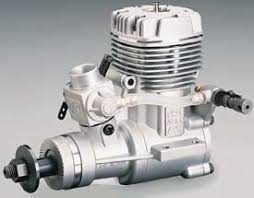
Two–Stroke
Diesel Engine:
How Does It Work?
Generally, the vehicles we use, such as cars, buses, trucks, etc., are powered by two types of engines: 1. Gasoline 2. Diesel. These again come in two types: 1. Four-stroke internal combustion engine, 2. Two-stroke internal combustion engine. In this article, I will describe how a two-stroke internal combustion diesel engine works.
What is a Two-Stroke
Engine?
First, we need to know what a two-stroke engine is. Below, the basic parts of a two-stroke engine are shown.

[Image: Sourced from How Stuff Works website]
At the top of the cylinder, there are 2-4 exhaust valves, which open at the same time simultaneously. Right next to the exhaust valve is the diesel fuel injector (yellow colored). The piston in a two-stroke engine is slightly longer, which allows it to also function as an intake valve. When the piston reaches the very bottom of the cylinder, the intake port opens and air enters the cylinder. This air is first compressed to the required level by a turbocharger or supercharger. The crankcase is made airtight and contains oil.
Advantages of
Two-Stroke Engines:
1. Two-stroke engines do not have any valves, which simplifies their construction and also makes them lighter.
2. In two-stroke engines, combustion occurs once per revolution, while in four-stroke engines, combustion occurs once every two revolutions. As a result, more power can be generated from two-stroke engines.
3. Two-stroke engines can operate in any orientation, which is helpful for mobile applications. On the other hand, with four-stroke engines, there are more complications, such as the need to keep the engine upright to ensure proper oil flow.
These advantages show that two-stroke engines are lighter in weight and provide power with each stroke. Thus, the power-to-weight ratio of a two-stroke engine is much higher than that of a four-stroke engine.
How Does the
Two-Stroke Diesel
Cycle Work:
1. When the piston reaches the top of the cylinder, it compresses the air inside to a high pressure. At that exact moment, diesel fuel is sprayed into the cylinder via the fuel injector. Due to the cylinder’s high pressure and temperature, combustion starts immediately.
2. The pressure generated by combustion pushes the piston down to the lower end of the cylinder. This stroke is known as the power stroke.
3. As the piston moves downward, the exhaust valve opens and the exhaust gases exit the cylinder, releasing the pressure.
4. As the piston descends further, the intake valve opens, allowing fresh air into the cylinder. This clean air also helps flush out the exhaust gases.
5. The piston then begins to move upward again, causing the intake and exhaust valves to close.
6. As the piston moves upward, the fresh air in the cylinder is compressed. This stroke is called the compression stroke.
7. The piston then reaches the top of the cylinder, and the process repeats as described above.
From this description, it is clear that only clean air is present in the cylinder of a two-stroke diesel engine, thus avoiding any environmental issues. However, a two-stroke diesel engine must always have a turbocharger or supercharger, making it more expensive.
References:
How Two-stroke Engines Work










This comment has been sanitized for the English site.
This comment has been sanitized for the English site.
Its truly fantastic post. Look forward to read the 4-stroke diesel engine (vehicle driven by a diesel engine).
This comment has been sanitized for the English site.
This comment has been sanitized for the English site.