


Introduction:
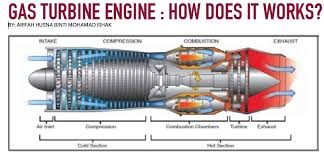
First of all, what is a gas turbine? It is a rotary engine that extracts energy from the flow of combustion gases. When we visit airports, we see jet airplanes. These jet planes are powered by very large engines, typically turbofans. The turbofan is an example of a gas turbine.

{Image: Collected from www.howstuffworks.com}
A Look Back:
Let’s briefly discuss the origin of the gas turbine concept. We usually hear about steam turbines, water turbines, and wind turbines. All of these are used in various power plants/power stations to generate electricity. The practical application (applied application) of these is the gas turbine. In a gas turbine engine, high-pressure gas is used to rotate the turbine blades.
Structure and Function:
Theoretically, the structure of a gas turbine engine is very simple.
1. Compressor: It compresses the air coming through the intake to a high pressure.
2. Combustion Chamber: Burns fuel and produces high-pressure, high-speed gases.
3. Turbine: Extracts energy from the high-pressure, high-speed gases flowing from the combustion chamber.

{Image: Collected from www.howstuffworks.com}
In the image above, we can see an axial-flow gas turbine. This type of gas turbine is commonly used in helicopter rotors. Now, let’s discuss in detail how they work.
Compressor:
The compressor in this engine takes in air. The compressor is a cone-shaped cylinder with a series of small fan blades arranged in rows. When air enters the compressor, its pressure is low (normal atmospheric pressure), but after being compressed by the compressor, the pressure increases by up to 30 times.
Combustion Chamber:
The high-pressure air enters the combustion chamber. Then, fuel is injected steadily from the ring of fuel injectors. Typically, kerosene, jet fuel, propane, or other natural gases are used as fuel. The high-pressure air flows through the combustion chamber at about 100 miles per hour, and combustion must be accomplished in these conditions, which is nearly impossible under normal circumstances. To solve this problem, a flame holder or can is used in the combustion chamber. The can is a hollow, perforated heavy metal component. The cross-section of a can is shown below:

{Image: Collected from www.howstuffworks.com}
The injector is on the right side of the can, and compressed air enters through the holes. Exhaust gases are expelled from the left side of the can.
Turbine:
The rest of the engine is the turbine.

{Image: Collected from www.howstuffwork.com}
In the image above, two sets of turbines are shown. The first stage directly drives the compressor. The turbine and compressor are connected via a shaft, so all three turn together. The final stage of the turbine is connected to the output shaft, which is separate from the rest of the engine and can spin completely freely (even without assistance from the other sections!). This part is also known as the free-wheeling unit. After combustion in the combustion chamber, the resulting hot gas spins the free-wheeling unit, generating up to about 1,500 horsepower.
Advantages and Disadvantages:
The main reason for using gas turbine engines in tanks, jet planes, various power plants, etc., is that it generates much more power relative to its weight. In other words, the power-to-weight ratio of a gas turbine engine is much higher than that of other engines.
And the main disadvantage of this engine is that it is quite expensive.
Sources: howstuffworks.com








This comment has been sanitized for the English site.
This comment has been sanitized for the English site.
Apner Lekhati Porlam. Khub Valo Legacha. In future-A Aro Valo Biggan Subject Lekha Chai.
Allah Hafez
Very well, straigt forward analyzation.
Pic gulo oshadharon