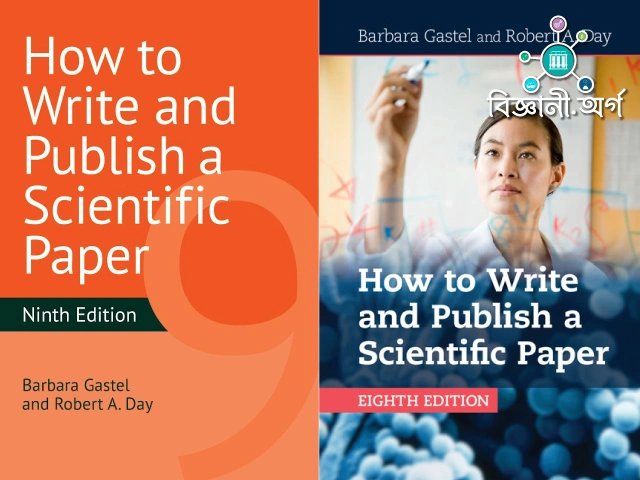
Many talented young researchers in Bangladesh dream of making a name for themselves on the international stage. They enter the world of research, start working with new ideas, collect data, and carry out analyses—all driven by enthusiasm and ambition. Yet, presenting their findings correctly, turning them into a scientific article that meets international standards, and getting published in a reputed journal—this entire process often seems unfamiliar and daunting to them. Some are discouraged right from the start, while others, despite years of research, become confused at the publication stage. An extraordinary resource makes this challenging path easier—How to Write and Publish a Scientific Paper.
Barbara Gastel and Robert Day, co-authors of this book, did not merely see it as an instructional manual. Instead, they built it as an ideal hands-on guide, carefully unraveling the mysteries of scientific publishing step by step with the needs of novice researchers in mind. The book explains, very clearly and with practical examples, how a student should structure a paper, what information goes into each section, the most common mistakes, and how to avoid them.
Speaking of Bangladesh, while many universities offer research-based studies, training in scientific publishing is almost absent. Students submit theses, some write for local journals, but very few are able to produce research articles of international quality. A major reason for this is the lack of clear understanding about scientific writing style, structure, and rules. Sometimes, due to their busy schedules, supervisors cannot provide ample guidance either. This book steps in as a truly reliable companion to fill that gap.
After starting research, the most crucial aspect during paper writing becomes the structure. Introduction, methods, results, discussion, and conclusion—many students are confused about how to organize these sections logically. The authors of this book provide step-by-step guidance, showing exactly how to organize information in each paragraph and how to maintain reader engagement. This structural advice not only helps a student write a good paper, but also refines their perspective on research itself.
Many believe that quality research alone is enough for publication. But in reality, a poorly written paper—even if the underlying research is significant—will not be considered by prestigious journals. This is because, for editors and reviewers, the most important issues are clarity, relevance, and a reliable presentation of scientific reasoning. This book offers guidance with an eye on writing quality, scholarly style, and reader comprehension, ensuring that the writer’s thoughts are clearly conveyed to the audience.
Another commendable feature of the book is its detailed explanation of the ‘peer-review’ process. How a paper is submitted for review, what aspects reviewers focus on, and how to respond to reviewer feedback—this entire process is usually a grey area for new researchers. This book guides them from that darkness into the light.
Among Bangladeshi students, there is often a sense of fear and hesitation about international publication. Many believe that without strong English skills or a big reputation as a researcher, publishing in international journals is impossible. In reality, numerous researchers around the world whose mother tongue isn’t English regularly publish on the international stage. Their only reliance is a robust writing structure and clear scientific reasoning. This book helps build that confidence—if you can present your information well, language becomes much less of a barrier.
In today’s world, scientific knowledge is no longer confined to the laboratory; it plays a vital role in policymaking, technological advancement, and social change. Therefore, properly presenting research findings is a responsibility for every researcher. Limiting research to the lab may never have a real impact on society. Publication makes research come alive, puts it at the center of discussion, and opens doors for solving societal problems. This book not only teaches writing strategies but also highlights the social responsibilities of a scientist.
The greatest benefit for young researchers is the book’s simple language and concise, relevant examples. Rather than theoretical discussions, the emphasis is on practical advice. For those writing a paper for the first time, or those struggling to construct a strong structure despite multiple attempts, this book serves as a guiding map. It’s as if an experienced mentor is sitting beside you, saying—‘Change this part a bit, clarify this section, present this result more effectively.’
Some may think the book is relevant only for researchers in biology or engineering. In reality, researchers from sociology, economics, anthropology, or any discipline can benefit from it. While the core principles of scientific publishing may vary across fields, the style of writing, presentation of reasoning, and reader comprehension apply equally in all disciplines.
If Bangladesh aspires to become a scientifically advanced nation, the first step is to teach its young researchers how to present themselves at an international standard. Research should not be limited to solving local problems but become part of the global conversation. In this journey, this book is a milestone. Our universities—especially at the postgraduate and research level—could consider including it as a required reading or as part of training programs.
Finally, for those embarking on research alone, lacking the courage to write a paper, or facing disappointment after repeated rejections—this book offers silent reassurance. It says, you are not alone. Many have walked this path before, and you can too—if you have the right guidance, patience, and a good book like How to Write and Publish a Scientific Paper. Once you master the skill of putting science onto paper, young Bangladeshi researchers will, one day, become part of the global treasure trove of knowledge.