Have you ever seen a bird fly backward? While some of us can float on our backs when swimming, have you ever seen a bird fly on its back in the air? Eagles, hawks, and other birds inspired humans to invent airplanes, but it was insects like dragonflies and bees that inspired the invention of helicopters, because birds cannot hover in one place like these insects can. But there is one kind of bird that can perform all these acrobatics in the air! The males of this bird species sometimes swing like a pendulum while suspended in the air to impress the females! When flying backward, this bird can see everything behind it clearly without turning its head, thanks to the unique position of its two eyes on either side of its head and the special structure of its brain.
In the mountainous forests of South America, the mornings are very cold. Since the body temperature of insects is determined by their surroundings, in such cold they become so sluggish that they don’t actively collect nectar from flowers. As a result, there is a significant decline in plant pollination and reproduction. Probably for this very reason, nature created these birds, who use their long, slender beaks and tongues to drink nectar, flying from flower to flower even in the cold to fill their stomachs.
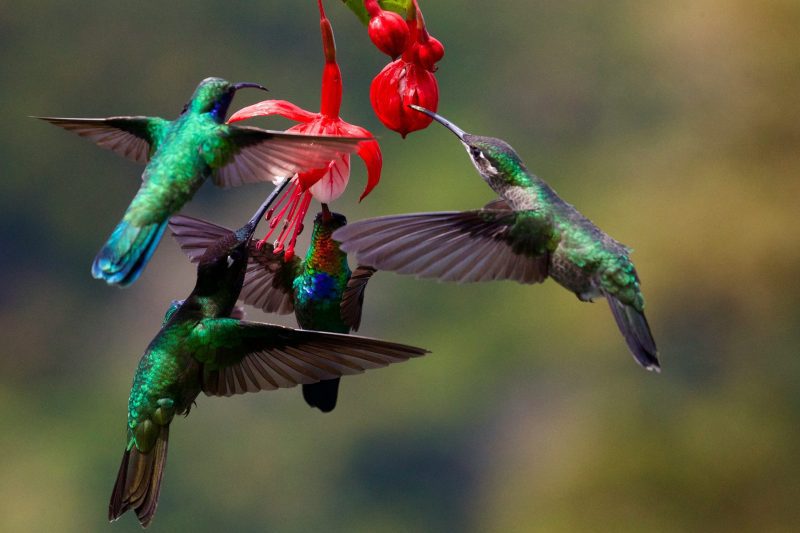
Their wings are attached to their bodies through a “ball and socket joint,” which allows both shoulders to rotate up to 180 degrees. So, unlike other birds, they can flap their wings not just up and down, but in every direction! Not only that, while flying, they can move their tail feathers to easily reduce air resistance. This ability also allows them to fly backward when needed. This skill comes especially handy when they move swiftly from flower to flower in a crowd to drink nectar.
To make it easier to sip nectar from selected flowers, nature gave these birds the ability to hover in one place for a long time in the air. When hovering like this, they have to flap their wings at a very high rate to overcome the force of gravity—up to 80 times per second! Their metabolic rate is extremely high, which powers their hearts to beat more than a thousand times per minute! This allows the heart to deliver blood to the wing muscles at a high rate, enabling rapid wing movement.
They can sip nectar at a rate of ten drops every fifteen milliseconds. Each day, this bird drinks nectar from various flowers equal to about half its own body weight. Their memory is as sharp as that of bees. Once they know which flowers in a region produce the most nectar, they can easily find those flowers among the countless blossoms.
Comparable in size to many insects, these birds are known as the smallest birds in the world—among their species, the smallest ones measure just five centimeters from beak to tail! Because they flap their wings so rapidly, a unique sound is created due to the difference in air pressure above and below the wings. In English, this sound is called “humming.” Hence, these birds are famously known as “hummingbirds.”