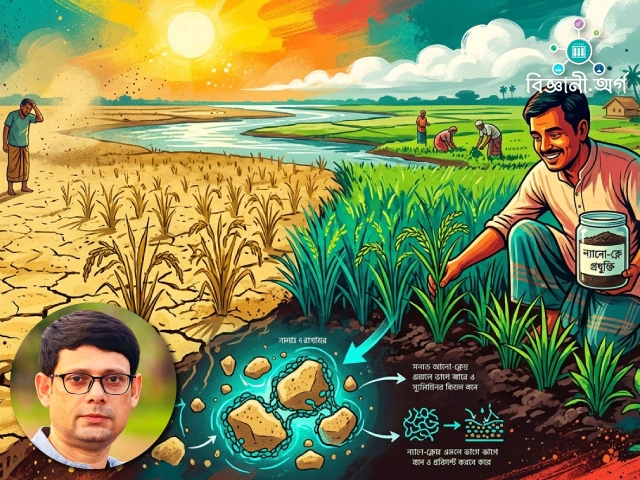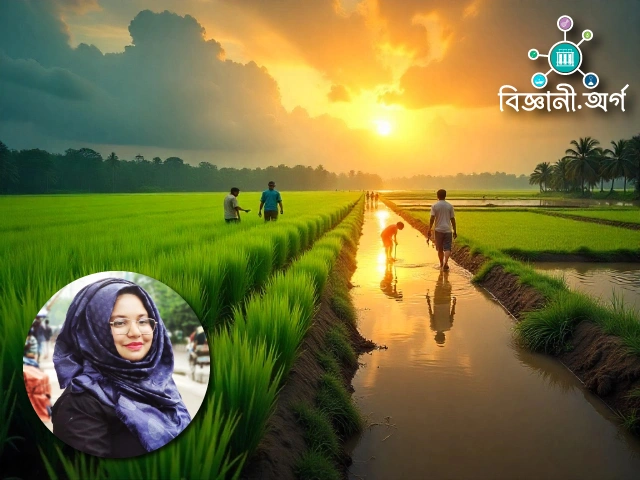
A new stretch of land has appeared in Mirsarai Upazila in Chattogram. Smiles are lighting up the faces of farmers, locals are breathing in hope for a more secure future, and news of this has traders eager to start counting their profits.
But disaster struck while everyone was admiring the golden crops—before the hard-earned harvest could stand tall, it sank into the mud and vanished like the new moon. Whispers and rumors started spreading everywhere. Eventually, the news reached the community of researchers.
The Tale of Joys and Sorrows Downstream
This vast land was created downstream of the river. No matter how beautiful it appears on the surface, it conceals an equal measure of sorrow beneath. Just as crops cannot survive without water, in this case, the water itself is destroying them. It was soon discovered that there is a direct and seasonal link between the quality of river water and crop production.
The area regularly experiences storms, tidal surges, and the rise and fall of tides. These disasters are making the soil infertile, turning every day into a struggle. Farmers are at their wits’ end—where will they find double the harvest and double the price? Instead, it seems like their hard-earned money is just slipping away!
The Vigorous Efforts of Bangladeshi Researchers
Seeing the hardship faced by the working people of their own country, the research team found themselves unable to eat in peace. They hurried to Chattogram, to the Mirsarai area. There, they separately collected soil, water, and mud samples. Their objective: to identify exactly where the problem lies, how severe it is, and what solutions might be possible.
First, they selected a specific area for research. Then, they divided it into four sections—old protected, newly protected, unprotected, and affected areas.
Soil samples were collected from each location and from three different depths:
- Top layer
- Middle layer
- Subsoil layer
Research Findings
- During the Aman and Rabi seasons, soil salinity across the research area was less than 4 dS/m.
- In the Rabi season, salinity remained low in all areas except the unprotected region.
- Salinity inside the cross dam water during the Rabi season was only 0.1 dS/m (excellent for irrigation).
- Outside the cross dam, however, during the Aman season salinity levels reached 4.8–5.4 dS/m, and in the MHI C-Channel, 12.4–20.8 dS/m—extremely harmful for irrigation.
Rice can tolerate up to 4 dS/m salinity, so soil salinity in the Aman season isn’t much of a problem. The main issue, however, turned out to be waterlogging.
Proposed Solutions
The researchers proposed four solutions to resolve waterlogging—
- Old protected area: Waterlogging in Godashara canal must be addressed.
- New protected area: Boundaries of fish ponds should be removed.
- Unprotected area: A dam should be constructed on the eastern bank of the Feni River.
- Affected area: Cultivate waterlogging-tolerant crops and high-yielding rice during the Aman season.
Seasonal Cultivation Guidelines
- In the Rabi season, rice can be cultivated in all areas except the unprotected region.
- During the monsoon, high-yielding rice can be grown in the old and newly protected areas.
- By using water from the Pheni River, the Muhuri regulator, and inside the Raja Dam for irrigation, it is possible to produce HYV rice.
A Surprising Discovery
The researchers found a positive relationship between soil salinity and khesari (grass pea) yield. In other words, despite salinity issues (up to 4 dS/m), khesari can be cultivated. Even unprotected areas (previously considered toxic) could see successful khesari production during the monsoon season.
Bottom Line: Thanks to the efforts of the researchers, it has been proven that with proper planning and management, the farmers of Mirsarai will be able to successfully cultivate crops once again.
Taranum Binte Zakir
Engineering student, University of Asia Pacific | Interested in water, environment, climate change, disaster management, civic facilities, and urban planning.