


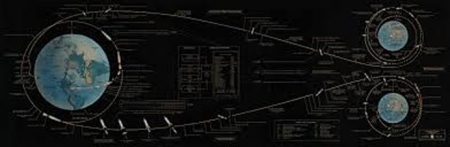
After reaching the highest level of the atmosphere, that is, almost 250 miles above the Earth, the moon-bound rocket must travel at a speed of 36,500 feet per second (about 7 miles per second). However, upon reaching 250 miles, as soon as it achieves this speed, its fuel will run out. Of course, the rocket will not continue to ascend at that point, because even at 250 miles above, Earth’s gravity remains quite strong. This gravitational force will pull the rocket back at a rate of 29 feet per second, so one second after the fuel runs out, the rocket’s speed will be 36,471 feet per second. After two seconds, the speed will be 36,442 feet per second, and after three seconds, the speed will be only 36,413 feet per second.
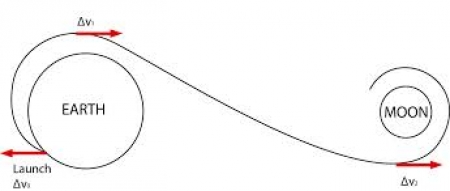
In other words, the rocket’s speed decreases steadily with each passing second. As more time passes, the distance between the rocket and the Earth will increase, and the gravitational pull of the Earth will become progressively weaker. After 300,000 seconds, or about 83 and a half hours, the rocket’s speed will reduce to only 12 or 13 feet per second. However, even then the distance between the rocket and the Moon will still be 23,600 miles.
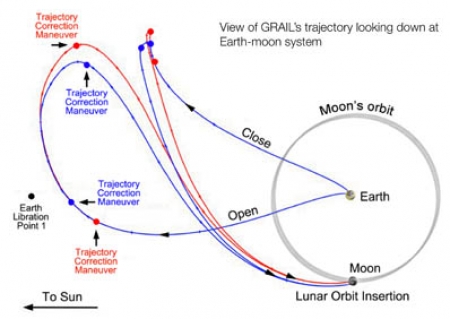
This distance is roughly nine-tenths of the total distance from the Earth to the Moon, and this particular distance holds special significance. At this location, the gravitational forces of the Earth and the Moon are equally strong—or you could say, equally weak. Just a few feet on either side of this boundary, the pull of one body becomes stronger than the other. So, if the rocket still retains just enough speed to cross this boundary, it will enter the Moon’s gravitational field.
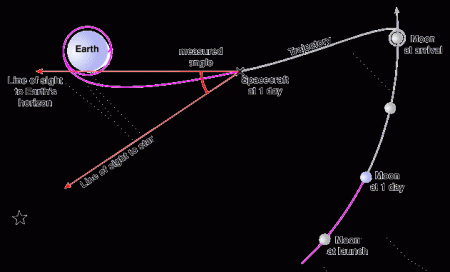
The Moon’s gravitational force may be relatively weak, but there is no doubt that it exists. Thus, for this reason, the rocket will start to be pulled towards the Moon. Exactly 50,000 seconds after crossing the boundary line, it will fall onto the surface of the Moon. To cover the distance from Earth to Moon, the rocket will require 97 hours and a few minutes, that is, 4 days, 1 hour, and a few minutes in total. Some claim that a rocket can reach the Moon in only 10 hours, but that’s a rocket of imagination, not a real one.
There is a bit of history behind this “10 hours” calculation. The average distance from the center of the Earth to the center of the Moon is 239,000 miles. Sometimes, this distance decreases to 229,465 miles, and at other times it increases to as much as 252,710 miles. Someone may have divided this larger number (252,710) by 7 miles (the speed per second) and arrived at the answer of ten hours. However, they may not have realized that the rocket’s speed is not always 7 miles per second.








This comment has been sanitized for the English site.
This comment has been sanitized for the English site.