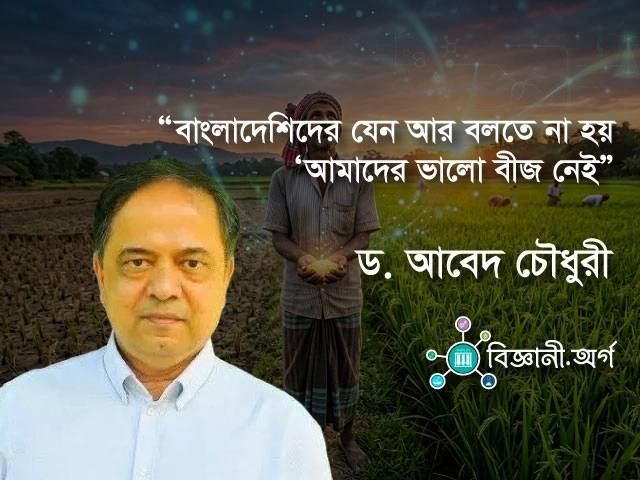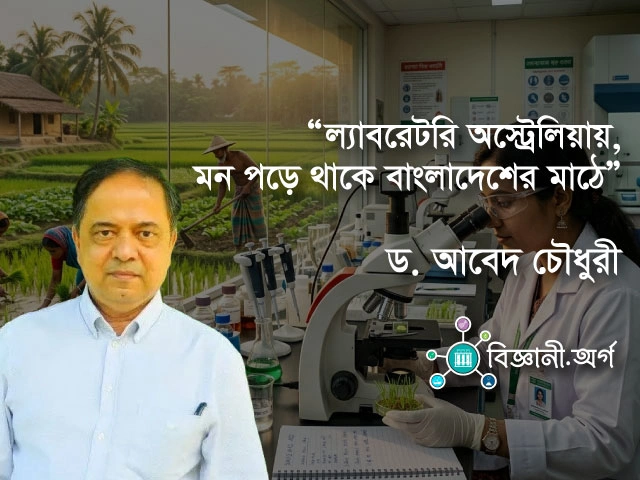
Many Bangladeshi scientists working in global research laboratories live between two worlds—on one side, international standard labs; on the other, the pull of home fields, farmers, and real-life problems. This duality is evident in the life of plant scientist Dr. Abed Chowdhury as well. Though he works at Australia’s national research agency CSIRO, his thoughts consistently return to the crisis facing Bangladeshi agriculture and seeds. In his words, he dreams of working in Bangladesh in the future—this is not just a personal dream, but a sense of responsibility.
Research Abroad, Responsibility at Home
Dr. Abed Chowdhury’s academic and research journey has brought him to the world’s leading research institutions. Working at US universities, NIH, and MIT, he has gained experience that is not just a personal crown of success; that experience could also be a tremendous asset for the nation. Yet in reality, the knowledge and skills of many expatriate scientists are not fully utilized for the country’s development.
Dr. Chowdhury believes it is possible to maintain an active connection with home even while working abroad. Regular visits to Bangladesh, staying in touch with local scientists and students, and initiating collaborative research—through such efforts, expatriate scientists can enrich the nation’s research infrastructure. He himself has tried in recent years to participate in a variety of agricultural and science-related initiatives in Bangladesh, so that laboratory expertise can serve real-world needs on the ground.
Not ‘Brain Drain’ but ‘Brain Circulation’
For a long time, ‘brain drain’ has been a major worry for developing countries—talented students go abroad and settle permanently, limiting their contribution to the home country. But in the modern world, that idea is gradually changing. Dr. Abed Chowdhury sees this process as ‘brain circulation’—where scientists gain knowledge abroad and return it home in various ways.
The ways to give back are not limited to permanently returning. Collaborative projects, online mentoring, research partnerships, and even technology transfer can all make that contribution. In his view, if the state creates a supportive environment for expatriate scientists, this “circulation” can become even more dynamic.
Research Is Incomplete Without Understanding Local Problems
In Dr. Chowdhury’s view, science is not just about theory or laboratories; it needs to engage with real societal problems. His deep concern for Bangladesh’s agriculture and seed crisis comes from witnessing realities at the grassroots. Talking to farmers in villages reveals how the lack of quality seeds or modern technology impacts their production and incomes.
This experience has also shaped his approach to research. Alongside fundamental studies on plant seeds, he is considering how this knowledge could be applied as practical solutions in countries like Bangladesh. In this way, the scientist’s role is not only as a researcher but as a partner in addressing the issues of society.
Inspiration for the Young Generation
The stories of expatriate scientists can serve as inspiration for young people. Dr. Abed Chowdhury’s career path shows that pursuing research of international caliber does not require severing ties with one’s homeland. In fact, global experience can open new perspectives and opportunities for the country.
He encourages the youth to dream big, to seize opportunities for study and research abroad. At the same time, he reminds them not to forget their roots. With sensitivity to real issues facing the country, scientific practice becomes even more meaningful.
Final Thoughts
The life and perspective of Dr. Abed Chowdhury pose an important question for us—can we not fulfill our responsibilities as citizens of our country, even while being global citizens? His story proves that the illumination of the laboratory and the soil of the homeland are not opposing forces; rather, their connection can pave the way for sustainable development. If the knowledge and experience of expatriate scientists can be systematically unified with national development, Bangladesh’s future can become even brighter.
Read the full interview with Dr. Abed Chowdhury: