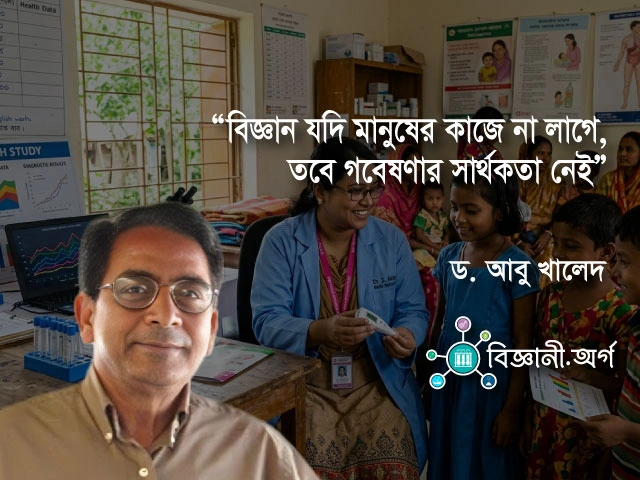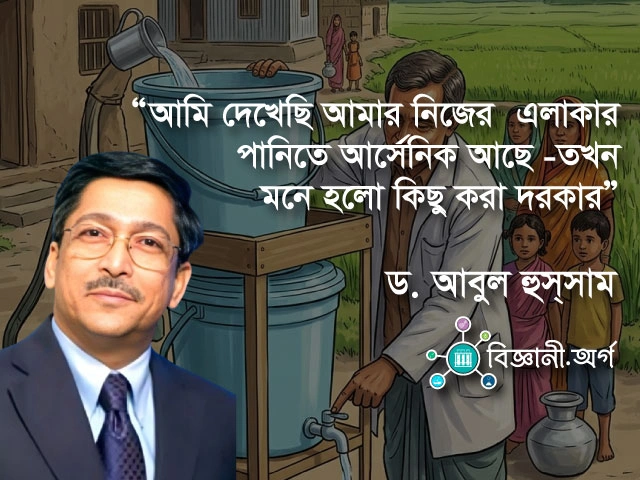
Sometimes scientific discoveries are born in the lab, and sometimes they are sparked by profound personal experiences. In Dr. Abul Hussam’s case, the driving force behind his work on arsenic contamination was a deeply personal realization. When he detected the presence of arsenic in the water of his birthplace, Kushtia, the issue stopped being just a research question—it became a matter of people’s lives. In his words, “I saw that my own area’s water contained arsenic— that’s when I felt I needed to do something.”
Arsenic contamination in Bangladesh is a silent public health crisis. For years, people have considered tubewell water to be safe, not realizing that it was slowly poisoning them. The harmful effects of arsenic are not immediately noticeable. It accumulates in the body over years, giving rise to skin diseases, kidney problems, and even deadly conditions like cancer. The problem is as insidious as it is severe. Standing at the heart of this silent catastrophe, Dr. Hussam’s work offers a deeply humane answer to the question: what should a scientist’s responsibility be?
As a researcher in analytical chemistry, he was well-versed in advanced methods for detecting arsenic. But detection alone was not the solution. He realized that it was crucial to provide rural communities with a technology they could use themselves. Here is where science and social responsibility intersect. His main goal became to bring laboratory theories into practical use in the field.
With this in mind, he invented the Sono filter using locally available materials. This is a water purification technology that works without electricity and can be made at a very low cost. As a result, even poor rural communities can use it. Dr. Hussam’s dream was to solve a complex problem like arsenic contamination right in the courtyards of village homes.
The motivation behind this invention was not purely technical; it was driven by a deep sense of humanity. The presence of poison in the water of his own community affected him personally. This feeling drew him beyond the confines of the laboratory. Many scientists research social problems but do not always take direct action to solve them. In Dr. Hussam’s case, science and social responsibility were not two separate paths; rather, they strengthened each other.
This story holds an important lesson for young scientists. A scientific career is not just about publications, promotions, or international recognition. A scientist’s true role lies in facing real problems in society and seeking solutions. When a personal, witnessed problem is transformed into a research question, science can truly change lives.
That is why Dr. Hussam’s statement is not just a reminiscence; it’s a call to action—observe the problems around you, feel them, and think about how you can contribute to solutions through science or knowledge.
Read the full interview with Dr. Abul Hussam: