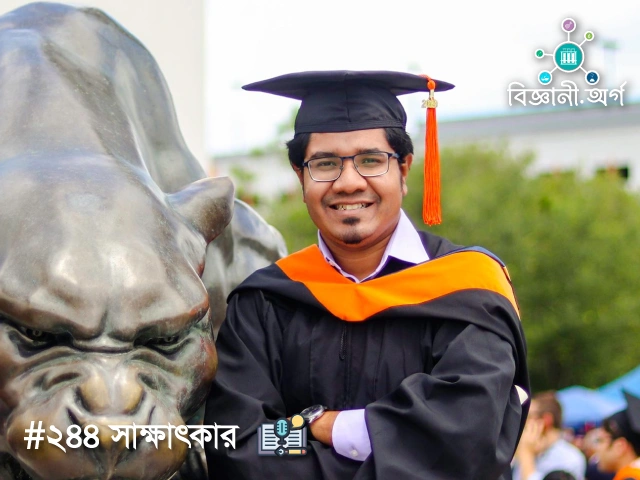
In our interview series with the new generation, this time we spoke with Suhail Haque Rafi. He is working at BRAC University. Read his interview below:
First, please tell us a little about yourself.
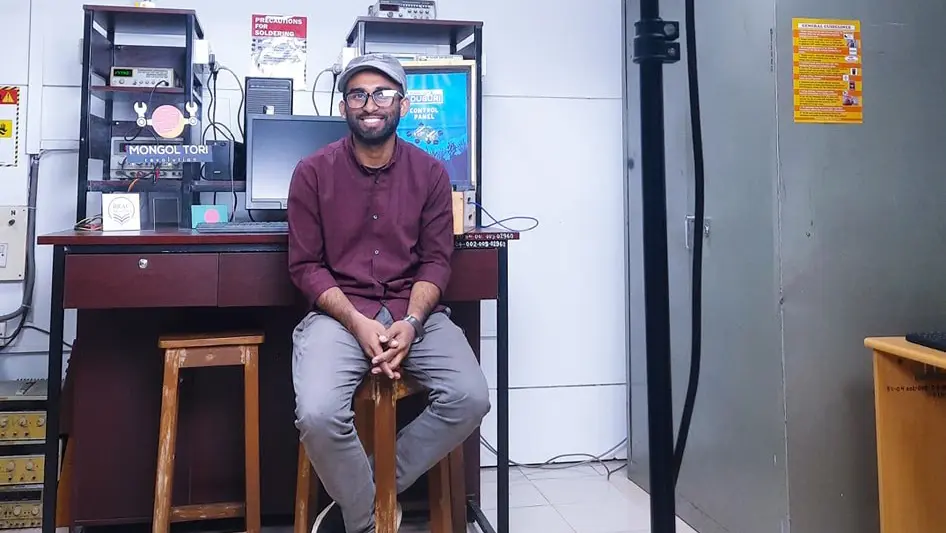
I am Suhail Haque Rafi. After completing my Bachelor’s in Computer Science from BRAC University, I’m currently working here as a research assistant. At present, I am involved in BRAC University’s Mars rover project ‘Mongoltori’ and the underwater rover project ‘Duburi’. I enjoy working with robots and artificial intelligence.
What is your research topic? Please describe your main area of research in simple terms for us.
I work with robots and their ability to make accurate decisions using intelligence. A significant part of my interest lies in autonomous systems. Among these, robot navigation is a major focus. Many of you may be familiar with the idea of Tesla’s self-driving cars by Elon Musk. Similarly, I mainly work on how autonomous driving technology, assisted by artificial intelligence, can be applied to Mars rovers or unmanned aerial vehicles (drones). Besides that, my work includes skillfully controlling robotic arms (manipulation) to perform various tasks.
In most of these technologies, artificial intelligence plays a crucial role. For example, if you want a drone to land autonomously on a helipad, a moving car, or a ship, it needs a specialized branch of AI—computer vision—to recognize and track the helipad/car/ship.
Recently, one of my research papers on NASA’s Astrobee robot at the International Space Station has been published. As you may know, the space station is an extremely delicate place. Any accident there can pose a serious threat to the lives of the astronauts onboard. Our aim was to use NASA’s Astrobee robot to precisely repair any damage that might occur on the space station.
How does your research benefit us?
With the help of robotics, it’s possible to avert danger during critical situations on the space station, potentially saving the precious lives of those present there. Not only that, it can also protect valuable equipment from destruction.
Speaking of Mars rovers, as you know, no human has set foot on Mars yet. Still, for the past thirty years, various Mars rovers built by humans have been exploring Mars, providing us with information about its climate, geography, surface, water, or signs of life. For these vehicles to move from one place to another, autonomous navigation is essential. Besides terrestrial rovers, if unmanned drones have autonomous navigation and landing capabilities, critical medical supplies, disaster relief, food delivery, and many other essential services can reach remote areas quickly and efficiently, even in daily life.
Would you like to share any experiences from your research work?
In my work in robotics, I have observed that reverse engineering is a very important skill. For instance, when we were as students working on the BRACU Mongoltori Mars rover, we needed to take panoramic photos of the survey site. But the challenge was, due to COVID restrictions, electronic parts sourced from abroad were very expensive and shipment was delayed. So, we had to find an alternative solution. We tried to mimic the function of a panoramic camera using a regular camera. We began reverse engineering. Since a panoramic camera covers a wider area than an ordinary camera, we attached a motor to a regular camera, rotated it to specific angles, and took three consecutive pictures. Then, using onboard autonomous image processing on the rover, we removed the overlapping parts and combined the three regular images into a single panoramic shot.
What qualities do you think a scientist should possess?
The most important quality is perseverance. As a scientist, you are generally trying to expand the bounds of our current knowledge. It’s important to remember that you are attempting something that has never been done before, and you will face various complexities. It is in moments of crisis that a scientist’s scientific mindset is revealed. The more patience and perseverance you can devote to your efforts, the more likely you are to find success.
Do you have any message for young Bangladeshi students who wish to pursue science?
When you start, of course you are not an expert. Set small goals. First, spend one hundred hours on your research topic, then a thousand. You’ll find that things become easier for you over time.
To do research on a particular topic, you first have to learn about previous works done in that specific or related area. For this, you need to read a lot of research papers—and you need to read with understanding.
Initially, all research work in science seems a bit difficult. This is natural. The language of a scientific paper is different from what we use in daily life. Moreover, when reading a research paper for the first time, you’ll encounter complicated terminology, the meanings of which take time to grasp, especially when you’re new. You need to overcome this fear right from the start. Keep up your reading habit. The more you read, the easier things will get, because each field has some commonly used terminology. So after finishing one paper and moving on to the next, you’ll find it isn’t as hard as the first, because you now understand many of the terms used. In this way, the more you read and do research, the better you’ll master it.
Andrej Karpathy, former Director of AI and Autopilot Vision at Tesla, often cites Malcolm Gladwell’s principle: “To become an expert in anything, one must invest ten thousand hours in that field.”
Your contact information:
Email: suhailrafi [email symbol] proton.me
Website: https://sites.google.com/view/suhailsh7
Your LinkedIn site address
https://linkedin.com/in/suhailsh7
Your website, research work links, etc.
Website: https://sites.google.com/view/suhailsh7
Google Scholar Profile: https://scholar.google.com/citations?user=I-nkStcAAAAJ&hl=en