When we fail to find a solution to a problem, we often assume that the problem itself is just too complex or deep. Yet, quite often, it’s not the nature of the problem but the way we look at it that becomes our main obstacle. Scientist and researcher Donella H. Meadows sought to fundamentally shift this perspective in her book Thinking in Systems. She showed that the world around us isn’t simply made up of isolated parts, but rather emerges from a complex pattern of interrelationships and feedbacks.
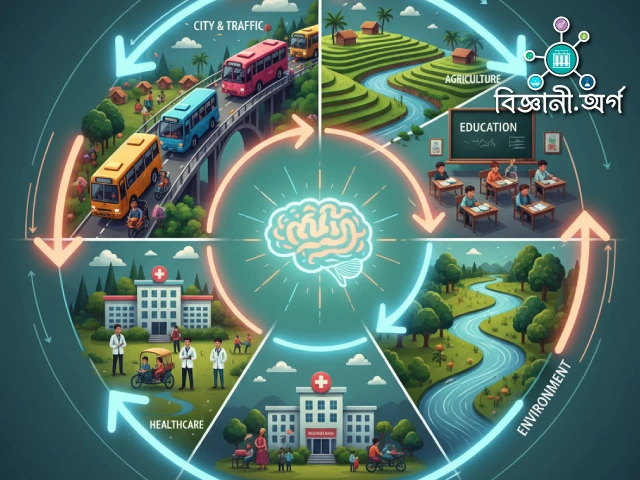
A social system, an ecosystem, a city’s transport network, even the dynamics within a family—all are systems where every element connects to others, and a change in one influences the rest. According to Meadows, if we want to solve any complex problem, we must first understand our position within that system and identify which elements drive and influence one another.
In a country like Bangladesh—where the environment, population, healthcare, and education are all interdependent—systems thinking becomes vital not only for scientists but also for policymakers, development workers, and everyday people. For instance, if your goal is only to reduce traffic jams in the capital, you might think of building new roads. But if you look at the entire system—where people are coming from and going to, why they travel, peak traffic times, the state of public transport—you’ll see that the solution isn’t just about infrastructure, but also deeply connected to social and economic systems.
Meadows placed special emphasis in her work on a system’s feedback loops. Simply put, a feedback loop is a process where a change influences its own origin. For example, when water supply in an area increases, agricultural activity rises. But if this is unregulated, the groundwater table drops and eventually leads to water shortages. In this way, even a positive change can bring negative consequences if we fail to understand the system’s feedback mechanisms.
At one time, Bangladesh’s agricultural policy focused on high-yield seeds and chemical fertilizers in the style of the Green Revolution. Production rose at first, but later it became clear that soil fertility was dropping, water pollution rising, and farmers’ costs increasing. Meadows might have labeled this a system’s ‘latent feedback’—which appears only much later, and by then, the situation may already be out of control. This reality teaches us that when we pursue short-term fixes, neglecting long-term impacts, those consequences can grow into even bigger problems eventually.
One of the most powerful aspects of systems thinking is its ability to identify ‘leverage points.’ In a complex system, interventions do not have the same effect everywhere. In some places, even a small change can have widespread impacts. Take education, for example: if you only change the examination system—adding analytical questions instead of rote memorization—it can shift students’ thinking patterns, the style of teaching, even parents’ expectations. Meadows would call this ‘leverage.’ The key is, if you make a change in the right spot, it can have a large-scale effect—much like the domino effect.
Systems thinking also gives us a new mindset. It teaches that complexity doesn’t mean there is no solution—rather, it means we need to look harder, understand better, and be patient. If our education system can cultivate systems thinking in students, they will learn to view life’s challenges—whether technological, social, or environmental—not just as problems but as patterns to understand. This will foster future policymakers, scientists, and entrepreneurs who are more visionary and integrative in their approach.
Through her life and writing, Meadows demonstrated that true change begins when people realise they are part of a greater system. She never dismissed technology, but always advocated for its proper application. Her core argument, however, was that perspective is even greater than technology. If you change the way you see a problem, often the solution will reveal itself.
Today, the world is grappling with interconnected problems: climate change, health crises, socioeconomic inequalities. These issues cannot be solved by any single nation or scientific discipline alone. Meadows’ ‘Thinking in Systems’ teaches us how to analyze connections and interactions, and, through information and feedback loops, step-by-step understand and redesign complex systems. This concept is no longer just a subject of research—it’s a survival strategy.
In developing countries like Bangladesh—where resources are limited, populations dense, and social challenges numerous—systems thinking can become an essential perspective. Sustainable development’s true key may not lie in technology-driven solutions alone, but in finding and addressing interconnections, long-term impacts, and points of change.
Perhaps Donella H. Meadows wanted to remind us that the world is, in fact, one vast, interconnected living system. And we, as part of it, are not merely observers—we are the very architects who shape and reshape this system. Our task is to foster the perspective from which we find the path to solutions—one where not only do the depths of problems become clearer, but entirely new pathways unfold.