


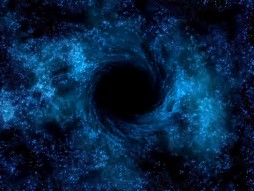
Black Hole
Fayez Ahmed

Where are we situated? In other words, where is this planet Earth located in the universe? The quest to answer this question began long ago. But ultimately—it turns out that in this vast universe, it is nearly impossible to pinpoint the planet Earth.
According to the uniqueness of the Big Bang, the universe began with a massive explosion. Its age is estimated to be between thirteen and fifteen billion years. Since the Big Bang, the universe today consists of nearly one trillion galaxies. These galaxies are composed of thousands of stars. The Milky Way, or our home galaxy, is just one such galaxy. It is believed that the Milky Way contains about two hundred billion stars. Among these is our Sun, around which we exist—all living creatures and plants on Earth depend on it. Every star in every galaxy shines with its own light. Some stars emit colored light, with various unique spectra. By observing these lights, we feel as if the stars are twinkling. The reason we perceive them as twinkling is that they are not stationary. In reality, what appears to twinkle are the stars, and what appears stationary are planets or satellites.
New stars are continually being born in the universe. Therefore, it’s truly challenging to tally the exact number of stars. However, all scientists agree that stars are spherical like footballs.
Now, what are these stars? How are they formed? Where do they end up? If we find answers to these questions, we may uncover the answers we seek.
The ultimate question we want answered is: “Black Hole or Krishna Bibor?”
A black hole is a void or an abyss, such that if a spacecraft were to fall into it, it could never escape. That is, once anything crosses the boundary of a black hole, it is impossible to return. The gravitational pull of a black hole is so immense that not only can nothing escape from within it, but even light rays cannot get out. If a human were to fall into a black hole, the difference in gravitational force between the head and the feet would be so massive that, within moments, the person would be ripped into pieces—like shredded vermicelli. This is why black holes are often called the monsters of space.
To understand what a black hole is and how one is formed, we must first understand the life cycle of stars: how do stars form?
Based on color, stars can be divided into four groups:
1. Yellow Main Sequence
2. Orange Main Sequence
3. White Main Sequence
4. Blue Main Sequence
Based on state, stars can also be categorized further, for example:
1. Red Dwarf
2. White Dwarf
3. Red Giant
4. White Giant
5. Yellow Giant
6. Blue Giant
All these stars are far away from our beautiful Earth. The light from some of these stars reaches Earth only after many years, while from others it may not have reached Earth yet. It could take anything from a few years to several hundred thousand years for their light to arrive. Sometimes, we even observe light from stars that have already been destroyed long ago.
Stars, regardless of whether they appear large or small, round or triangular, have internal processes governed entirely by chemistry. Stars originate from nebulae, which are vast reservoirs of hydrogen gas and dust. Hydrogen gas is the main ingredient in the formation of stars. When a large amount of hydrogen gas collapses under its own gravitational pull, a star is born. The star gradually contracts. As it does, the atoms come closer together, increasing in density and speed, causing the air to heat up. With extreme pressure and heat inside, the colliding hydrogen atoms fuse, not breaking apart but combining to form helium gas. This process is akin to a controlled hydrogen bomb explosion—releasing a massive amount of heat, causing the star to shine. The extra heat increases internal pressure until it balances out the gravitational contraction. From this balance, stars can remain stable for a very long time. Eventually, the star’s hydrogen and other fuel runs out. Interestingly, the more initial fuel a star has, the faster it depletes; larger stars must become hotter to counterbalance their gravity.
And the hotter the star, the quicker its fuel is exhausted. After its fuel runs out, a star cools and contracts. So, what happens then to the star?
This question was answered towards the end of the 1920s, in 1928. The solution was provided by an Indian graduate student named Subrahmanyan Chandrasekhar. While en route to Cambridge University to study under Sir Arthur Eddington, he calculated how massive a star must be to withstand its own gravity when it has run out of fuel.
His theory was this: as a star shrinks, its constituent particles come very close together, so according to Pauli’s exclusion principle (which says that electrons in an atom must differ by at least one quantum number), the particles must each have different velocities. This causes them to push apart, creating a new pressure to counter gravity, similar to the way thermal pressure supports a star during its active life. However, Chandrasekhar demonstrated that there is a limit to this quantum mechanical pressure. According to Einstein’s relativity, there is an upper limit determined by the speed of light. If a star becomes dense enough, quantum pressure will eventually lose out to gravity. Chandrasekhar calculated that if the mass of the degenerate star (the star left after fuel runs out) exceeds one and a half times the mass of our Sun, it cannot support itself against gravity. [For reference, the Sun’s mass is 1.9891×10^30 kg.] What happens if the star cannot resist its own gravity? We will discuss that shortly.
Towards the end of the 1920s, Chandrasekhar and Russian scientist Lev Davidovich Landau were both working on stellar mass limits. Chandrasekhar showed that if such a degenerate star exceeds 1.5 solar masses, it cannot support itself—this threshold is known as the Chandrasekhar Limit. However, Chandrasekhar’s teacher, Arthur Eddington, was initially unwilling to accept this limit. Chandrasekhar was an expert in relativity; at the time, only three people were considered to fully understand relativity: Einstein, Eddington, and Chandrasekhar. When even his teacher would not recognize his work, Chandrasekhar left this field for a time, researching other areas of astrophysics. In 1983, he was awarded the Nobel Prize for this work.
If the mass of a star is less than the Chandrasekhar Limit, or about equal to the Sun’s mass, it is called a low-mass star. When such a star runs out of fuel, gravitational contraction produces intense heat. This heat causes the outer layers to expand, turning it into a Red Giant. Eventually, the outer envelope is ejected, leaving behind the internal core—this remnant is known as a White Dwarf. The radius of a white dwarf is a few thousand miles; its density is hundreds of tons per square inch. The white dwarf is supported by electron degeneracy pressure. One of the first such stars discovered is Sirius, the brightest star in the night sky.
Our Sun still has about five hundred million years’ worth of fuel left—meaning, after five hundred million years, it will become a Red Giant, then a White Dwarf. But Lev Davidovich Landau suggested another possible fate for some stars. He showed that some stars, with masses between one and two solar masses, can be smaller than white dwarfs. In these stars, it is neutron and proton degeneracy pressure (rather than electron degeneracy) that provides support. They are called neutron stars. Their radius is only about ten miles, but their density is millions of tons per cubic inch.
If the mass of a star exceeds the Chandrasekhar Limit, it will ultimately become a black hole. The term “black hole” is quite recent—American scientist John Wheeler coined it in 1969.
Stars much heavier than the Sun are called high-mass stars. When these run out of fuel, they face several problems. In some cases, post-fuel contraction increases so drastically that the star explodes in a supernova. In other cases, a star can shed enough mass to drop below the critical limit—resulting in a white dwarf or neutron star. If the remnant mass exceeds about two solar masses, it typically collapses into a black hole. Although a black hole is finite in size, its mass is almost infinite. Thus, density, gravitational acceleration, and escape velocity are all nearly infinite. The gravitational pull of a black hole is so great that nothing—no object or even photons of light—can escape once inside its grasp. Any emitted photon or light ray, before traveling far away, is pulled back by the black hole’s gravity.
Here’s what happens—a star’s gravitational field distorts the paths of space, time, and light. Where space-time cones indicate the paths of outgoing light from the star, near the surface, these paths become curved toward the interior. As the star contracts, its gravitational field strengthens. The stronger the field, the more it bends light rays. Eventually, when the star contracts within a certain critical radius, even those outgoing light cones bend inward. The curvature becomes so extreme that no light can escape.
This idea of light being trapped by gravity was first proposed by British geologist John Michell in 1783. He wrote to scientist Henry Cavendish, describing the possibility that a massive object could have such gravity that even light could not escape. A similar idea was expressed by French mathematician and astronomer Pierre-Simon Laplace in 1796.
These ideas, however, were largely ignored—few could readily accept that a massless wave like light could be influenced by gravity.
The true solution to this puzzling issue came with the discovery of Einstein’s theory of relativity by Nobel Prize-winning German physicist Albert Einstein. However, even before relativity, it had been established that gravity could influence the motion of light.
According to relativity, nothing can travel faster than light. So if even light cannot escape from a black hole, nothing else can. Its gravitational field pulls back everything.
No definitive, direct evidence of these vast, dark, and powerful black holes has yet come into scientists’ hands. As nothing can escape from a black hole—not even light—this may also explain why their absence is hard to prove. Scientists determine their presence by studying the motion and direction of nearby stars. The boundary of a black hole is called the event horizon, and its radius the Schwarzschild Radius (named after scientist Karl Schwarzschild, who, while working on Einstein’s field equations in 1916, proposed it). The Schwarzschild Radius is obtained when a star contracts within a certain critical radius.
Black holes are classified based on mass, charge, and angular momentum. Many black holes have mass but no charge or angular momentum; these are called Schwarzschild black holes. Based on mass, black holes are of four types:
1. Super Massive Black Hole
2. Intermediate Black Hole
3. Stellar Black Hole
4. Micro Black Hole
Besides these, there are also Charged Black Holes, Rotating Black Holes, and Stationary Black Holes described respectively by the Reissner-Nordström metric, Kerr metric, and Kerr-Newman metric.
Currently, physicist Stephen W. Hawking explores black holes in various ways in his book “A Brief History of Time.” If proven, these could mark revolutionary advances on Earth.








সত্যি অসাধারন। Really extraordinary.
PLZ DESCRIBE ABOUT SUPER NOVA AND COSMIC RAY .