


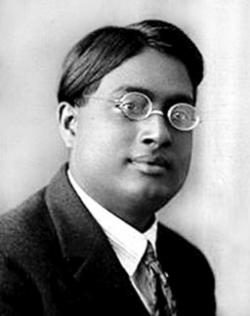
‘Those who claim that scientific research is not possible in Bengali either do not know Bengali or do not know science.’ This unforgettable remark was made for future generations by one of the subcontinent’s greatest minds—Satyendra Nath Bose. During an era that saw the birth of four legendary atomic scientists—Lise Meitner, Otto Hahn, Albert Einstein, and Max von Laue—this subcontinent also gave rise to another worthy successor alongside Ramanujan, Meghnad Saha, Acharya Jagadish Chandra Bose, and Rabindranath: Satyendra Nath Bose. What sets Bose apart is that he accomplished his most significant work while sitting in a room of Curzon Hall at the University of Dhaka. Through this, the University of Dhaka became a renowned name on the world stage. In the history of physics, Bose’s name became immortalized through the boson particle.

But the University of Dhaka did not remember Bose. The house where he lived was demolished. They also failed to preserve his documents. In truth, our country seems oblivious to the notion of gratitude. History holds no meaning for them. It is all too common for memories to quickly fade away.
This was a time when the world was passing through a massive transformation in knowledge and science. Old concepts were being upended, and new ideas stormed in like a whirlwind. In such a period, a young professor at the University of Dhaka wrote a fundamental four-page article called the ‘Planck’s Law and the Light Quantum Hypothesis’ and sent it to the scientific research journal, Philosophical Magazine, in England. But as it was deemed unfit for publication there, Bose sent it with a letter to Albert Einstein, the father of relativity. Einstein immediately recognized its significance and arranged for its publication in 1924 in the journal *Zeitschrift für Physik*. Einstein remarked: In my opinion, the method of derivation given by Bose for Planck’s law is a significant advance, and this theory can be applied to the quantum theory of the ideal gas, which I will demonstrate elsewhere. Shortly after, the article was recognized as the Bose-Einstein statistics, and Bose’s name became eternally remembered in history as the father of quantum statistics. While at the University of Dhaka, he wrote many more research papers.
He was born on January 1, 1894, in his ancestral home on Ishwar Mill Lane in the Goabagan area of North Kolkata. He died on February 4, 1974. His father, Surendranath Bose, was an accountant in the railways, and his mother was Amodini Devi. His maternal grandfather, Motilal Roy Chowdhury, was a lawyer. In 1909, he ranked 5th in the entrance examination from Hindu School and was first in the ISC exam from Presidency College in 1911. Subsequently, in 1913, he ranked first with honors in mathematics, and in 1915, stood first in the first class in the postgraduate mixed mathematics examination. In 1914, he married Ushabati Devi, the daughter of Dr. Jogendranath Ghosh. Among his distinguished classmates were Meghnad Saha, Gyan Chandra Ghosh, Gyanendranath Mukhopadhyay, Ranjan Sen, and Shailen Ghosh. Notable among his eminent teachers were Prasanta Mahalanobis, Acharya Prafulla Chandra, Professor D.N. Mallik, and Professor Shyamdas Mukhopadhyay.
Between 1918 and 1955, he published only 29 scientific papers. Many people say he was unwilling to publish any work with even minor flaws, as a result of which a number of his research papers or lectures have been lost. He would often recount the story of the famous mathematician Langevin, who was imprisoned in a Nazi concentration camp. While in captivity, the cruel Nazis did not even give him a scrap of paper or a pencil. This forced him to use burnt matchsticks to solve complex mathematical problems. He did not plead to God before millions; instead, people felt they themselves might be lacking in some way. Therefore, one must be proactive, struggle, and strive to live well against adversity. Satyendra Nath Bose was born on January 1, 1894. We remember him with deep reverence.
Courtesy of: http://www.samakal.com.bd/details.php?news=27&action=main&menu_type&option=single&news_id=223612&pub_no=924&type#.TwdXjw_dEQQ.facebook
Featured Insights:
http://en.wikipedia.org/wiki/S._N._Bose





বিজ্ঞানী সত্যেন্দ্রনাথ বসুকে নিয়ে লেখা “কোয়ান্টাম সংখ্যাতত্ত্বের জনক” শিরোনামে খালেদা ইয়াসমিন ইতি লিখিত নিবন্ধটি একটি সুন্দর রচনা এজন্য তাঁকে অনেক ধন্যবাদ সাম্প্রতিক ইতিহাসই আমরা হারিয়ে ফেলেছি, অতীত ইতিহাস কতই-না মুছে গেছে সেসব কে উদ্ধার করবে? বাংলার জলমাটির মতই নরম আমাদের ইতিহাস চেতনা
মনোজকুমার দ. গিরিশ
কোলকাতা
১৯/০১/২০১২
এটা জানতে পেরে খুশি হলাম,,.সুন্দর লিখনি
খবরটি পড়ে ভালো লাগলো
সত্যি গর্বে বুকটা ভরে যায়। কিন্তু আমরা দুর্ভাগার দল তাঁদের মর্ম বুঝিনি!
apnar lakhta bhalo laglo
খুব ভাল লাগল…
valo laglo
বোসের কথা চিন্তা করলে গর্বে বুকটা এক’শ হাত ফুলে যায়..হায় ঢাকা ভার্সিটি তার দাম দিলনা!ঢাকা ভার্সিটিতে তার নামে একটি ভবন কিংবা হলের নামকরন করা দরকার।
চমৎকার লেখা। ধন্যবাদ …
Hmmmmm……….
চমৎকার লেখা। ধন্যবাদ