


Organic agriculture is a realistic method that recognizes tomorrow’s ecology as more important than today’s economy. Its main goal is to learn from the natural state of the agricultural environment. Organic agriculture is a production system that creates a beautiful link between the scientific knowledge of ecology and modern science with the age-old practices of natural biological processes. In reality, the biggest challenge for organic farming is the lack of sufficient organic fertilizers to maintain current production levels as an alternative to chemical fertilizers. Organic matter is often used for competing purposes, such as household cooking fuel. Most crop residues are simply burned. I firmly believe that if we truly want to establish organic agriculture, we need organic fertilizer factories, organic inoculants, recycling of organic matter, traditional organic-based practices, organic control agents for diseases, pest and nematode management, and environment-friendly alternative technologies. In the current circumstances, it is not possible for farmers to rely entirely on organic agricultural resources. At present, it is not feasible to depend solely on organic farming to feed the population of our country. The development of high-tech organic technologies with strict quality control is underway. Identifying the niche for organic farming is essential. Crop residues must be fully utilized. To change farmers’ mindsets, the extension system needs feasible technologies for recycling/reusing farm residues and waste for rapid composting.
The Current System Has Failed, Organic Agriculture Is The Solution

Member International Federation for Organic Agriculture Movements (IFOAM) and General Secretary Bangladesh Organic Agriculture Network (BOAN)
Began a professional career at Bangladesh Agricultural Research Institute (BARI). This is where the leading role in the country’s organic agriculture movement started. Has worked as an organic agriculture researcher in various organizations. In recognition of contributions to organic agriculture research, has already been selected as the chief investigator of the Asian Network for Sustainable Organic Farming Technology (ANSOFT) and as a member of the International Federation for Organic Agriculture Movements (IFOAM). Additionally, is an elected executive member of IFOAM’s Technology Innovation Platform and serves as the general secretary of the Bangladesh Organic Agriculture Network (BOAN). Currently, is actively working on implementing BARI’s model organic village program. Simultaneously, is involved in the Participatory Guarantee System (PGS) there. Recently discussed the prospects and challenges of organic product production and marketing in the country with Bonik Barta. Interview conducted by Said Shaheen—
Why is there so much interest in organic food?
The petroleum-based farming system that began in the last century has now become a major cause of various diseases and fatalities. To meet our body’s nutritional needs, it is essential to consume a balanced diet every day, including adequate cereals, vegetables, and fruits. Yet knowingly or unknowingly, we are ingesting poisons each day under the guise of food. From rice—containing cadmium and arsenic—to vegetables and fruits, various stages of production and marketing see the addition of numerous toxic pesticides and chemicals to these foods. The cultivation of high-yielding modern hybrid and GM vegetables and other crops involves repeated, heavy applications of toxic pesticides, acaricides, fungicides, herbicides, and more. In Bangladesh, it is commonplace for vegetables to be sold in the market right after heavy chemical treatments. We end up consuming these with our food. To preserve and ripen these fruits and vegetables for longer periods, toxic substances like carbide are used. Fish are preserved with harmful formalin. To attract buyers, various poisonous dyes are added to vegetables and fruits. As a result, the consumption of these items is causing numerous diseases in our bodies, and also decreasing vitality and lifespan.
What is meant by organic food or products?
Generally, organic food or product refers to food produced through organic methods, that is, without the use of chemical fertilizers and pesticides. Organic agriculture is a production system that creates a bridge between ecological scientific knowledge and the modern science and traditional understanding of natural biological processes. Unlike conventional farming—which relies heavily on artificial pesticides and water-soluble chemical fertilizers—organic agriculture cannot be judged by the standards of chemically intensive agriculture. The practice of modern organic agriculture is based on four principles: health, ecology, fairness, and care. Each principle is dependent on the others, and by following them, organic agriculture can be enriched and developed. Numerous studies have proven that organically grown food is safer and more nutritious.
How is organic agriculture being expanded in the country?
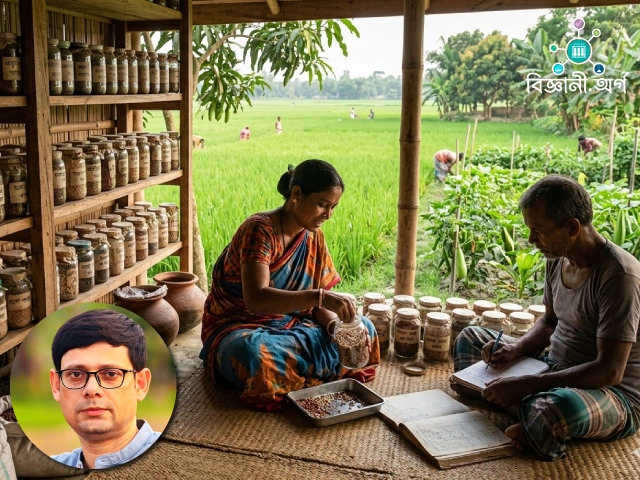
Before the 1960s—before the advent of the current chemical-based system—the entire agricultural sector relied on organic methods. Today, organic agriculture exists in two ways. First, people produce food, especially fruits and vegetables, for their own consumption in home gardens. Second, in the form of organized commercial farming for business. For example, KKT is currently producing and selling a variety of products—both domestically and abroad (USA, Japan, European Union)—through commercial farming in its own garden in Panchagarh. Modern organic products require third-party certification, which KKT adheres to. Currently, organic shrimp is being produced and exported to the USA, Japan, EU, New Zealand, Malaysia, and India. Besides this, some local farmers produce and market organic products on their own initiative in areas like Jhenaidah, Mymensingh, Netrokona, Dinajpur, Tangail, Pabna, Manikganj, Narsingdi, Sylhet, and Gazipur without third-party certification. All food produced in our home gardens is technically organic. Several organizations in Bangladesh have been working on this issue since independence, among which Proshika and UBINIG are notable. Currently, Unnayan Dhara, Hunger Free World, ActionAid, Rajshahi Agricultural Library, BARCIK, ALRD, and Caritas are working on organic or sustainable agriculture.
Have government institutions stepped forward in organic food production?
The use of toxic substances in food production has increased alarmingly, causing adverse effects on public health. Eventually, we will have to move towards organic agriculture. For 40 years, we have been destroying beneficial soil microorganisms with poison. We need to restore them. Bangladesh’s temperate climate has significant potential for natural agriculture, since the temperature never falls below zero. Thus, organic elements are present in nature throughout the year, supporting vibrant greenery and healthy plants. By leveraging this climate and using natural resources, Bangladesh can be a global model for natural agriculture. There is now an urgent need to innovate organic technologies for the safe production of food worldwide. Considering environmental and health risks, IFOAM will support Bangladeshi scientists to develop organic agriculture technologies. The Department of Agricultural Extension has yet to launch any government-level programs in this field. However, substantial work is being done to increase soil fertility and environmental conservation, particularly through integrated plant nutrition systems, increased use of organic fertilizers, and IPM practices. BARI’s primary mission is research and development in accordance with the needs of the people. To this end, the Vegetable Division of BARI has been conducting research since 2006. BARI has already introduced a standard and participatory guarantee system. Additionally, a network of researchers, extensionists, and institutions working in organic agriculture has been established, known as the Bangladesh Organic Agriculture Network. BARI has developed several organic-based safe food production technologies that are being disseminated to farmers. Indigenous knowledge is at the heart of organic agriculture. BARI collects this local knowledge and organizes regular workshops and training sessions to coordinate with other stakeholders. For technology transfer, BARI has launched a model organic village program. Work is ongoing in three villages—Netrokona, Mymensingh, and Dhamrai—with the involvement of the local Department of Agricultural Extension.
What is the future of organic food in the country?
There is broad demand for organic food in the country, and production is also underway. However, there are some misconceptions. Some people, perhaps unknowingly, spread rumors of low yields and high prices. But who doesn’t want or need safe food? All classes in the country know that organic food is safe—a fact backed by scientific evidence. Here, the focus is more on production with pesticides and chemical fertilizers, while organic cultivation is often neglected or discouraged. Over the past sixty years, there has been little research in this area. The current approach is based on “use more inputs, produce more.” This has severely damaged the soil, environment, and human health. Even advocates of the current method admit this. But what is the alternative? This question is not seriously addressed. Some speak of organic agriculture, but only quietly. My message is clear: the current system has failed—organic agriculture is the solution. However, overnight adoption of organic agriculture nationwide is not a realistic solution. Preparations are needed, requiring a strategic approach.
Is it possible to meet food needs through organic agriculture?
Organic agriculture is a dynamic and adaptable method. It is not static and survives through continuous innovations in response to internal and external needs. As a result, some technologies may be phased out or refined, and new ones adopted as necessary. Agriculture is the tool for food supply, and it is now time to decide which methods should be used. Truly, it must be done organically. The crisis facing our country’s agriculture and farmers calls for the establishment of a sustainable agricultural system to ensure food security for both present and future generations. There is widespread skepticism, even among policymakers, about whether organic agriculture can meet the food needs of Bangladesh’s large and growing population. At an international conference of the United Nations Food and Agriculture Organization (FAO), experts asserted that organic farming can ensure food security for every individual worldwide. Recently, scientists have presented a theoretical model suggesting that, based on efficiency, it is possible—with existing arable land and without increasing yields—to meet global nutritional needs of 2,640 to 4,380 kilocalories per person per day through organic agriculture alone.
What is the scientific basis for the sustainability of organic agriculture?
Organic agriculture considers the health and development of soil, plants, animals, and humans as a singular, inseparable entity. This principle forms the core of organic systems. All living systems, from soil microbes to humans, are interdependent; though distinct, together they create a unified environment. Organic agriculture values the living system as a whole. Health encompasses physical, mental, and social well-being—not just absence of disease. It is an ongoing process for collecting and distributing food and energy to keep living systems active. Self-regulation and quick recovery are key features of this process. The current petroleum-based agricultural model prioritizes food production while neglecting the sustainability of other natural components. The decline of environmental elements over the past century has already been noted. Valuing the fundamental principles of organic agriculture will improve the current system.
Take soil health, for example. Protecting soil health requires equal consideration of soil’s physical, chemical, and biological properties. Yet, in the so-called modern agricultural systems of the past 100 years, soil chemistry has taken precedence; the use of organic fertilizers has declined, while chemical fertilizer use has steadily increased. Excessive use of chemicals has disrupted the activity of soil microorganisms. A hectare of farmland harbors nearly three tons of microorganisms, living, reproducing, and decomposing, maintaining nutrient cycles. So far, 16-17 key elements needed for plant nutrition have been identified, but only three are predominantly supplied by artificial means, and among these, nitrogen is most emphasized. However, for every 100 kg of chemical nitrogen applied to soil, plants typically use only 27-30 kg; the rest is lost to water or gas. Overuse damages crops and destroys microbial activity.
Applied organically, on the other hand, plants uptake only what they need, and the remainder remains in the soil as humus, eventually benefiting subsequent crops and improving soil’s physical, chemical, and biological properties. Various crops that boost nitrogen levels can be incorporated into production lists. Our farmers rarely know which natural sources provide abundant nitrogen or how to maximize its effectiveness. And can we blame them? Most modern high-yield varieties, bred over the last seventy to eighty years to meet rising food demands, require high external inputs—meaning higher fertilizer and pesticide use to maintain yields. Even if productivity has increased, the health of soil, people, and the environment continues to deteriorate. It is now crucial for research priorities to shift—to develop varieties needing less external input but with comparable yields. Nature already contains such genes, and identifying them is essential. This is an area of ongoing research globally, and we must follow suit. Simultaneously, organic sources of essential plant nutrients must be identified and disseminated to farmers.
Does organic mean opposing pesticides?
If pesticides were beneficial, why would we oppose their use? The world recognizes pesticides as harmful. Moreover, we are replacing diversified crops with monocultures, resulting in overproduction of a few crops while others receive little attention and disappear. Conventional agriculture has degraded soil fertility through excessive use of fertilizers and pesticides. In 10,000 years of agriculture, soil organic matter dropped from 5 percent (or more) to 3.5 percent over 9,900 years, and in the last 100 years, it has fallen further—to between 0.5 and 1 percent—due to current practices. So what is the solution? Certainly, organic agriculture—because it champions crop diversity, increases soil vitality and organic matter, ensures food safety, maintains environmental quality, and sequesters carbon. Thus, organic food is essential not only to oppose pesticide use but also to sustain human civilization in a natural, orderly way.




মরিচ গাছের গড়া পচা রোগের সমাধান কি?