


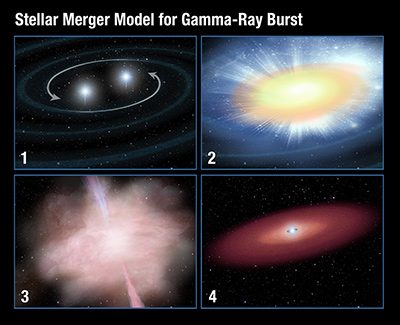
If the universe were to be compared to a type of food, it’s best imagined as a bag of microwave popcorn—everywhere, there is chaos from the intense heat and explosions. Novae, supernovae, and hypernovae are stellar explosions that are common in the universe, but when astronomers discover an entirely different kind of explosion, it can surely be called a rare event.
A nova occurs when a white dwarf star is disrupted, and a supernova happens in stars with more than 1.4 times the mass of the Sun. In June of this year, NASA’s Hubble Space Telescope identified a new kind of stellar explosion called a kilonova. This explosion is seen when two extremely dense objects—such as neutron stars—collide. Hubble observed a faint fireball from a kilonova. Soon after, Hubble detected a brief gamma-ray burst four billion light-years away from Earth. According to Professor Nial Tanvir of the University of Leicester, UK, who led the study, this observation may finally reveal the mystery of short gamma-ray bursts.
A gamma-ray burst is a flash or spark created by high-energy radiation. Such flashes can be seen propagating across the cosmos during a gamma-ray burst. These sparks are of two types: some are short, and some are long. It is believed that long-duration gamma-ray bursts (lasting more than two seconds) occur when a massive star collapses. Tanvir’s research group, among other astronomers, holds this view and has already presented sufficient evidence supporting it. While scientists’ understanding of long-duration gamma-ray bursts is quite clear, short gamma-ray bursts remain quite mysterious.
It was thought that short gamma-ray bursts occur as a result of the merging of dense objects like neutron stars, but scientists did not previously have strong enough evidence to support this. Thanks to this new observation by Hubble, scientists have now been able to provide concrete proof.
Astrophysicists had already hypothesized that short gamma-ray bursts are created from the merging of a pair of extremely dense neutron stars in a binary system. This happens due to the emission of gravitational radiation from the system, which in turn creates small waves in the fabric of spacetime. As energy is emitted through these small waves, the two stars rapidly draw closer to each other. Just milliseconds before the explosion, the two stars spiral inward and come into contact. This releases radioactive material into the surrounding space, which then heats up, expands, and emits a burst of light.
A kilonova created in this way is an intermediate among stellar explosions in terms of brightness. It is a thousand times brighter than a nova but produces only about one-tenth or one-hundredth the brightness of a supernova. Daniel Kasen, an astrophysicist at the University of California, presented a new analysis that greatly helped scientists understand what a kilonova would look like, though he was not involved in this particular research. Kasen was working on developing a theoretical model of kilonovae. He predicted that the hot plasma emitting radiation would block visible light, and that the massive release of energy from the kilonova would obscure the infrared light for several days. He advised scientists, “To detect these, you should focus on the infrared spectrum, although this had never been done before.”
To find gamma-ray bursts in the infrared range and observe the remnants from the neutron star explosion, Tanvir used the Hubble Telescope. Although the burst lasted only a tenth of a second, NASA’s rapid-response telescope captured it on June 3rd, and it was cataloged as GRB1306030B. A neutral analysis of data from another research group confirmed the discovery. Kasen described the observation as remarkable, since the explosion was extremely distant from Earth and short-lived. Indeed, the findings confirm that the merging of two objects can produce an infrared glow through such an explosion: this is the kilonova. The results of the study were published in a special online issue of the science journal Nature on August 3rd.
In a vast universe, discovering a new type of cosmic event may be difficult but is only natural. Much has already been discovered, and yet much may still remain unknown. The universe is a place without shortage of wonders to amaze us and expand the boundaries of our knowledge. The discovery of the kilonova is just one example among many. With its infinite black darkness, the universe sits waiting for us with its treasury of mysteries, calling, “Come, thinkers, come, seekers. Uncover all my mysteries; use your intellect, wisdom, and hard work to solve all the puzzles.” Who knows what new mysteries the universe will reveal to us next? What surprises wait ahead, who can say?

References:
The Kilonova: A New Kind Of Cosmic Blast –www.popularmechaniscs.com
HUBBLE SEES THE FIREBALL FROM A “KILONOVA” – NASA .








মহাবিশ্বকে যদি একটি খাদ্যের সাথে তুলনা করা হয়, তবে একে মাইক্রোওয়েভ পপকর্ণের একটি ব্যাগ হিসেবে কল্পনা করাই ভাল…………….. অসাধারণ
অনেক নতূন কিছু জানতে পারলাম। Science Fication এর উপর খুব সুন্দর একটি লেখা।