


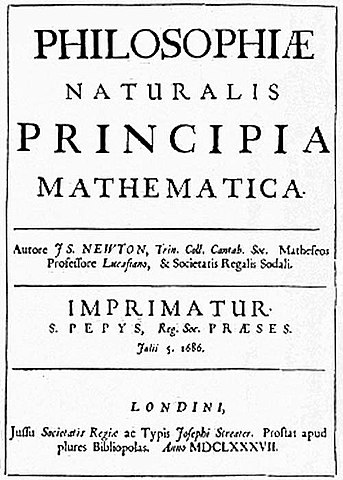
A timeless scientific book that transformed the world and changed humanity’s conventional understanding.
Today, I will introduce you to a book that guided the science of our world onto a new path. The name of this book is “Philosophiæ Naturalis Principia Mathematica”, commonly known as “Principia Mathematica”, an epic in the history of science. This work stands as a revolutionary contribution in the realms of science and mathematics and laid the foundation for modern physics. Today, we will discuss in detail the significance of this book, its content, and how it contributed to the advancement of science.
Principia Mathematica: Context and Necessity
Published in 1687, Principia Mathematica is considered Sir Isaac Newton’s greatest work. Divided into three volumes, this book elaborates on Newton’s three laws of mechanics and the law of universal gravitation in detail.

Context
The period when Newton published Principia Mathematica was the era of the scientific revolution. Following the works of Copernicus, Galileo, and Kepler, people’s understanding of the workings of the earth and the universe was changing. Newton’s work was a crucial part of this transformation, subsequently laying the foundation for modern physics.
Contents of Principia Mathematica
Principia Mathematica is divided into three volumes: the first covering Newton’s fundamental laws of mechanics, the second dealing with fluid dynamics, and the third discussing the law of universal gravitation.
First Volume: Fundamental Laws of Mechanics
The first volume sets out Newton’s three fundamental laws, known as Newton’s laws of motion:
- First Law (Law of Inertia): An object remains at rest or in uniform motion unless acted upon by an external force.
- Second Law (Law of Force and Acceleration): The acceleration of an object is proportional to the net force acting on it and occurs in the direction of the force. This is expressed by the formula F = ma.
- Third Law (Law of Action and Reaction): For every action, there is an equal and opposite reaction.
Second Volume: Fluid Dynamics
In the second volume, Newton discusses fluid dynamics. He gives a detailed account of the theories of motion and flow of fluids. Newton highlights various experiments and observations concerning the density, pressure, and velocity of fluid flow.
Third Volume: Law of Universal Gravitation
In the third volume, Newton explores the law of universal gravitation. He explains that every object attracts every other object with a force proportional to the product of their masses and inversely proportional to the square of the distance between them. This is known as the law of gravitation and is described by the formula F = G (m₁m₂ / r²).
The Impact of Principia Mathematica
Principia Mathematica caused a revolution in the scientific world. It established a fundamental basis for physics and served as a milestone for subsequent scientists.
Impact on Science
Newton’s Principia Mathematica brought about revolutions in various branches of science. It laid a fundamental foundation in physics, astronomy, and engineering. Newton’s laws served as an essential basis for research for later scientists.
Impact on Society
Principia Mathematica also had a profound impact on society. It changed people’s ideas about the nature of reality and the workings of the universe. It ushered in a new era of scientific thinking, later known as the scientific revolution.
Principia Mathematica: Importance for Students
It is extremely important for students to have knowledge of Principia Mathematica, as it provides the foundation for understanding basic concepts of physics. By studying this book, students can gain a detailed understanding of Newton’s laws and their applications.
Learning and Research
By reading Principia Mathematica, students can learn the basic concepts of various branches of physics. It can serve as a strong foundation for their research and help them advance in different scientific disciplines.
Career Preparation
Knowledge of Principia Mathematica is also crucial for students’ careers. For building a career in physics, engineering, and other scientific fields, this work provides an essential foundation. With a thorough understanding of Newton’s laws and their applications, students can succeed in various scientific disciplines.
Conclusion
Newton’s “Philosophiæ Naturalis Principia Mathematica” is a revolutionary contribution in the worlds of science and mathematics. It serves as a fundamental basis for understanding core concepts of physics and sparked revolutions across various scientific domains. For students, learning about Principia Mathematica is of paramount importance, as it will serve as a strong foundation for their future research and careers. Newton’s epic work will forever be remembered as a milestone in the history of science.











Leave a comment