


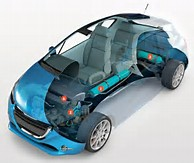
{mosimage}Today, I thought I’d share some knowledge with you all. After all, we Bengalis love to share knowledge. Once you read my post, you might feel it’s just giving out knowledge… This small effort of mine is to share my limited experience about the amazing air-powered car with all of you. Let me know how you liked my modest effort by leaving a comment—it would make me happy.
{mosimage}The internal combustion engine is a very familiar engine to us. Almost everyone knows about its use in cars. However, this well-known engine also has some drawbacks. The biggest downside is that it’s pretty expensive in terms of fuel consumption. It uses heat energy to generate mechanical power, but about 33% of that heat energy is wasted cooling the engine, and 30% escapes into the environment. Only the remaining heat is converted into mechanical energy. Now, if we used a big engine instead of several small ones, total waste might be reduced. But in reality, that isn’t possible. Add to that, besides widespread air pollution, there’s another aspect we often overlook: a 4-liter internal combustion engine uses about 1/4 million liters of oxygen. Imagine how much oxygen millions of cars are consuming worldwide. With global oil prices rising as they are, it’s wise not to rely solely on oil to power cars. The day may not be far when oil is more expensive than gold. That’s why research into alternative fuels is happening worldwide. One such outcome is the air-powered car, still a wonder to many of us. Perhaps a few decades ago, we didn’t even imagine running cars on air, but now it’s possible.
This engine has many similarities with the internal combustion engine. Let’s see how the functions of an internal combustion engine work. There are four stages: intake, compression, expansion, and exhaust. In the intake phase, the engine takes in fuel and air, which are compressed, then the piston drops. At the end of this stage, ignition causes an explosion (in a petrol engine), pushing the piston out, and finally, the burnt gases are released through the exhaust. Petrol engines run on the Otto cycle, while diesel engines run on the Diesel cycle and don’t require a separate spark—the explosion happens during compression.

Our air-powered engine runs on the Stirling cycle. Here, compression and expansion occur as isothermal processes. A compressor is used to compress the air. When air is compressed at 300 bar, it stores enough energy to power an air engine. The compressor sits outside the engine, which means, instead of using oil as fuel, we use highly compressed air to run the car. The parts excluding the compressor are known collectively as the pneumatic actuator. Air-powered engines are manufactured from lightweight yet strong materials, such as carbon fiber.
Now let’s discuss the advantages and disadvantages of air-powered engines. The first and foremost benefit is the drastically reduced fuel cost. The CityCAT by MDI runs all day on just $3 worth of “fuel.” On one charge, at low speeds, it can run for about 10 hours. MDI (Motor Development International) is the company behind Nigre, the maker. You can recharge the car at an Air Filling Station in just 2-3 minutes. The car has a top speed of 60 km/h, which is plenty for city roads.
Air pollution is a major concern in today’s world. The air-powered car is completely pollution-free. In 1998, MDI’s TOP (Taxi zero Pollution) made waves worldwide. There are, of course, some differing opinions regarding these eco-friendly vehicles. Critics argue that the compressor requires electricity, which is largely produced by burning fuel, so how is this environmentally friendly? The answer is that electricity can be generated in many ways—including hydro and wind power—not just from fossil fuels.
Another key feature is the lightweight design and cost-effective manufacturing. The weight is significantly lower because the compressor is housed separately from the main components.
An Australian company called Engine Air has developed the Di Pietro Motor (a rotary engine) based on air-powered engine research. Its operation is different from standard rotary engines. This engine has six eccentric ports that control the flow of air, regulating the engine’s power. For higher speeds, less air enters and more room is given for piston expansion; for heavier loads, more air is admitted to increase power.
The company lists several features of their developed rotary engine:
1/ Efficiency of 94.3%
2/ Continuous high torque
3/ Vibration-free operation
4/ Amazingly, it only requires 1 pound/square inch of force to overcome friction
5/ Very smooth speed control
Research continues on this revolutionary engine. Now, how do you refill the engine? Nigre states that customers can refill at home using a compressor, though that would be costly. Using a filling station makes it much cheaper. Let’s look into the refilling methods.
There are two ways to compress air with a compressor:
1/ In an adiabatic system
2/ In an isothermal system
According to the book “Vacuum and Pressure Systems Handbook” by Gast Manufacturing Corporation, using a compressor in an isothermal process requires less energy to compress the air. The heat removed from the compressor can be used to heat households, warm water, or even, with some ingenuity, generate electricity. Theoretically, the efficiency of an isothermal process is 100%, but in reality, no heat conductor has been invented that can transfer all heat to the environment without loss, which reduces overall efficiency.
Finally, let’s move on to some Q&A. My original article is 7 pages, or 14 sides. I can’t write any more—my head is spinning! If you have any questions, please feel free to ask in the comments; I’ll be happy to answer them.









I am stonished.
রেদওয়ান নেওয়াজ, Excellent. Very interesting.I have enjoyed reading your article. Thank you.
Thanks to all
রেদওয়ান, apnar ei lekhatar shironam ‘batas chalito garri’ hole kamon hoto? শফিউল
সুন্দর একটি লেখা উপহার দেবার জন্য অসংখ্য ধন্যবাদ।
এমন একটি গাড়ির প্রতিক্ষায় রইলাম…
খুব সুন্দর হয়েছে রেদওয়ান ভাই। আশাকরি ভবিষ্যতে আমরা আরও ভাল ভাল লেখা আপনার কাছে পাব।
ধন্যবাদ।
I have enjoyed reading your article thank you.
আমি একটি বয়ু ইঞ্জিন এর ডিজাইন করেছি খুব সহজে তৈরি সম্ভব পরিক্ষার কাজ ও শেষ মুল কাজে হাত দিয়েছি ইনশাআল্লাহ খুব দূরত রেজাল্ট পাব।
আশা করি খুব তাড়াতাড়ি আপনার বায়ু ইঞ্জিন নিয়ে আমাদের লেখা দিবেন। অপেক্ষায় রইলাম