


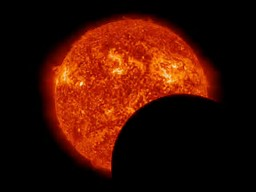
{mosimage}On the morning of June 6th, Venus will disappear as it walks across the face of the Sun for about five and a half hours, appearing as a tiny black dot. Those who miss this rare astronomical event will surely regret it, because it will not occur again until December 11th, 2117—exactly 105 years later.
In astronomical terms, Venus’s crossing is called a “Transit.” There is a pattern to these transits: first, after 8 years, then 121 years and 6 months, then again after 8 years, then 105 years and 6 months, followed by another 121 years and 6 months, and so on. Hence, it’s a rare sight. For those who witnessed the transit on June 7, 2004, this is another chance to see it.

Only Venus and Mercury experience such transits in our solar system because their orbits pass between that of Earth and the Sun. The first observation of Mercury’s transit across the Sun was made by French astronomer Pierre Gassendi in 1631. The first observation of Venus’s transit was made by two British astronomers, Jeremiah Horrocks and William Crabtree, in 1639.
Transit of a planet: Occasionally, lower planets can be seen moving across the solar disc as black dots. This occurrence is called a planetary transit. It is a rare event; for example, a similar transit of Venus occurred in 2004. This only happens when the inferior planets and Earth line up exactly in a straight line with the Sun. However, because the orbital planes of these planets are slightly tilted compared to Earth’s orbit, only at the node points can a planet be in a straight line with the Sun and Earth. Also, such an event does not happen every time the planet is between Earth and the Sun—only if the planet is at inferior conjunction and at a node.
These events do occur, but not frequently. Due to the position of the line linking the node of the orbital planes, Venus transits happen in early June or December of the relevant year. For instance, Venus transits occurred on December 8, 1874, and December 6, 1882.
For astronomers, Venus transits are of great value. During these times, it’s possible to measure the distance between the Sun and Earth very accurately. To do this, the transit is observed simultaneously from two widely separated points on Earth’s surface. Then, the angular distance between these two locations is used to calculate the distance from the Earth to the Sun. Many facts about Venus’s atmosphere have been discovered during its transits. When Venus comes between Earth and the Sun, some sunlight passes through Venus’s atmosphere. At that time, Venus’s atmosphere appears as a faintly lit ring. This subtle and remarkable sight is created in the same way as twilight. The extent and brightness of this ring are not always constant.
When Venus is at or near inferior conjunction during transit, the extent and brightness of its twilight ring appear evenly around the planet. As Venus moves away from this alignment, its visible portion diminishes like a crescent moon. When Venus takes on a half-moon phase, the ring becomes very narrow and pointed.
Timing of the transit: On June 6, at 4:00 a.m. Bangladesh time, Venus will come in front of the Sun. However, it will not be visible yet, as sunrise will not have occurred. About an hour after the transit begins (at 5:15 a.m.), we will be able to observe it, and it will continue until 11:00 a.m. The diameter of Venus’s disc across the Sun will be 58 arcseconds.
This celestial event can be seen with the naked eye, without binoculars or a telescope. However, be warned—do NOT look at the Sun directly with the naked eye, as it can cause serious eye damage. To view it safely, use the darkest part of an X-ray film, a solar filter, or welding glass. Those wishing to use a telescope or binoculars must use a solar filter.
What you’ll see is Venus moving from one side of the Sun to the other as a round black dot. So get ready to witness this rare celestial event. In 2004, Venus’s transit occurred across the lower part of the Sun; this time it will be through the upper part (the northeast corner) of the Sun.
For those who want to take photographs: You can use a 6, 7, 8, 10, or 14-inch auto-guided telescope connected to a Canon EOS series or any other good-quality DSLR camera. Use an exposure of 1/2000 second at f/6.3, ISO-1600, for good results.
Open this link for notes on how to capture video of Venus’s transit:
http://www.fourmilab.ch/images/venus_transit_2004/
Map: Google.






Leave a comment