


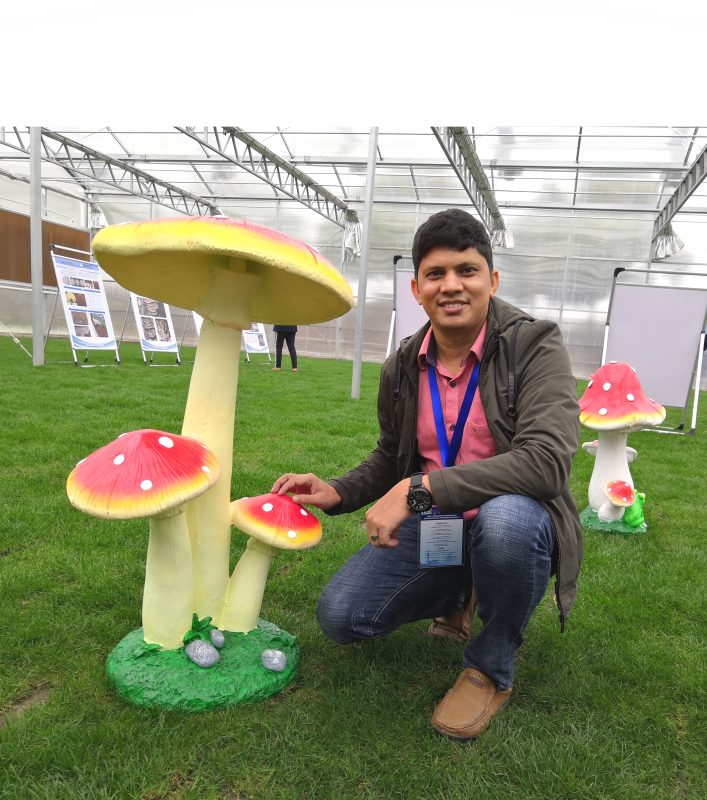
Dr. Iqbal Hossain was born in Khalifapara, Akhanagar village, Sadar Upazila, Thakurgaon district. He began his education at a local primary school, then went on to complete his SSC from Thakurgaon Government Boys’ High School and HSC from Cantonment Public School and College, Savar. He earned a bachelor’s degree in Agriculture in 2004, and in December 2007 completed a master’s degree in Plant Pathology (scholar.google.com).
In 2014, he received his DSc/PhD from Kunming Institute of Botany, University of Chinese Academy of Sciences, China (scholar.google.com). He is currently working as an Associate Professor (Research) at the Guangdong Institute of Microbiology (a part of the Guangdong Academy of Sciences) in China.
His research mainly focuses on mushrooms (macrofungi)—particularly the taxonomy and molecular phylogeny of mushroom species in Bangladesh. He has discovered several new mushroom genera and species for Bangladesh, marking important and novel scientific contributions.
💬 Q&A Segment:

Question: Biggani.org: First, please tell us a bit about yourself.
Answer: Assalamu Alaikum. My greetings and sincere thanks to you and Biggani.org. I was born in Khalifapara, Akhanagar, Sadar Upazila, Thakurgaon district. Currently, I am working as an Associate Professor (Research) at Guangdong Institute of Microbiology, China, since January 2019. From December 2014 to December 2018, I worked there as a Postdoctoral Research Fellow (first and second terms). In December 2014, I obtained my DSc/PhD from Kunming Institute of Botany, University of Chinese Academy of Sciences. I completed my bachelor’s in Agriculture in 2004 (exam held in 2006) and my master’s in Plant Pathology in December 2007 from Sher-e-Bangla Agricultural University. Before coming to China, I taught at BAF Shaheen College, Dhaka for about a year (August 2009 to September 2010). In 2000, I passed HSC from Savar Cantonment Public School and College and in 1998, SSC from Thakurgaon Government Boys’ High School. Prior to that, I began my education at the local government primary school, Velarhat Government Primary School.
Question: Biggani.org: Who inspired you to become a scientist?
Answer: Many people have contributed to who I am today. My parents, relatives, and especially many teachers played an important role. Since I studied agriculture, I always aspired to work as a scientific officer in research institutes under NARS (such as BARI, BRRI, etc.) or as a university teacher, while also hoping to pursue higher studies. Around 2010, I received an offer from China for higher education, specifically a PhD, and completed my research under Professor Dr. Chu Liang Yang in China. Later, I did my postdoctoral work under another Chinese professor, Dr. Tai Hui Li. Both Professor Yang and Professor Li have contributed greatly to bringing me to where I am today. Additionally, there were direct and indirect contributions from others—such as Dr. F M Aminuzzaman, Professor Nasima Akhtar, Dr. Md. Rafiqul Islam, Dr. Nazneen Sultana, Dr. Salauddin Mahmud Chowdhury from Sher-e-Bangla Agricultural University, and Dr. Ashraf Uddin Ahmed, Chief Scientific Officer at Bangladesh Agricultural Research Institute. My father (Md. Abbas Ali) and my uncle (Abdus Samad) helped me a lot in collecting mushrooms from Bangladesh, which greatly benefited my PhD research. My own curiosity, determination, and the support of these people shaped who I am today.
Question: Biggani.org: Where and on what topic did you do your PhD?
Answer: I obtained my DSc/PhD from the Kunming Institute of Botany (a research institute under University of Chinese Academy of Sciences) in June 2014. While my master’s research was on microfungi—particularly working on the physiology and management of Botrytis grey mold disease of chickpeas under Professor Dr. Md. Rafiqul Islam (Sher-e-Bangla Agricultural University) and Dr. Ashraf Uddin Ahmed (Bangladesh Agricultural Research Institute)—my PhD focused on macrofungi, or what we commonly call “mushrooms”. My PhD research focused on the taxonomy and molecular phylogeny of two mushroom families from Bangladesh: Boletaceae and Amanitaceae. In this research, I successfully identified a total of 34 species of mushrooms from Bangladesh for the first time, including a new genus (Borofutus) and 17 new species. Of these, one new genus and five new species (Borofutus dhakanus, Phylloporus catenulatus, Phylloporus gajari, Phylloporus attenuatus, and Amanita cinereovelata) have already been published in various mycological journals as the first discoveries of such mushrooms in Bangladesh, with the rest awaiting publication.
Question: Biggani.org: You are currently researching at Guangdong Institute of Microbiology, Guangdong Academy of Sciences, China. Tell us about this institution and your current research.
Answer: This research institute was established in 1964 in Guangzhou, Guangdong Province, China. Initially, it was under the Chinese Academy of Sciences, but in 1972, it became part of the Guangdong Academy of Sciences (GDAS). GDAS has 24 research institutes, among which the Guangdong Institute of Microbiology is the main one. There are around 250 staff. To enter research here even at entry level (Research Assistant Professor), a PhD is required along with several publications in good (SCI) journals. … (as mentioned) … Currently, I am working on the taxonomy and phylogeny of several mushroom genera (such as Rossbeevera, Xanthagaricus, Pluteus, Tricholomopsis, etc.) collected from China.
Question: Biggani.org: You frequently use DNA sequencing in your research. Tell us about this technology. How does it help scientists?
Answer: Whether plants or animals, all are fundamentally made up of four nucleotides (A, T, G, and C). However, differences in their sequence arrangement in chromosomes lead to species-level differences. We mainly use DNA sequencing to determine relationships between species, genera, families, or even higher rankings. … (as mentioned) … For mushroom research, we use short sequences (600–1200 bases) such as ITS, LSU, tef1, rpb1, rpb2, etc. Since mushrooms are short-lived (2–5 days) crops and decompose into the soil quickly, it is very difficult to find their fossils from hundreds of years ago. In this context, DNA sequencing helps scientists determine their evolutionary age.
Question: Biggani.org: What are you currently researching?
Answer: My main focus is on taxonomy and molecular phylogeny of mushrooms. I am working on several Chinese mushroom projects of my own. Since 2009, I have been continuously working in this field.
Question: Biggani.org: Why are these studies important?
Answer: The desire to know the unknown is a human trait. It is said that for every one species of plant, there are about six species of fungi. While 95–98% of plants have been identified worldwide, only about 5–7% of fungi have been discovered. This indicates that 93–95% of fungi remain undiscovered. They act as saprobes, symbionts, and parasites in nature. … (as mentioned) … From this perspective, research on mushrooms is quite significant.
Question: Biggani.org: Why do you think the statistics in this field are so low?
Answer: As far as I know, mushroom taxonomy research in Bangladesh has been going on for less than 10 years; in contrast, China has a history spanning over 150 years. … (as mentioned) … I believe the main reasons are the lack of properly trained experts, lack of opportunities for those who want to research this field, and insufficient financial support for those who have started. … (as mentioned) …
Question: Biggani.org: What do you want to work on in the future?
Answer: I want to continue working on mushrooms. In this regard, I’d like to explain it in three parts:
1. Train fungal taxonomists.
2. Establish a fungarium.
3. Incorporate mushrooms and mycology at secondary and higher secondary levels.
Question: Biggani.org: What advice do you have for those who want to go to China for research?
Answer: I think China is changing by the second. They have advanced significantly and are progressing rapidly. … (as mentioned) … Most research funding comes from the government. … (as mentioned) … As a researcher, being focused on research and having publications in high-quality journals is essential.
Question: Biggani.org: Do you have any advice or message for young students aspiring to work in science?
Answer: I welcome those who wish to work in science. Bangladeshis who are working abroad in research are doing so with great reputation. … (as mentioned) … Talent is a relative thing, but if hard work and patience are combined with talent, you will reach your goal.
Question: Biggani.org: Is there an opportunity for young researchers to enroll in MSc and PhD at your institute? How should one prepare and whom to contact?
Answer: In short, no. It is quite different from other institutes—similar to Bangladeshi research institutes. There are no direct MSc or PhD opportunities for foreign students here, but there are postdoctoral research fellow positions. … (as mentioned) …
🔗 Profile Link: https://scholar.google.com/citations?hl=en&user=2GTkHzQAAAAJ scholar.google.com
Dr. Iqbal Hossain’s mushroom research is writing a new chapter in Bangladesh’s scientific community. He has played an undeniable role in the country’s significant advancements in mushroom biodiversity. The biggani.org family thanks him for his contributions and hopes his research will inspire the next generation of Bangladeshi scientists. We wish him continued success in his research endeavors.
Pioneer of Mushroom Research in Bangladesh: Dr. Iqbal Hossain
Dr. Iqbal Hossain was born in Khalifapara, Akhanagar, Sadar Upazila, Thakurgaon District. He began his education at the local primary school, later completing SSC at Thakurgaon Government Boys High School and HSC at Cantonment Public School & College, Savar. He earned a BSc in Agriculture in 2004 and an MSc in Plant Pathology in December 2007.
In 2014, he obtained a DSc/PhD from the Kunming Institute of Botany, University of Chinese Academy of Sciences, China. He currently works as an Associate Professor (Research) at the Guangdong Institute of Microbiology, part of the Guangdong Academy of Sciences. His primary research focus is on mushrooms (macrofungi), especially taxonomy and molecular phylogeny of Bangladeshi species. He has discovered several new genera and species of mushrooms for Bangladesh.
💬 Interview Highlights:
Q: Could you tell us about yourself?
A: Greetings. I was born in Khalifapara village, Thakurgaon, Bangladesh. I am currently an Associate Professor (Research) at the Guangdong Institute of Microbiology, China, since January 2019. Prior to that, I completed a postdoctoral fellowship at the same institute from December 2014 to December 2018. I obtained my PhD in June 2014 under Professor Chu Liang Yang. I briefly taught at BAF Shaheen College, Dhaka, before moving to China. My education journey started at the local primary school, followed by SSC and HSC, and finally higher studies in agriculture and plant pathology.
Q: Who inspired you to become a scientist?
A: Many people influenced me—parents, relatives, teachers. My interest in agricultural research and higher studies naturally guided me toward scientific work. I was fortunate to have guidance from several professors in Bangladesh and China. My father and uncle also helped me in mushroom collection in Bangladesh, which later contributed to my PhD research.
Q: Where and on what did you complete your PhD?
A: I completed my PhD at the Kunming Institute of Botany, focusing on macrofungi (mushrooms). My research involved taxonomy and molecular phylogeny of two mushroom families—Boletaceae and Amanitaceae. During my PhD, I identified 34 mushroom species from Bangladesh for the first time, including a new genus, Borofutus, and 17 new species. Five of these have already been published in international mycology journals.
Q: Tell us about your current work at the Guangdong Institute of Microbiology.
A: The institute, founded in 1964 in Guangzhou, China, is a leading research center under the Guangdong Academy of Sciences. Currently, I am working on the taxonomy and phylogeny of several mushroom genera collected from China, including Rossbeevera, Xanthagaricus, Pluteus, and Tricholomopsis.
Q: You often use DNA sequencing in your research. How does it help scientists?
A: DNA sequencing allows us to identify and classify species by comparing genetic sequences. For mushrooms, we use sequences like ITS, LSU, tef1, rpb1, and rpb2 to study evolution and relationships among species. This method is especially important because mushrooms are short-lived and decompose quickly, making traditional identification difficult.
Q: Why is your research important?
A: Only 5–7% of fungi on Earth have been discovered, while 95–98% of plants are already known. This means 93–95% of fungi remain unexplored. Mushrooms play crucial roles as decomposers and symbionts, so studying them enhances our understanding of biodiversity.
Q: Why has fungal research been limited in Bangladesh?
A: Fungal taxonomy research in Bangladesh is relatively recent, less than 10 years old, compared to China’s 150-year history. Lack of trained experts, limited funding, and few research opportunities have hindered progress.
Q: What are your future plans?
A: I plan to continue mushroom research with three main goals:
- Train fungal taxonomists.
- Establish a fungarium in Bangladesh.
- Introduce mycology into secondary and higher secondary education.
Q: Advice for students interested in research abroad, especially in China?
A: China is rapidly advancing in science. Government-funded research is abundant, and publication in high-quality journals is crucial. Students should be dedicated and hardworking to succeed.
Q: Advice for young Bangladeshi scientists?
A: Hard work and perseverance, combined with talent, are key. Bangladeshis working abroad are gaining valuable experience and building reputations. Young researchers should take inspiration from them.
Q: Can students join your institute for MSc or PhD?
A: Not directly. Opportunities for foreign students are limited, but postdoctoral research positions are available.
🔗 Profile Link: Google Scholar
Dr. Iqbal Hossain’s work in mushroom research opens a new chapter in Bangladesh’s scientific community. His discoveries in taxonomy and molecular phylogeny are pioneering, offering inspiration for young scientists and advancing knowledge of Bangladesh’s biodiversity.







Leave a comment