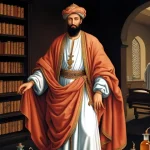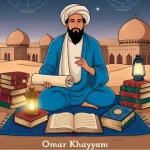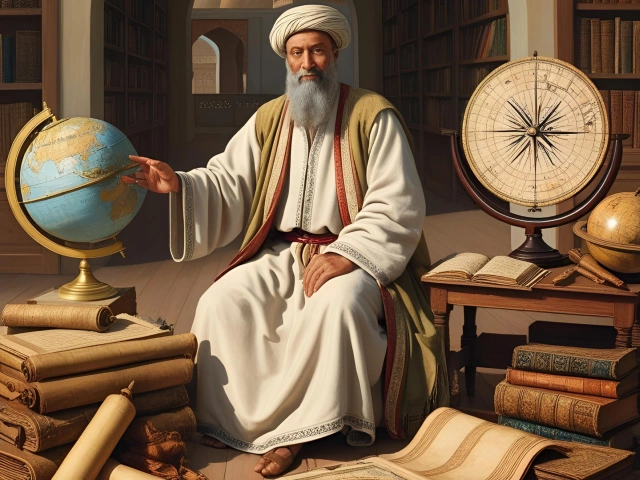
One quiet afternoon in the capital’s old book district, my eyes suddenly caught an ancient tome. Though faded and yellowed, the cover boldly proclaimed in large letters—“Al-Biruni.” Stepping gently away from the surrounding commotion, my fingers brushed across its pages, unveiling the outline of a wondrous world—a world where knowledge, curiosity, and human welfare had converged under the hands of a singularly scientific intellect. In this way, the centuries-old pages of history seemed to shimmer, where Muslim scientist and philosopher Al-Biruni remains forever immortal.
Chapter One: The Beginning of the Story
At a time in the medieval world when Greek, Indian, and Persian knowledge gradually blended together, Abu Rayhan Al-Biruni emerged—a prodigiously talented and versatile scholar. Born at the end of the 9th century, he grew up in the tide of a new era. Nature, mathematics, astronomy, geography—his curiosity was boundless in all these fields. History tells us that from his youth, he was intensely drawn to mathematics. That curiosity led him through the streams of knowledge from various parts of the world: from Greek philosophy to Indian mathematics, from astronomy to geography—he traversed all subjects with equal ease.
Al-Biruni did not limit himself within the boundaries of his own research; rather, his strong desire to know the world drove him down an enlightened path. It is often said that he was a true pioneer in the quest for knowledge—whose rich contributions have given us countless important researches, theories, and works.
Chapter Two: Facts and Analysis
One of Al-Biruni’s greatest achievements lies in his remarkable research on geography and astronomy. He undertook the task of measuring the circumference of the earth, a step that laid a firm foundation for medieval science. Besides this, his famous work “Tahqiq Ma Li-l-Hind” or “Research on India,” written on Indian mathematics and astronomy, remains to this day a vital resource for understanding ancient scientific traditions of the Indian subcontinent.
Many historians see Al-Biruni as a bridge of civilizations. He accelerated cultural and intellectual exchange between the Middle East and South Asia. Researchers assert that his work as a mathematician played a key role in popularizing the Indian numeral system and the concept of ‘zero’ in the West and the Middle East.
Professor Dr. Anisuzzaman of the Department of History at the University of Dhaka remarks, “Al-Biruni was not just a scientist, he was the embodiment of multifaceted genius. From mathematics, astronomy, and geography to theology—he made his mark in nearly every field. These contributions greatly accelerated the scientific discourse of the medieval era.”
Meanwhile, general reader Suman Mahmud comments, “Whenever I open the pages of history, I always see Western scientists at the forefront. But when I learn that Muslim thinkers like Al-Biruni made such vast contributions to science and scholarship during the Middle Ages, I am truly amazed. His name and works deserve much greater recognition.”
Chapter Three: Influence and Impact
Al-Biruni’s research also clearly reveals the harmony between religion and science. His writings show his passion for science and his respect for all types of cultures and beliefs. This multifaceted perspective has established him as an exemplar among people around the world.
On the international stage of science and knowledge, Al-Biruni’s works are still studied. In his book “Al-Athar al-Baqiyah,” he discussed calendars from the Christian and Islamic worlds, as well as time-reckoning methods from Persia, India, and other regions. Before Galileo and Newton, he conducted various researches into rotation, measurement, and astronomy, laying a foundation for future scientists in the centuries that followed.
Renowned medieval historian Dr. Azharul Islam comments, “The ‘scope of thought and questioning’ of Al-Biruni was astonishingly broad. His unique perspective on epistemology remains relevant to modern research even today. For he believed that if a question arises, one must seek its answer—religion, culture, or any ‘boundary’ should not stand in the way of inquiry.”
Chapter Four: Legacy and the Future
In today’s modern age, from space research to artificial intelligence—we are witnessing incredible advances in science. But the historical foundation behind these advancements has been significantly shaped by pioneer figures like Al-Biruni.
Now, in the age of information technology, the works of thinkers like Al-Biruni remind us that the spirit of scientific inquiry knows no boundaries. Experts express hope that if we continue to nurture his methodology, inquisitive mindset, and broad outlook, the world of tomorrow will be even richer and more oriented toward human welfare.
A segment of book-loving young men and women in Dhaka city are now busy searching for Al-Biruni’s works. Demand for this great scientist’s books and research-based works concerning him is on the rise at old bookshops. Many are telling journalists, “It’s time to rediscover Al-Biruni. If the new generation wishes to trace the roots of scientific exploration, they cannot overlook this luminary from history.”
Conclusion
Al-Biruni’s life and work have always reminded us—that man’s innate curiosity and thirst for knowledge are what drive civilization forward. This Muslim scientist and philosopher is an eternal source of inspiration, whose research acumen and vision have led humanity beyond conventional boundaries into the field of international scholarship.
Though time pushes all things into the shadow of history, the name of Al-Biruni will never fade from memory. As today’s youth step into the world of modern science and technology, it is our hope that the path and spirit shown by Al-Biruni will serve as a beacon in their journey ahead.