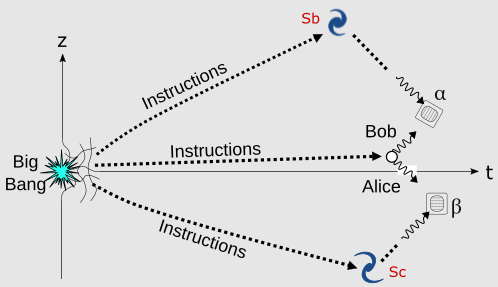
Superdeterminism is a concept which holds that every event in the universe, as well as all our decisions, are predetermined, and that free will does not actually exist.
In quantum mechanics, the idea of being superdeterministic is considered a loophole in Bell’s theorem. According to this notion, both the system being measured and how it is measured are interrelated in advance. As a result, the conditions of Bell’s theorem do not apply properly anymore.
This allows for a kind of hidden variable theory that follows local rules yet still matches the results of quantum mechanics.
Superdeterministic models state that everything is determined beforehand, and that the method of measurement and the state of the system are already deeply intertwined.
Bell’s theorem assumes that the measurement to be performed at each detector can be chosen independently of each other and of any hidden variables determining the measurement outcome. This relationship is usually called measurement independence or statistical independence.
However, in the superdeterministic theory, this independence is absent; there is inevitably a relationship between the hidden variables and the settings of the measurement. Since both the choice of measurement and the hidden variables are predetermined, the result from one detector can depend on what measurement was performed on another detector, without requiring any information to travel faster than the speed of light.
This concept of statistical independence is sometimes called the free choice or free will assumption, since to deny this independence is essentially to say that human experimentalists cannot actually decide which measurement they will perform.
Some limited versions of superdeterminism can be tested, assuming that a correlation between hidden variables and measurement choices has arisen somehow in the recent past. But overall, superdeterminism is constructed in such a way that it is fundamentally untestable—as these correlations can be considered to exist since the Big Bang, making it nearly impossible to close this loophole.
In the 1980s, John Stuart Bell discussed superdeterminism in a BBC interview—
There is a way to escape the inference of superluminal speeds and spooky action at a distance. But it involves absolute determinism in the universe, the complete absence of free will. Suppose the world is super-deterministic, with not just inanimate nature running on behind-the-scenes clockwork, but with our behavior, including our belief that we are free to choose to do one experiment rather than another, absolutely predetermined, including the “decision” by the experimenter to carry out one set of measurements rather than another, the difficulty disappears. There is no need for a faster than light signal to tell particle A what measurement has been carried out on particle B, because the universe, including particle A, already “knows” what that measurement, and its outcome, will be.
That is, there is a way to escape the ideas of superluminal speed and spooky action at a distance. But for this, we must accept absolute determinism in the entire universe—that is, the complete absence of free will.
Suppose the world truly is superdeterministic, in which not only inanimate objects, but even our behavior, and even our belief that we are freely choosing an experiment, are all predetermined. Even the “decision” by the experimenter about which measurement to choose is predetermined. If we think this way, the problem disappears.
At that point, there is no need for any faster-than-light signal for particle A to know what measurement was done on particle B, because the universe—including particle A—already “knows” what measurement will happen and what the outcome will be.
Although John Stuart Bell acknowledged the existence of this loophole, he also argued that it is extremely unrealistic in practice.
He said that even if a deterministic random number generator is used to make decisions on measurements, those decisions can still be considered “effectively free” in this context, as the device’s choice changes due to countless tiny influences.
Moreover, it is very unlikely that the hidden variable would be equally sensitive to exactly the same minute influences that affected the random number generator.
References:
- https://en.wikipedia.org/wiki/Superdeterminism
- Andreoletti, G., Vervoort, L. Superdeterminism: a reappraisal. Synthese 200, 361 (2022). https://doi.org/10.1007/s11229-022-03832-6