Rauful Alam
Researcher, University of Pennsylvania, USA
Once upon a time, Arab scientists illuminated the world. Through their work, we have come to know much about mathematics, biology, optics, and astronomy. Here is a brief account of some of the great minds from that golden age…
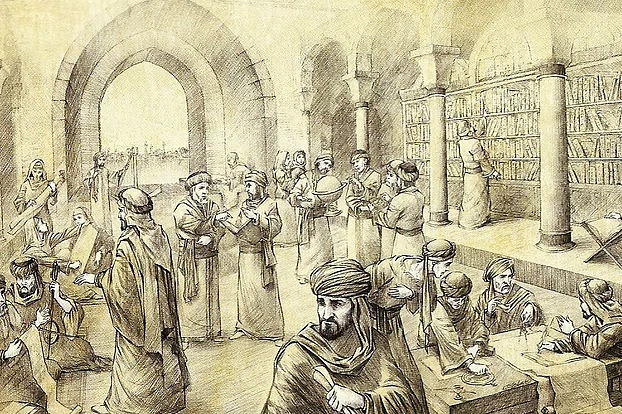
The year was 819. Caliph Al-Ma’mun sat on the throne of Baghdad. Al-Ma’mun was a seeker of knowledge. He respected scholars. He increased the salaries and benefits of the intellectuals in his realm. Every week, he would gather with them to talk and share stories. No field was left out of these gatherings—whether philosophy, mathematics, or science.
Perhaps there was no other monarch in medieval Arabia as fond of books as Al-Ma’mun. It is said that in numerous wars, instead of taking gold and jewels from his defeated enemies, he took books from their libraries. Al-Ma’mun knew that the Greeks possessed great treasures of knowledge, as did Persia, India, and China. He believed this knowledge needed to be acquired—and to do so, it had to be translated into Arabic. So dedicated was he that he wished to collect all the books in the world under one roof and have them translated into Arabic, so that the scholars could study them in depth.
It was from this vision that the Bayt al-Hikmah, or the House of Wisdom, was firmly established. In Bangla, it means the House of Knowledge. The Bayt al-Hikmah was a gathering place for intellectuals. It was not only a center for translation but also a place where the contents of many books were interpreted and explained in new ways. Many new ideas were born there. The solid foundation of what is known as the Golden Age of Arabia or the Muslim Golden Age was laid during Al-Ma’mun’s time. Notably, even before Al-Ma’mun, during the era of Caliph Al-Mansur, scholars had already begun translating many books into Arabic.
During Al-Ma’mun’s rule, the most renowned translator was Hunayn ibn Ishaq, a Christian by faith. But Al-Ma’mun chose him for his intellect. At just 17 years old, Hunayn ibn Ishaq translated the works of the famous Greek philosopher Galen. He had deep expertise in both Greek and Arabic.
In 820, the position of head of the Bayt al-Hikmah was given to the foremost mathematician of the time, Al-Khwarizmi. He was the brightest star of Al-Ma’mun’s reign. Al-Ma’mun showed—over 1,200 years ago—how to put the right people in the right places. Comparing the Bayt al-Hikmah of that time to today’s Royal Society or the US National Academy of Sciences would not be an exaggeration.
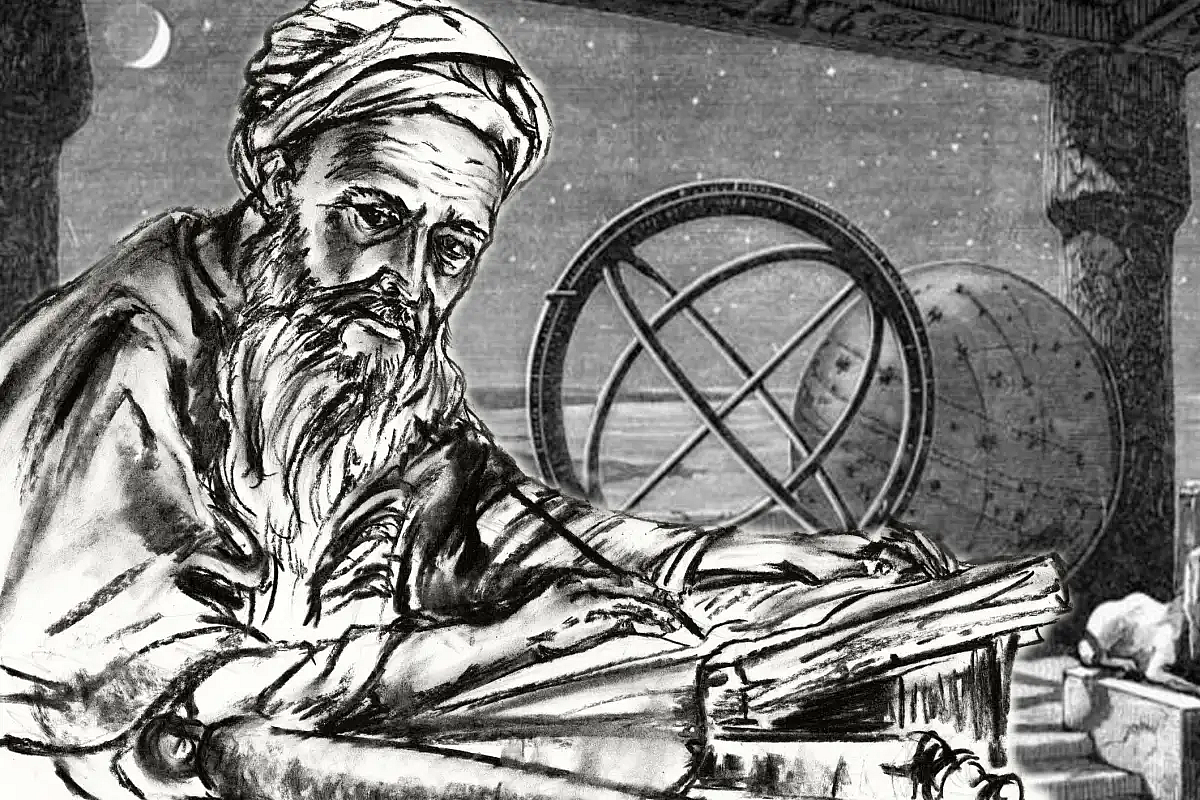
Al-Khwarizmi wrote many famous books. The influence of Indian mathematicians is clear in his work! He used the Hindu numeral system. Al-Khwarizmi invented a new branch of mathematics—algebra. He is called the father of algebra.
Al-Khwarizmi
It was the Arab scholars who first realized in the Middle Ages that the Indian subcontinent was a fertile ground for mathematics. They started translating the works of Indian mathematicians. Al-Khwarizmi wrote many celebrated books, and in them, the influence of Indian mathematicians is evident. He made use of the Hindu numeral system. Al-Khwarizmi developed a new branch of mathematics—algebra. He is regarded as the father of algebra. The word “algebra” itself originates from the title of his book al-Jabr. Likewise, the word “algorithm” comes from his Latinized name, Algoritmi.
Al-Khwarizmi implemented this new numeral system in mathematics. His book was translated into Latin as Liber Algorismi de Numero Indorum. This numeral system became known as the Hindu-Arabic or Indo-Arabic numeral system. The English numerals we use today come from this very system.
At that time, Europe still used Roman numerals, whose limitations were clear to Europeans—yet alternatives were unknown. It was then that the famous Italian mathematician Fibonacci came into contact with Arab mathematicians and learned from them. At age 32, in 1202, Fibonacci wrote Liber Abaci (or Book of Calculation), where he used Hindu-Arabic numerals. For the first time, Europe received a new numeral system. Arithmetic and algebra began to spread across Europe. European mathematicians eventually gave the world calculus. Without algebra and calculus, the European Renaissance in science and knowledge would have been impossible.
Al-Razi always preferred experimenting. He hung pieces of meat in various places around Baghdad. After a few days, he examined the meat. He recommended building the hospital in the place where the meat decomposed the least.
The Bayt al-Hikmah established a remarkable continuity of knowledge. It forged an unprecedented culture of scholarship, which endured for ages. Many great scholars were born from this tradition, one of whom was Al-Razi.
About 70 years after Al-Ma’mun’s rule, Caliph Al-Muqtafi reigned in Baghdad. Al-Muqtafi wanted to build a hospital in his kingdom—one so modern, no other such hospital existed in the world. The location for the hospital had to be chosen. But the king did not claim to know everything. He did not want to impose his decision by his authority alone. Instead, he called upon the kingdom’s greatest medical scientist, Al-Razi, and asked him to select the best location for the hospital.
Al-Razi had a penchant for experimentation. He hung pieces of meat in several places around Baghdad and, days later, examined which spoiled the least. His advice was to build the hospital where the air was healthiest and the meat decayed the least. This was 1,100 years ago.
Al-Muqtafi died a few years later, before the hospital could be completed. The hospital was later built during Caliph Al-Muqtadir’s reign, with Al-Razi placed in charge. Several hospitals were established during Al-Muqtadir’s rule, the largest being called “Al-Bimaristan Al-Muqtadiri.”
Al-Razi treated patients and conducted medical research from the hospital. At that time, two physicians were regarded as the most revered—Galen and Hippocrates. Their books were the most widely used. Al-Razi himself studied their works and was influenced by them. Challenging the doctrines of Galen and Hippocrates was a bold act of defiance at the time. But Al-Razi was undeterred. He challenged many of Galen’s theories, claiming them to be incorrect. If questioning knowledge and science is fundamental, then perhaps Al-Razi was the first in the Middle Ages to demonstrate this with courage.
A thousand years ago, Al-Razi recognized mental illness as an actual disease. He treated it as such, whereas in Europe, mental illness was still considered either a punishment for sins or a consequence of demonic possession. Al-Razi is regarded as the father of psychology and psychotherapy. He wrote extensively on medicine. His famous book is Al-Kitab Al-Hawi (Al-Kitab Al-Hawi). This massive work spans 23 volumes—astounding! In 1279, it was translated into Latin, and his influence spread across Europe. Al-Razi became known in Europe as Rhazes. At the University of Paris’s medical faculty in 1395, there were only nine books, and one of them was by Al-Razi.
If we were to count the five brightest stars of the Arab Golden Age, Al-Razi would certainly be among them. In his honor, “Razi Day” is still celebrated annually in Iran on August 27th.
The Arab Golden Age produced numerous philosophers and scientists—Ibn Sina, Al-Biruni, Omar Khayyam, Al-Tusi, Abbas Ibn Firnas, Ibn Khaldun—the list goes on. I will end this article with a mention of a renowned physicist: Ibn al-Haytham, also known in Latin as “Alhazen.”
We often credit Newton with many discoveries in optics. Yet research into optics began long before Newton. It’s important to mention that, even a hundred years ago, scientists communicated only by letter, and little was known about discoveries in distant lands. Many medieval manuscripts were lost due to neglect, or destroyed in wars. A culture of always acknowledging others’ work did not yet exist. Many Arab scientific works were present in Europe, and in the 16th and 17th centuries, European scientists adopted many ideas from them—though they did not always cite these sources properly. As a result, many Arab scientists remained unknown to Europe. Ibn al-Haytham was one such figure.
Ibn al-Haytham
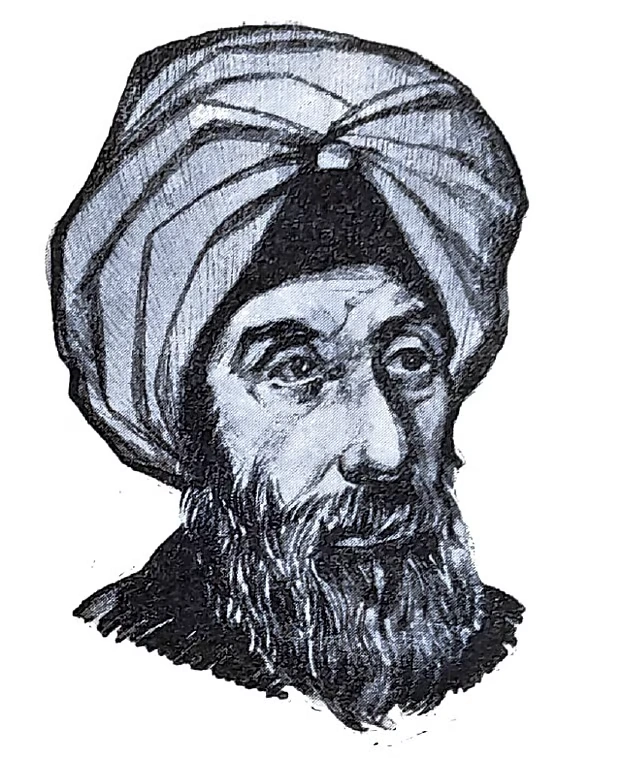
Ibn al-Haytham performed careful experiments in optics. He drew illustrations, gave descriptions, and established formulas. On these topics, he wrote a seven-volume work, Kitab al-Manazir (Book of Optics). He published this book a thousand years ago. At that time, there was no one in Europe doing such work on optics. His book was translated into Latin as De aspectibus in the 12th or 13th century. The British scientist Roger Bacon was likely the most influenced by Ibn al-Haytham’s book. Ibn al-Haytham was a believer in experimentation, valuing experiments as much as theories—an unusual stance a thousand years ago.
Knowledge never belongs to any one group. Over time, it passes from one people to another. Those who embrace knowledge, nurture its growth, and devote themselves to its advancement become leaders among nations. Europe and America today—and China, Japan, and Korea—are prime examples. For the development, expansion, and creation of knowledge, a society must value the wise, honoring knowledgeable people regardless of race, religion, or belief, and evaluating talent fairly. The Muslim leaders of the Middle Ages valued scholars and put them in the right positions, appreciating merit above race or religion. That is how the Golden Age was written.
References:
This article was adapted from an essay originally published in the January 2018 issue of Biggan Chinta magazine. Author: Dr. Rauful Alam, researcher, University of Pennsylvania, USA.