News Desk, Biggani Org
biggani.org
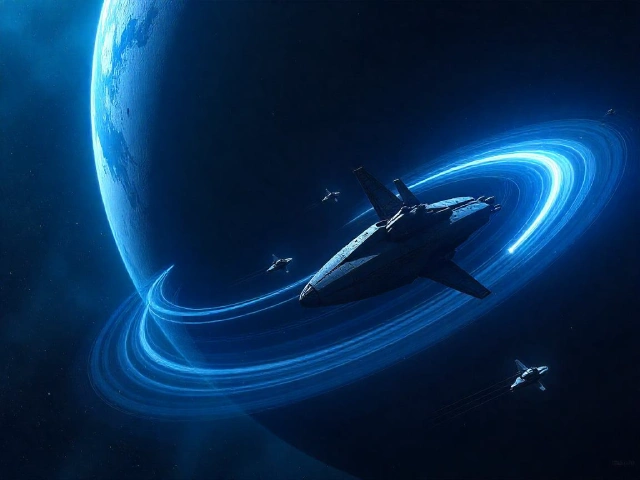
We often see in movies—a spacecraft runs out of fuel, is fleeing from enemy attacks or a cosmic disaster, and suddenly, a planet appears ahead. They use the planet’s gravity and perform a kind of ‘slingshot’ to escape rapidly. Is this scene actually possible in real life?
Surprisingly, this technology is indeed used in reality! Scientists call this technique ‘gravitational assist’ or gravitational slingshot, which is vital for space exploration.
The core idea behind this method is: when a spacecraft comes close to a planet, its trajectory changes due to the planet’s gravitational pull. However, it’s not just the trajectory—the spacecraft can also gain speed by using the planet’s orbital velocity. Though it may seem strange at first glance, this is possible in reality. But how?
Imagine you are holding a ball a little above the ground and then let it go. As the ball falls, it speeds up downward and bounces back up after hitting the ground. But it never rises above the original height from where it was dropped. In other words, the ball’s kinetic energy remains constant by the laws of physics—it never increases.
The same thing happens with spacecraft. As the craft approaches a planet, it speeds up, but it loses that same amount of energy on its way out. So how does a spacecraft actually gain speed? This is the core mystery.
The main factor is the “relative velocity of the planet.” When a spacecraft passes close to a planet, it can steal a small amount of energy from the planet’s own orbital speed. That is, the spacecraft can add some of the planet’s velocity—while it orbits the Sun—to its own. For the planet, this loss is negligible because of its massive size. A small spacecraft weighing just a few tons has virtually no effect on the planet’s immense motion.
Reaching distant planets in space requires vast amounts of fuel. Due to the limitations of rocket technology, this is extremely difficult. The more fuel a rocket carries, the heavier it gets. And with more weight, it needs even more fuel. This cycle eventually becomes quite difficult, a challenge explained by the “rocket equation.”
Therefore, gravitational assist is an important solution. For example, think of the Cassini spacecraft, which began its journey to Saturn in 1997. On its voyage, it passed close to Jupiter and used the energy from the planet’s orbit to increase its own speed. Thus, Cassini was able to reach Saturn in less time. In fact, Cassini passed by Venus and Earth multiple times as well, allowing it to accumulate even more energy.
This technique also works in reverse. To travel from Earth to planets closer to the Sun, like Venus or Mercury, it is extremely challenging to overcome Earth’s tremendous velocity of 30 kilometers per second. So, scientists direct the probe in the opposite direction, bringing it close to Venus, and reduce its speed by giving some of its velocity to the planet. This process gradually slows the spacecraft down and sends it toward the Sun. The joint European and Japanese project, BepiColombo, is using this method to reach Mercury.
In January 2025, it will make its final approach to Mercury and, by November 2026, will enter the planet’s orbit. By using this technology, scientists have made interplanetary missions significantly more efficient and faster.
The gravitational slingshot clearly shows us just how complex space travel truly is. Space travel really is “rocket science”—it’s highly complicated. Escaping Earth’s gravity is the biggest challenge. Interestingly, the very force we struggle to escape—gravity—has become a tool to help us reach deep space more easily.
Gravitational slingshot technology has not only made our space missions easier, but also opened new doors to endless possibilities in space exploration.