✍️ News Desk, Biggani.org |
📧 [email protected]
🔥 Scientists Aim to Bring the Power of the Sun to Earth
Imagine a power source that could last almost indefinitely, uses ordinary seawater as fuel, and produces no harmful carbon emissions or nuclear waste. If such energy production were possible, it could be a revolutionary solution to the world’s energy crisis. This dream is called “controlled nuclear fusion.”
Recently, two European research institutions—Germany’s Wendelstein 7-X and Britain’s Joint European Torus (JET)—have set new records in controlled fusion reactions. According to many scientists, this success has brought us closer than ever to a long-awaited fusion power plant.
☀️ What Is Fusion?
In simple terms, fusion is a process in which two light atoms (for example: deuterium and tritium) combine to form a heavier atom, releasing an enormous amount of energy in the process. This is exactly how the sun generates energy.
However, creating this process artificially on Earth is extremely challenging, because fusion requires hydrogen gas to be maintained in a ‘plasma’ state under incredibly high temperatures and pressures. Plasma is a state in which a gas’s atoms separate into free electrons and nuclei.
🌐 Why Is Fusion Important?
The future impact of fusion energy is enormous:
- Abundant Fuel: The hydrogen in seawater is enough to power fusion.
- Environmentally Friendly: It produces no greenhouse gas emissions.
- No Nuclear Waste: Fusion energy produces no long-term toxic nuclear waste.
- Safe: There is no risk of a ‘nuclear meltdown’ during fusion.
🧪 Two Contenders: Wendelstein vs. JET
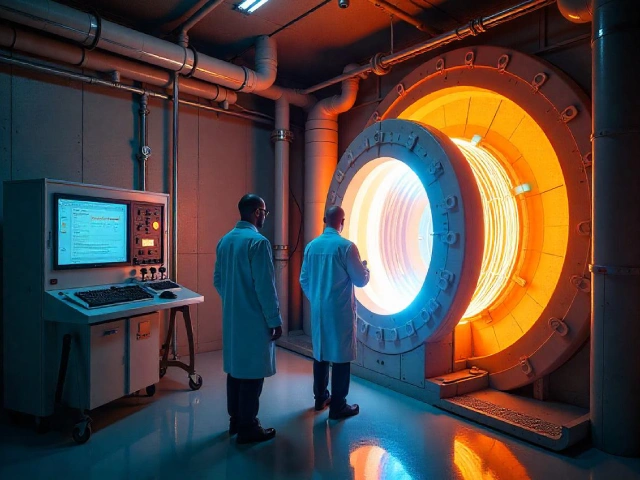
Germany’s Wendelstein 7-X is a “stellarator”-type fusion reactor, which confines plasma using powerful magnetic fields. Recently, this reactor managed to contain plasma for 43 seconds—a new record.
On the other hand, Britain’s JET reactor, which is of the “tokamak” type, has achieved plasma confinement for 60 seconds. Although JET is three times larger, both research centers are progressing almost neck-and-neck in this technological race.
🌀 Stellarator vs. Tokamak: What’s the Difference?
Tokamak:
- Invented in Russia
- Shaped like a donut
- Stabilizes plasma by driving an electric current through it
- Comparatively easier to build and maintain
Stellarator:
- Uses a complex magnetic design
- No current is passed through the plasma
- Better at keeping plasma stable for longer periods
Dr. Thomas Klinger, lead scientist of the German project, says, “We have now reached a point where we see the possibility of running plasma for over half an hour.”
💡 Another Method: Laser-Based Fusion (Inertial Confinement)
In 2022, the United States’ National Ignition Facility (NIF) achieved a remarkable breakthrough—using lasers to heat a tiny deuterium-tritium sphere and achieve fusion that produced more energy than was input.
The problem, however, is that for a single successful experiment, 192 lasers must be charged for 12 hours, which consumes a huge amount of energy. For long-term electricity production, 10 fusion pellets would need to be ignited every second—posing a massive engineering challenge.
🚀 Private Companies Enter the Race
Now, it’s not just government research labs—many private companies have joined the race. For example:
- General Fusion (Canada): Using Magnetized Target Fusion (MTF)—as simple and robust as a diesel engine.
- Commonwealth Fusion Systems (MIT): Building a compact ARC tokamak reactor in Virginia, expected to produce 400 megawatts of electricity as early as the early 2030s.
🧲 Superconducting Magnets: A Game Changer?
These new magnets are cooled near absolute zero using liquid helium to achieve zero electrical resistance. This creates extremely strong magnetic fields, which help contain plasma effectively.
According to Tony Roulstone, nuclear engineer at Cambridge University, “These superconducting magnets are what’s bringing us closer to realizing fusion energy.”
⚖️ The Road Ahead
Scientists are still uncertain whether the tokamak or stellarator will ultimately succeed. Perhaps future reactors will combine both technologies. But it’s certain that we have come much closer to controlled nuclear fusion than ever before.
In the words of nuclear engineer George Tynan, “Fusion technology still has many years of research ahead, but it’s likely that both methods will ultimately work.”
📚 Recommended Reading for Readers
If you want to learn more about fusion technology, you may read:
- The Future of Fusion Energy – Jason Parisi & Justin Ball
- Sun in a Bottle – Charles Seife
- Introduction to Plasma Physics – Francis F. Chen
- Physics of Solar Energy – C. Julian Chen
- Plasma Physics and Fusion Energy – Jeffrey Freidberg
- Energy, Environment, and Climate – Richard Wolfson
- The Physics of Inertial Fusion – Stefano Atzeni & Jurgen Meyer-ter-Vehn
- Nuclear Fusion: Half a Century of Magnetic Confinement Fusion Research – C.M. Braams
- Making Starshine on Earth – Daniel Clery
- Fusion: Science, Politics, and the Invention of a New Energy Source – Garry McCracken
✨ Conclusion
For today’s students, teachers, and general readers, fusion is no longer just a scientific fantasy—it is a potential future. As we face the threats of energy crises, climate change, and the limitations of fossil fuels, fusion power could become the ‘sun’ that illuminates the path for future generations.
On behalf of Biggani.org, we urge you—learn, understand, and stride forward in the light of science’s promise. 🌍⚛️
📩 Send your feedback and questions to: [email protected]