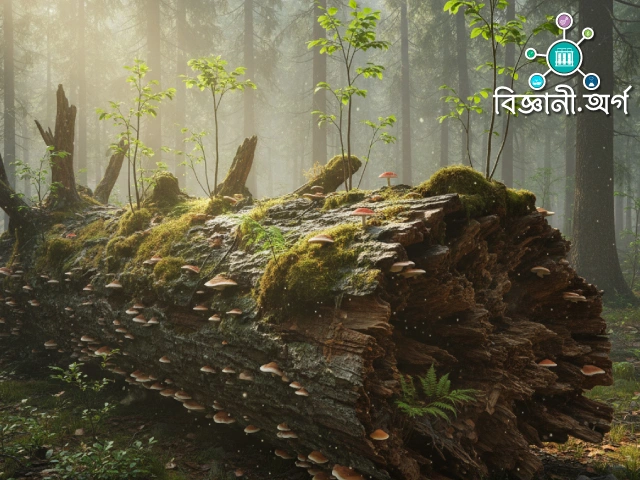
One day, while walking through the forest, I noticed a towering tree leaning down, fallen over. At first, my heart felt strangely empty. So many birds’ nests, so many squirrels at play—all seemed to have suddenly come to a stop. But then another question echoed inside me: is the end really the end? American researcher Mark Harmon set out to find the answer to this question almost forty years ago. For four decades, he observed the decay process of over five hundred dead trees across six forests. Just imagine—while we’ve changed governments at least three times by voting in that span, he’s been taking notes on an invisible science fiction unfolding quietly.
When you hear about Harmon’s research, you might feel like taking your glasses off in disbelief. Some dead trees merge with the earth within three years, while others decompose so slowly that even after seven hundred and fifty years—and several generations—the marks of time refuse to show on their wood. In a 2020 analysis, he showed that the rate of tree decay can differ by up to 244 times depending on species and climate. Two hundred and forty-four times! Like the difference between a mosquito bite’s sting and the peace of sleeping inside a net—worlds apart.
But the science behind these statistics is even more astonishing. Within dead tree wood lie complex organic molecules called cellulose and lignin. Cellulose takes relatively little time to break down, but lignin’s chemical structure is so tough that only specific fungi and bacteria can decompose it. These microbes, in turn, work according to the temperature, humidity, and oxygen levels. In the cool, damp forests of the Pacific Northwest, where fungi grow slowly, it can take centuries to break down a tree’s lignin. Yet in tropical forests, with higher heat and humidity, the same lignin can break down within a few years.
Now consider: the speed of this decay process determines when vast amounts of carbon will return to the atmosphere. When alive, trees use photosynthesis to draw carbon dioxide from the air and store carbon in their wood. Once dead, that carbon is no longer trapped inside the tree but is gradually released back to the air through decomposition. If a forest is dominated by slow-decaying species, it can hold onto huge amounts of carbon for centuries. On the other hand, forests of fast-decaying trees release that carbon back into the atmosphere within a short period. In other words, these silent decay processes of dead trees play a major role in the global climate equation.
But the story of carbon doesn’t end with the wood. The soil surrounding a dead tree is its own complex laboratory. Soluble organic compounds released from the tree’s rot become food for soil microbes. These organisms, in turn, respire and release carbon dioxide. In some cases, carbon gets bound up with soil minerals and is locked away for the long term. So, the death of a tree reshapes the soil’s carbon cycle—sometimes sending carbon quickly to the sky, sometimes trapping it deep underground for thousands of years.
Scientists once thought that a tree’s death meant its sudden disappearance. But Harmon washed that misconception away. According to him, nowhere on Earth, at any time, has a tree vanished instantly at death. Instead, death is the start of a new phase. The decay of one body marks the birth of other life—new fungi, new insects, a new soil chemistry.
In today’s age of climate crisis, this research opens our eyes. As plans are drawn up to reduce carbon emissions to fight rising global temperatures, even a single piece of dead wood lying on a forest floor becomes an unsung warrior in the struggle. It’s like nature’s secret carbon bank—sometimes quickly depleted, sometimes filled for generations upon generations.
So, tell me, is the death of a tree truly death? To me, it seems more like a new chapter in nature’s long scientific epic. What we consider the end, nature marks as the opening note of transformation. This silent transformation teaches us—death is, in reality, a long shadow of life, from which the seeds of the future quietly peek out.