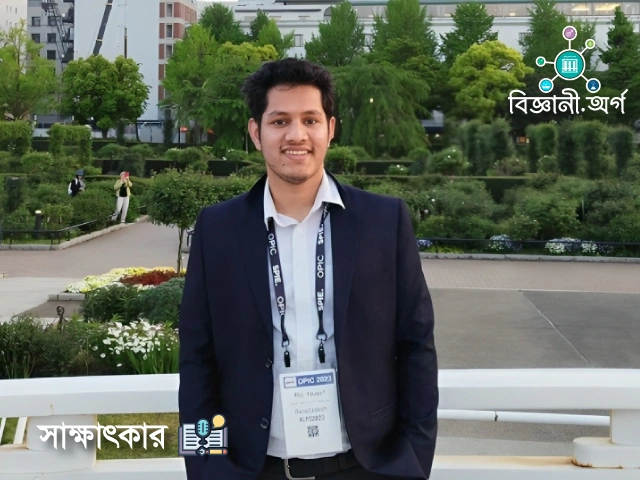
Abu Yousuf is currently working as a Junior Researcher at Japan’s national research institute, the National Institute for Materials Science (NIMS), and is also engaged in PhD research at Kyushu University, Japan. His research primarily focuses on optical and advanced ceramic materials, where he is working on developing highly transparent ceramic materials.
As a member of NIMS’s Optical Ceramic Materials Group, he is researching ceramic materials that are suitable for use in high-performance LEDs, lasers, and scintillator devices. Notably, he has successfully created transparent ceramics by doping calcium fluorapatite with rare earth elements such as Cerium (Ce) and Europium (Eu). In his research, controlling grain size, reducing defects, and improving optical properties play a crucial role.
The results of Abu Yousuf’s research have already been published in international journals such as Optical Materials Express and Optica (Optical Society of America). He is currently working on the design of new materials and Spark Plasma Sintering (SPS) technology for advanced ceramic LEDs and optical devices.
💬 Q&A Session:
Question: Could you please tell us a bit about yourself to start with?
Answer: I am currently working as a junior researcher at the National Institute for Materials Science (NIMS), Japan, and pursuing my PhD at Kyushu University at the same time. NIMS mainly focuses on advanced research and technological innovation in materials science. Here, I am conducting research on optical and advanced ceramic materials.
Question: What is the subject of your research?
Answer: The main subject of my research is the development of advanced ceramic materials that can be used in high-performance LEDs, lasers, and scintillator devices. Specifically, I am working on scintillators that are capable of rapidly detecting radioactive substances. For this, it is essential to make the ceramics highly transparent, which is a significant challenge. I am working on creating transparent and composite ceramics and controlling their structural and optical properties.
Question: How can your research benefit us?
Answer: The ceramic materials developed in my research can be used in ceramic LEDs, lasers, scintillator detectors, and radiation sensors. They can contribute to the advancement of security, healthcare, and energy-saving technologies. For example, my Ce-doped calcium fluorapatite ceramics are being studied by Hamamatsu Photonics in Japan, which could help enable rapid radiation detection in the future.
Question: Would you like to share any special experience from your research life?
Answer: The moment I was able to create a highly transparent ceramic for the first time was truly memorable for me. After many failures, I succeeded by changing the doping concentration and sintering technique. That achievement gave me the opportunity to present my research at my first international conference.
Question: What qualities do you think a scientist should possess?
Answer: Curiosity, patience, honesty, and analytical thinking are essential for a scientist. Additionally, the mentality for teamwork and communication skills are extremely important.
Question: What is your message for young students in Bangladesh?
Answer: You need to learn to ask questions with a curious mind. Do not fear failure; progress patiently. With regular study, proficiency in using technology, and seizing international opportunities, young people from Bangladesh can also become world-class scientists.
Contact Information:
Email: [email protected]
🔗 Profile Link:
LinkedIn: https://www.linkedin.com/in/abuyousufkawsar/
Website: https://www.researchgate.net/profile/Abu-Yousuf-5
Abu Yousuf’s research is creating real and diverse possibilities in the field of modern optical and ceramic technology. Even while working in an advanced research environment like Japan, he continues to give inspiring messages to young students in Bangladesh. It is expected that his work will have a significant impact in the fields of security, medicine, and energy-efficient technology in the future. The biggani.org team extends sincere best wishes for his research and future journey.
Researching Transparency: The Scientific Journey of Abu Yousuf
Abu Yousuf is currently working as a Junior Researcher at the National Institute for Materials Science (NIMS), Japan, while simultaneously pursuing his PhD at Kyushu University, Japan. His academic and research focus lies in optical and advanced ceramic materials, particularly in the development of highly transparent ceramics for photonic applications.
As a member of the Optical Ceramic Materials Group at NIMS, he is engaged in research aimed at fabricating ceramic materials suitable for high-performance LEDs, lasers, and scintillator devices. His work emphasizes controlling microstructural features such as grain size and minimizing defects to achieve high optical transparency—one of the major challenges in ceramic materials science.
A notable aspect of his research involves doping calcium fluorapatite, a material naturally found in human teeth and bones, with rare-earth elements such as Cerium (Ce) and Europium (Eu). His research outcomes have been published in internationally recognized journals including Optical Materials Express and Optica (Optical Society of America). Currently, he is exploring advanced material design strategies and Spark Plasma Sintering (SPS) techniques to develop next-generation ceramic LEDs and optical devices.
💬 Interview Section:
Question: Could you briefly introduce yourself and your current work?
Answer: I am currently working as a junior researcher at the National Institute for Materials Science (NIMS) in Japan, while also pursuing my PhD at Kyushu University. NIMS is a research-focused institution dedicated to advanced materials science and technological innovation. My research primarily involves optical and advanced ceramic materials.
Question: What is the main focus of your research?
Answer: My research focuses on developing advanced ceramic materials that can be used in high-performance LEDs, lasers, and scintillator devices. In particular, I work on scintillators capable of rapidly detecting radioactive materials. Achieving high optical transparency in ceramics is essential for these applications, but it is technically challenging. I work on fabricating transparent and composite ceramics and controlling their structural and optical properties.
Question: How can your research benefit society?
Answer: The transparent and composite ceramics developed in my research can be applied to ceramic LEDs, laser systems, scintillator detectors, radiation sensors, and optical devices. These materials have practical implications in security, healthcare, and energy-efficient technologies. For example, Ce-doped calcium fluorapatite ceramics developed in my work are currently being studied by Hamamatsu Photonics in Japan for potential radiation detection applications.
Question: Could you share a memorable experience from your research journey?
Answer: One of the most memorable moments was successfully fabricating a highly transparent ceramic for the first time. After multiple unsuccessful attempts, I optimized the doping concentration and sintering parameters. When I finally obtained a crystal-like transparent sample from the furnace, it felt incredibly rewarding. That success later enabled me to present my work at my first international conference.
Question: What qualities do you think are essential for a scientist?
Answer: Curiosity and the ability to ask meaningful questions are fundamental. Patience and perseverance are equally important, as failure is a natural part of research. Scientific integrity, analytical thinking, problem-solving skills, and the ability to collaborate and communicate effectively are also essential qualities.
Question: What message would you like to share with young students in Bangladesh who aspire to work in science?
Answer: Developing curiosity and asking “why” and “how” are crucial. Students should not fear failure but view it as part of the learning process. Strengthening basic knowledge, improving technical and English skills, and utilizing global learning resources can open many opportunities. With dedication and perseverance, Bangladeshi students can become world-class scientists.
Contact Information:
Email: [email protected]
🔗 Profile Link:
LinkedIn: https://www.linkedin.com/in/abuyousufkawsar/
Website: https://www.researchgate.net/profile/Abu-Yousuf-5
Abu Yousuf’s research contributes to the advancement of optical ceramic materials with significant potential applications in photonics, radiation detection, and energy-efficient technologies. While working in an advanced international research environment, his journey serves as an inspiration for aspiring scientists from Bangladesh and beyond. The biggani.org team wishes him continued success in his research endeavors and hopes his work will motivate young students to pursue scientific inquiry with dedication and integrity.