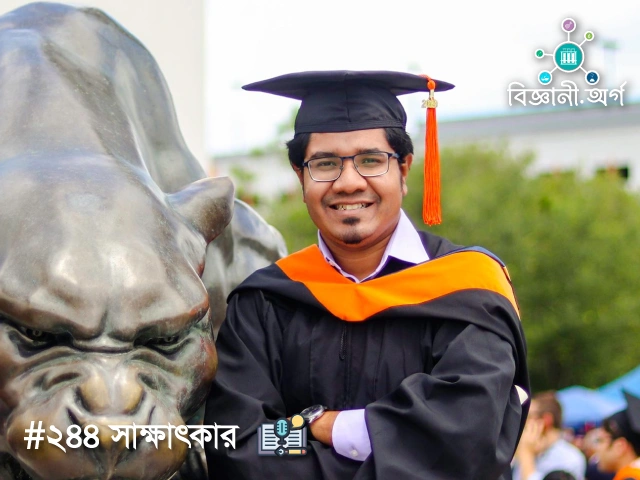
The new generation of young people are not only working to change our society, but they are also making strides in science and technology. Among the technologies that the world looks forward to with hope, one of the most discussed is quantum computing. And working in this field is a new generation scientist, Arman Sykot.
I had connections with Dr. Mahadi Rahman of North South University. A short post on his Facebook caught my eye. He shared a research work by one of his students. After reading that research paper in detail, I was amazed. Using both quantum mechanics and classical mechanics, this student has developed a hybrid technology that can be used for confidentiality of information (what we call encryption or decryption in tech terms). This research was carried out by our very own new generation scientist, Arman Sykot. I was truly impressed seeing his paper and research work.
Below I am sharing Arman Sykot’s post from Facebook:
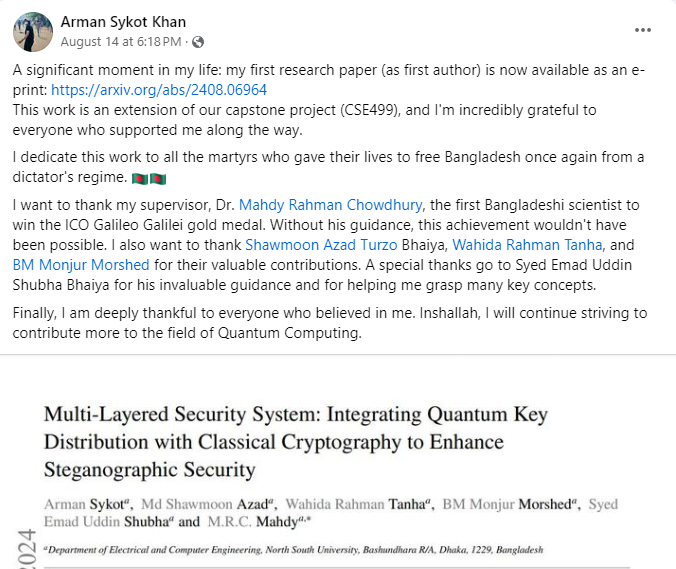
Without delay, I reached out to Arman Sykot and expressed my interest in interviewing this young scientist for Biggani.org. Below is his interview for our readers. If young scientists like these receive proper guidance and support, they can achieve greatness. Therefore, we should support budding scientists like Arman Sykot to help them grow even further.
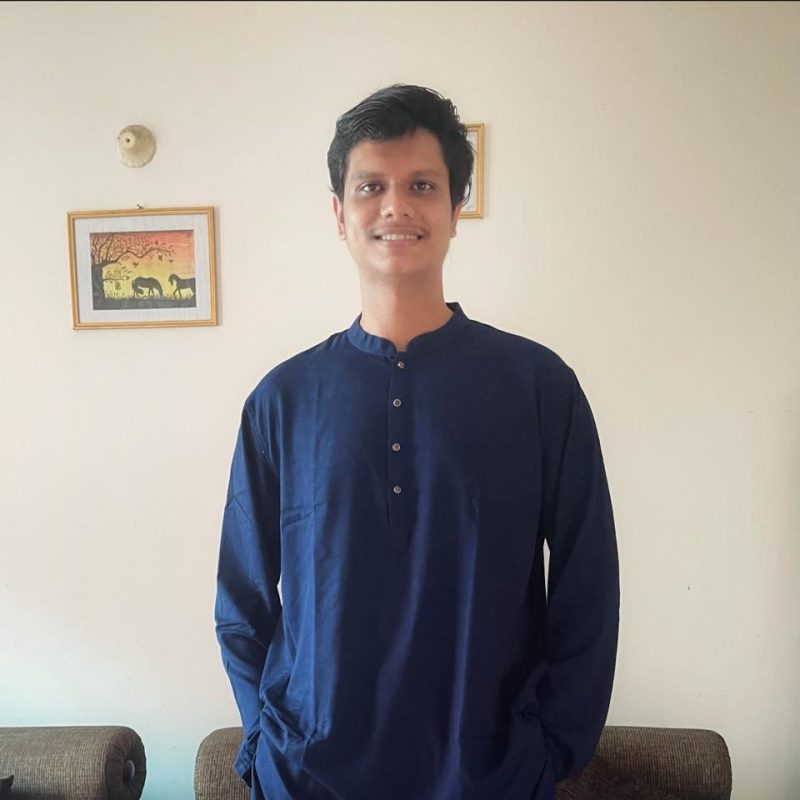
Interview with Arman Sykot
Please give a brief introduction of yourself
I am Arman Sykot, an undergraduate student in Computer Science and Engineering at North South University. This is my final semester.
Who inspired you to become a scientist?
Since childhood, I’ve loved science fiction books and movies. I always had this urge to invent something important. That’s where my initial interest sparked. I was really motivated by some important movies like A Beautiful Mind, The Man Who Knew Infinity, and APJ Abdul Kalam’s biography by Gulzar Saab. Although, to be honest, I haven’t achieved anything yet, but I have a strong desire.
With so many fields in science, why does quantum computing interest you?
My CGPA is extremely low. Unbelievably low. Academically, I’m in the back rows. After starting university, I didn’t particularly enjoy studying. I often heard from people that quantum computing is very tough and not everyone understands it. So I took it as a challenge and started reading in-depth about quantum mechanics—almost like people read science fiction books. I developed a strong desire, and my interest kept growing. Whenever I get interested in something, it becomes very dear to me. Around this time, my supervisor Dr. Mahdi Rahman Chowdhury gave me some lecture videos on quantum computing. After watching them, I felt, “This is exactly what I’ve been looking for in my life.” For my fourth year, final-year thesis, I decided I would do research in this field and make a contribution, no matter what. That developed into an intense determination within me.
Can you briefly explain your research paper to us?
The technology I developed is essentially a hybrid of quantum mechanics and classical mechanics. Its primary use is to encrypt (secure) or decrypt (recover) any information. When we want to encrypt anything, we need a key, which acts somewhat like a password. The current classical methods for generating keys will not be secure in the era of future quantum technology. Because quantum computers are so powerful, they can easily break or figure out those security keys. Personally, I find entanglement the most fascinating aspect of quantum mechanics. If two qubits are in an entangled state, no matter how far apart you separate them, they always maintain that entangled relationship. Inspired by this concept, Ekert in 1991 introduced the E91 protocol, which distributes keys following the laws of quantum mechanics, and no current technology can breach or break it. After creating the key using the E91 protocol, it is hashed using classical hashing. This way, no one can ever detect how many qubits the key generator actually used. For example, if you use 20 qubits and a 256-bit hash, you’ll get a 256-bit string from those 20 qubits. Even if you use 30 qubits, you’ll still get a 256-bit string. Then this hashed string goes into AES (Advanced Encryption Standard), which is another classical method. AES helps encrypt or secure any data, and there is currently no technology that can break AES. So, using quantum technology for key distribution and encrypting with AES and hashing together produces a security system that no existing technology can break. And if steganography is also used, as I’ve shown in my scientific paper, the security becomes even more powerful.
What is steganography?
Steganography is a technique for hiding information or messages within other data, so that no one can tell from the outside that hidden information is there. For example, you could hide a secret message inside a picture, and someone just looking at the image wouldn’t know. The word steganography comes from Greek, where “steganos” means “hidden” and “graphy” means “writing.” It’s usually used to conceal secret messages inside different types of digital media, such as pictures, audio, video, etc. The objective of steganography is to hide information in a way that makes it difficult for others to detect. It is generally used in cybersecurity, sending secret messages, and data protection.
Many say doing research from Bangladesh is tough. What is your opinion?
Since I’ve never done research outside of Bangladesh, I can’t say for certain. If I ever get to do research in another country, then I can compare and say whether it’s tougher or easier here.
What is your message to young people who want to do research like you?
I want to share a very simple message: “discipline over anything.” And this discipline will come naturally if you find something you truly love.
What qualities do you think are necessary for a researcher?
I think discipline, dedication, never underestimating yourself, and patience are crucial. An idea usually doesn’t come within 2-3 days; it’ll appear suddenly, but no one knows when. Until then, you have to keep studying—so patience is extremely important.
Title of the paper: Multi-Layered Security System: Integrating Quantum Key Distribution with Classical Cryptography to Enhance Steganographic Security
Scientists: Arman Sykot, Md Shawmoon Azad, Wahida Rahman Tanha, BM Monjur Morshed, Syed Emad Uddin Shubha, M.R.C. Mahdy
Subjects: Quantum Physics; Cryptography and Security
Paper Link: https://arxiv.org/abs/2408.06964
On behalf of Biggani.org, I extend my best wishes to Arman Sykot and his fellow researchers Md Shawmoon Azad, Wahida Rahman Tanha, BM Monjur Morshed, and Syed Emad Uddin Shubha. And of course, salute to Dr. Mahadi Rahman for his efforts in nurturing these young scientists. I believe that his work and initiative will inspire other teachers in Bangladesh to help create more young scientists.
Author: Dr. Mashiur Rahman, Editor of Biggani.org.