News Desk, Biggani Org
If you try to feel a second by slowly counting “one-thousand one… two-thousand two…,” imagine dividing a single second into a billion billion pieces. That’s what we call an attosecond—that is, 0.000000000000000001 second. This fraction of time is so unimaginably small that humans can barely conceive of it. Yet for electrons, atoms, and molecules, this slice of time is enough to trigger crucial physical or chemical events.
Attosecond: The Abyss of Time
Today, the cutting edge of the fastest scientific research centers on attosecond physics. Using advanced laser technology, scientists can now capture the tiniest events in these micro-moments, where electrons shift position, molecular bonds are made or broken, and the interplay between light and electrons changes energy in an instant.
According to Stephen Leone, a physicist and chemist at the University of California, Berkeley, seeing these ultrafast snapshots allows us to understand many hidden chemical processes that were once only theoretical.
Why is Attosecond Science So Important?
When an electron orbits around an atom, it takes only 1 to 1,000 attoseconds to complete an “orbital.” In this brief window, a bond may be created or broken, or the structure of a molecule may change entirely.
Here’s what happens at this timescale:
- When struck by a photon, the electron gets excited and jumps to a higher energy level
- The electron forms a bond with another molecule, or separates to create an ion
- A photon is emitted, providing scientists with a spectroscopic signal to explain the event
All of these phenomena are extremely fast and delicate. Without attosecond-level observation, they would have remained almost invisible.
How is This Research Conducted?
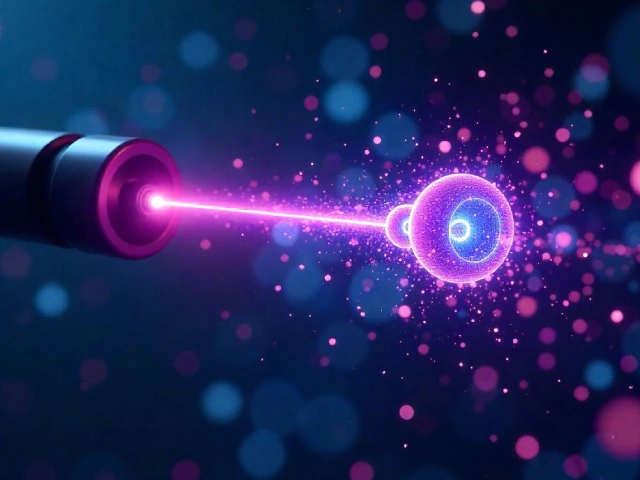
Behind this breakthrough is a technique known as High Harmonic Generation (HHG)—whose pioneers received the Nobel Prize in 2023. The process involves:
- Using a femtosecond laser (10^-15 seconds) to vibrate electrons within a gas
- The electrons then release energy to produce new light with even shorter wavelengths (UV or X-ray)
- This light is used in “pump-probe” studies—which make it possible to record the precise actions of individual electrons
Spectroscopy and the Connection to Biology
Daniel Kiefer of the Max Planck Institute explains that this technology is now being used to study biological molecules such as DNA and RNA. Sunlight’s ultraviolet rays can break DNA, but these molecules rapidly dissipate the energy and return to lower energy states. This defensive reaction happens so quickly that the risk of DNA damage drops dramatically.
With attosecond observation technology, it’s now possible to study this reaction—potentially aiding future research on cancer, genetic disorders, and more.
The Unknown Realm: Dark Matter and Quantum Vacuum
J. Yeun at the JILA Research Center in the United States is using attosecond physics in a bid to detect dark matter. He plans to develop a new type of clock—the nuclear clock—which monitors protons and neutrons in the nucleus for tiny shifts in energy that could signal a connection with dark matter.
Meanwhile, researcher Gillaspy notes that if we can develop even more powerful lasers, we might be able to turn virtual particles present in the quantum vacuum into real particles. Until now, these particles existed only in theory; but attosecond observation is showing us that, even in the midst of “emptiness,” we might find new forms of matter.
The Mystery of the Laboratory
These experiments are conducted in isolated, vibration-free laboratories—where ultra-precise arrangements of lenses, crystals, laser splitters, time delay setups, and more must be meticulously assembled. Experiments are performed in vacuum chambers so that air or dust does not disrupt the laser’s information.
One researcher described it as, “These complex instruments are essentially trying to capture the smallest ‘events’ in the world on camera.”
Conclusion: The Road Ahead
When scientists immerse themselves in this kind of research, they rarely know where it will lead. Nuclear physics once gave birth to MRI, X-rays, and radiotherapy. In the same way, attosecond science may lead us into a new era of cancer detection, gene repair, novel chemical discoveries, or even understanding dark matter—the universe’s mysterious material.
The phenomena unfolding within attosecond timeframes show us that sometimes, the most significant changes begin in the tiniest moments.
✍️ Article prepared by News Desk, Biggani Org
📬 Contact: [email protected]