

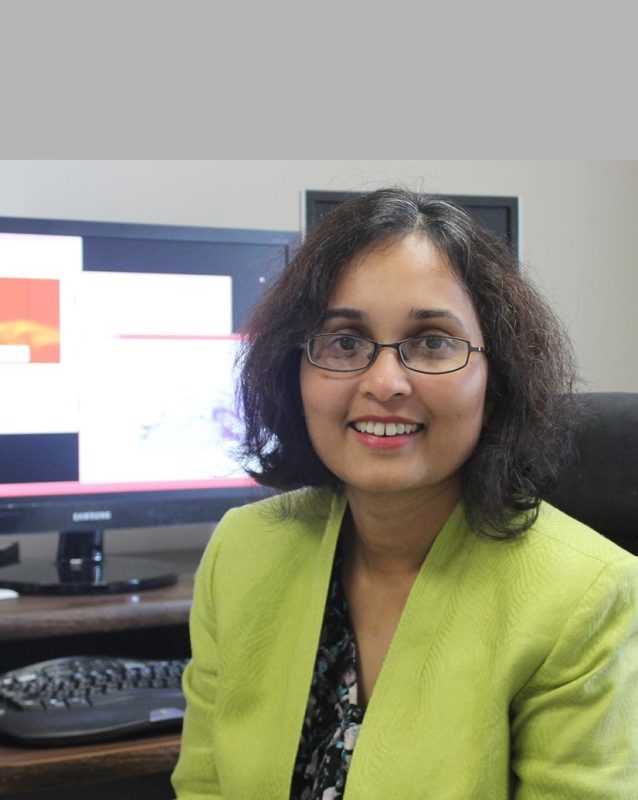
Dr. Samia Haque was born in Nigeria and spent her childhood and adolescence there. She returned to Bangladesh in 1989, completed her O-levels at Radiant School, and later finished her higher secondary education. In 2001, she earned her bachelor’s degree in Chemical Engineering from BUET. She then completed a master’s in Chemical and Environmental Engineering at the University of Toronto, Canada in 2004, and obtained her PhD in Environmental Engineering from Drexel University, USA in 2010.
Dr. Haque completed her postdoctoral training at the Environmental Protection Agency (EPA) of North Carolina. Currently, she is an Assistant Professor in the Department of Civil and Environmental Engineering at the University of South Carolina. Her main research topics are air pollution, indoor air quality, human-building interaction, contaminant transport, and indoor healthy environments. Her work is primarily focused on ensuring healthy indoor environments and developing advanced predictive models.
💬 Q&A Session:
Question: Greetings from biggani.org. First, can you tell us a little about yourself?
Answer: Thank you. I spent my childhood and adolescence in Nigeria. After returning to Bangladesh, I completed my O-level and higher secondary education at Radiant School in 1989. In 2001, I graduated in Chemical Engineering from BUET. Then I earned a master’s degree in Chemical and Environmental Engineering from the University of Toronto and a PhD in Environmental Engineering from Drexel University, USA. I did my postdoctoral training at EPA, North Carolina. Currently, I am an Assistant Professor at the University of South Carolina. My research focuses on air pollution, indoor air quality, and healthy indoor environments.
Question: Who has contributed to your success?
Answer: I can’t say whether I am fully successful yet. But my mother, father, brother, and life partner have especially supported me. The future generation inspires me. It is our responsibility to ensure a pollution-free environment for them.
Question: Why did you choose a scientific and teaching career?
Answer: Participating in school “science fairs” and asking various questions sparked my interest. My habit of teaching started with tutoring my younger brother, which later grew into private tutoring and coaching center roles. Research universities in the USA offer equal opportunities for both teaching and research.
Question: As a Bangladeshi woman who has come this far, what advice do you have for other women?
Answer: I’m not giving special advice. Many Bangladeshi women are already teaching at American universities and making significant contributions in the tech industry and R&D. I have followed their path—persistence, willpower, dedication, and accepting failures as a learning process.
Question: What are you currently researching?
Answer: Our lab is working on indoor air quality, microbial life cycles, human-building interaction, and contaminant transport. We’re trying to develop a comprehensive process through theory, lab-scale experiments, and building-based data analysis.
Question: Are you working on nanoparticle diesel fuel?
Answer: I’m researching NOx and VOC emissions. The aim is to determine the side effects of these substances emitted from vehicles. While fuel quality is regulated, rising numbers of vehicles worldwide are increasing emissions. We are working to understand and reduce these emissions and their impacts.
Question: Tell us about Computational Fluid Dynamics (CFD).
Answer: CFD models fluid flow and environmental transport by solving partial differential equations. Computers and high-performance computing have made simulations simpler and more effective.
Question: How do you feel about teaching? What do you find most challenging?
Answer: I enjoy it. The challenge is to inspire students from various backgrounds to think about environmental engineering and environmental issues in a similar way. It’s tough to convey how much knowledge students need and their learning potential.
Question: What do you want to work on in the future?
Answer: I want to use predictive capabilities to help solve new environmental problems quickly.
Question: What would you say to young students?
Answer: It’s very important to keep your fundamentals strong. If your foundation in physics, chemistry, and mathematics isn’t good, new discoveries aren’t possible. Be eager to learn and apply new topics. Maintain curiosity, because new scientific discoveries come from asking the right questions.
Dr. Samia Haque’s research has made significant contributions to indoor air quality, computational simulations, and environmental engineering. Her work shows how interdisciplinary research can solve real-life problems.
The biggani.org team congratulates Dr. Haque for her dedication and research and hopes her work will inspire young scientists in Bangladesh.
Exploring Environmental Engineering Challenges: Dr. Samia Haque Speaks