



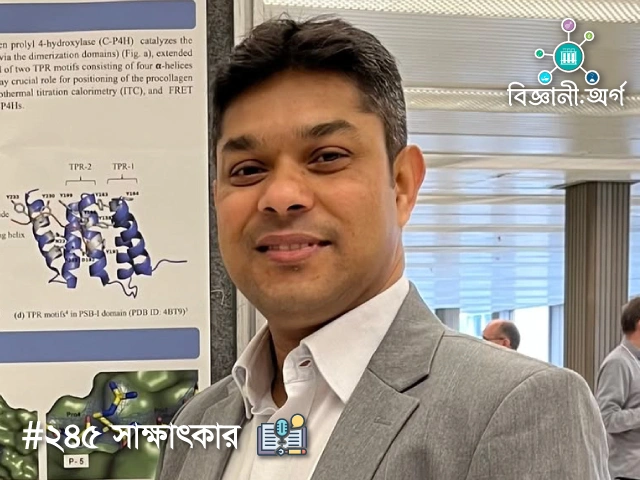
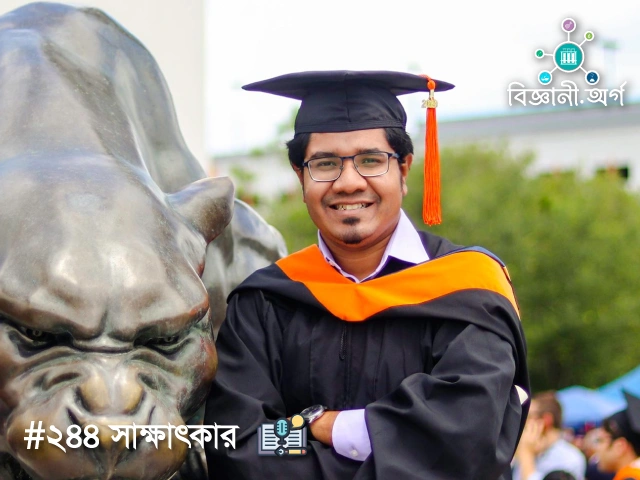
Travel-loving Bengalis often visit the city of Kyoto, Japan, to enjoy the unspoiled beauty of nature. In the peaceful, ancient, and picturesque ambiance of this city, I was having a conversation with an extraordinary person. He is the young researcher and professor, Dr. Mahfuzul Islam, who teaches at Kyoto University. Our conversation wasn’t limited to technology or research—it also touched on philosophy of life and some important thoughts for future generations.
My relationship with Mahfuz is much like that of a younger brother. Those of us who studied in Japan at the undergraduate level on scholarships formed an organization called “Shoshi.” Mahfuz is one of its key members, so we often talk. Around 2017, while visiting Kyoto city for a project, I met him again. One morning, Mahfuz called and said, “Let’s take a tour of Kyoto University.” I happily accepted. The Katsura campus, located a bit away from the main campus at the foothills and beside the Katsura River, was our destination. Mahfuz showed me his lab and other research facilities. I was truly mesmerized by the breathtaking scenery from atop the hills. Such government initiatives for researchers, set far from the city’s hustle and bustle, are indeed praiseworthy. I felt that this peaceful and creative environment is a key reason for the high-quality research at Kyoto University. A glance at the university’s website revealed that nineteen (19) Nobel laureates have come from here.
Freedom in Research & Kyoto’s Philosophy
Dr. Mahfuz began our discussion by highlighting the mantra behind Kyoto University’s success—academic freedom. Comparing it with the University of Tokyo, he said, “The research environment in Tokyo is much more market-oriented. There, the primary focus is on research that can quickly be translated into a product.”
On the other hand, Kyoto is just the opposite. Here, fundamental research is given utmost importance. One can work for years on a topic that sparks curiosity. There’s a profound philosophy behind this—”Ouyou o suru ni wa, kiso o yare”—which means, “If you want to apply something in practice, you must first strengthen its foundation.” This very approach is a major reason why so many Nobel laureates have come from Kyoto University.
The Journey of a Scientist
Dr. Mahfuzul Islam shared his life story. After completing high school in 2001 from Sylhet Cadet College, he got admitted to Bangladesh University of Engineering and Technology (BUET). Later, with a Japanese government scholarship, he went to Japan. There, after learning Japanese, he first enrolled in a College of Technology. He then completed his bachelor’s, master’s, and PhD at Kyoto University.
After finishing his PhD, he started working at the University of Tokyo as a researcher, but drawn by his love for Kyoto, he returned to Kyoto University in 2018, this time as a professor. He has published more than 30 research papers and holds two patents in circuit design—clear evidence of his hard work and talent.
LSI Circuit Design: An Exciting World of Science
His primary field of research is Large Scale Integration (LSI) circuit design. Simply put, he works on how to make the chips inside our computers, smartphones, or any electronic devices—built from millions of tiny transistors—function even more efficiently.
Dr. Mahfuz explains that the smaller the chip, the more transistors can be packed in. However, one major problem is that as transistors get smaller, “noise” or errors can occur in their operation. This noise can slow down the circuit and cause excess heat generation.
To solve this problem, he discovered a clever technique. He developed a method to identify which of the circuit’s transistors are slow. Then, by using a technique called the “body-bias effect,” these slow transistors can be sped up. This method has enhanced circuit performance by 30-50%, a major achievement in his research.
Certainly. I am now rewriting this article to be more accessible and engaging for high school students.
How Did He Become a Professor at Kyoto University?
Becoming a full-time faculty member at Kyoto University was by no means easy. It was a long road of hard work and patience. In Japan, due to government policies, the number of new teaching positions has been decreasing. In such circumstances, getting a permanent post at a world-class institution like Kyoto was almost impossible.
However, Dr. Mahfuzul Islam overcame these challenges through a unique international program. In 2013, Japan’s Ministry of Education launched a fund. Its main purpose was to attract international students to study in Japan. Under this scheme, Kyoto University started offering some first- and second-year courses in engineering, physics, and mathematics in English. As a result, language was no longer a barrier for international students.
Since Dr. Mahfuzul Islam was fluent in both Japanese and English, the university invited him, as an international researcher, to join this project. He said, “Japan’s younger population is shrinking. So, if we don’t attract talented foreign students, how will our universities survive?”
This is how Kyoto University is pushing forward its internationalization efforts, and Dr. Islam has become a vital part of this journey.
The Japanese Philosophy of Life
During his time in Japan, one incident had a deep impact on Dr. Mahfuzul Islam. A sensei (the Japanese word for teacher, used with respect after a teacher’s name) from his college of technology once told him, “Every place has both good and bad water. Your job is to drink only the good water.”
This simple piece of advice changed his outlook on life entirely. Since then, he does not just criticize nor blindly praise anything. His core mantra is—“I will accept what’s good and try to correct what’s bad.”
In Japanese educational institutions, students learn practical and technical skills hands-on right after high school. These institutions play a crucial role in providing skilled human resources for Japan’s technological advancement.
Future Technology & Advice for Students
Dr. Mahfuz believes that the future of computing is not limited to just making transistors smaller. Now, it’s necessary to develop both software and hardware together. He cites the famous scientist Gene Amdahl’s law (Amdahl’s Law). According to this law, even if a tiny part of a program remains sequential, the total speedup is limited by that small part, no matter how many processors you add. So, merely increasing the number of cores or processors isn’t enough—the program itself must be designed to run in parallel.
On Moore’s Law, he says that many once thought it was impossible to make transistors any smaller, but the semiconductor industry has repeatedly proved that assumption wrong by inventing new technologies. He hopes that in the next 15 to 20 years, circuits based on light or magnetic effects will bring about a new technological revolution.
He shared some valuable messages for young students in Bangladesh:
- “If you want applications, focus on the basics.”: If you want to achieve good results in something, first strengthen its foundations.
- Be patient: Patience and focus are crucial to pursue long-term goals.
- Value language skills: Especially for higher education or a career abroad, proficiency in both English and the local language is essential.
- Create your own platform: If you don’t see an opportunity, start something new yourself. One day, it might become a bridge to more opportunities for others.
Advice for Bangladeshi Students
Regarding Bangladeshi students, Dr. Islam noted that the number of Bangladeshi undergraduates in big cities like Kyoto or Tokyo is still low. However, our presence at the master’s and PhD levels is gradually increasing.
He said that a phrase commonly heard across Japan is—“Atama ga ii” (smart-headed). In other words, Japanese people believe Bangladeshis are very talented and hardworking.
But there are some challenges. In particular, the language barrier forces many Bangladeshi families to return home, as their children’s schooling is disrupted if they don’t know Japanese. Given the current economic situation in Japan, he cannot confidently say whether Japan is the best choice for undergraduate studies at this time.
Conclusion
The life and work of Dr. Mahfuzul Islam teaches us that the true power of science lies in curiosity, patience, and interdisciplinary integration. People like him prove that with hard work, curiosity, and a global perspective, a young Bangladeshi can make remarkable contributions to the world of technology. His journey is an inspiration for high school students, giving them the courage to pursue their own dreams.
Update
21 September 2025: Currently, Dr. Mahfuzul Islam is serving as Associate Professor at the Institute of Science Tokyo.
The interview was conducted by Scientist.org editor Dr. Moshiur Rahman.
Dr. Mahfuz’s website is: http://lowpower.iis.u-tokyo.ac.jp/~mahfuzul/
For further information, you can also visit the following sites:
https://www.linkedin.com/in/akmmahfuzulislam/
https://www.researchgate.net/profile/Mahfuzul_Islam3
Technical Terms Explained
1. Transistor: The smallest electronic part of a computer, functioning like a switch. By turning the electric current on or off, it produces digital signals known as ‘0’ and ‘1’. The computer’s brain is formed by billions of transistors working together.
2. Nanometer (nm): An extremely small unit of length. 1 nanometer equals one-billionth of a meter (1/1,000,000,000 of a meter). For example, a human hair is about 80,000 to 100,000 nanometers in diameter.
3. MOS Gate-Oxide: A thin layer in a transistor that acts as an electric control gate. Made of glass-like material, it regulates when current will flow and when it won’t.
4. Noise or Electrical Noise: Unwanted signals or interference in an electronic circuit. Just like the static noise in a radio, similar unwanted electrical fluctuations in tiny circuits are called noise, which can decrease the speed and accuracy of the circuit.
5. Variability: Even if every transistor is made as similarly as possible, small differences lead to variations in speed or current. This inconsistency is called variability.
6. Body-Bias Effect: A special technique that slightly increases or decreases the inner voltage of a transistor, making slow transistors work faster and reducing excess current leakage in others.
7. LSI (Large Scale Integration): The method of packing thousands to millions of transistors together to create complex circuits on a single chip. The main power of a computer chip comes from this LSI technology.
8. Power Density: The measurement of how much electric power is used or produced in a small area. When high, the chip heats up more, increasing cooling costs.
9. Moore’s Law: In 1965, Gordon Moore predicted that the number of transistors on a chip would double approximately every two years, reducing costs. This trend has defined the rapid progress of computer technology for decades.
10. Amdahl’s Law: No matter how many cores or processors are added, if some part of a program must run in sequence (serially), speedup will be limited. It explains that just adding more hardware won’t result in unlimited speed gains.
11. 3D Transistor or Tri-Gate: Instead of conventional flat (planar) transistors, these use a structure where current flows on three sides. This allows better current control and lower power consumption.
12. High-K/Metal Gate: A type of special material used to make transistor gates, which, though extremely thin, reduces current leakage. As a result, even smaller chips waste less power.
13. Edge Computing: Processing data close to the device itself (like sensors or smartphones) so that decisions can be made instantly without sending all the data to the cloud.
14. Cloud Computing: Storing and processing data on powerful remote servers via the internet. This allows big tasks to be performed even without a high-powered processor on your device.
15. IoT (Internet of Things): Connecting everything—from home refrigerators, cars, and watches to industrial machines—to the Internet for data collection and exchange.
16. Analog vs. Digital Signals: Analog signals are continuous waves, like sound waves of the human voice. Digital signals are broken into discrete steps, like the ‘0’ and ‘1’ in computers.
17. Supercomputer: Extremely high-speed, large computers capable of doing billions of calculations simultaneously—used for weather forecasting, space research, or complex scientific simulations.
18. Plug-and-Play Device: Devices that work as soon as they’re connected to a system, requiring no separate installation or configuration.





This comment has been sanitized for the English site.
good article