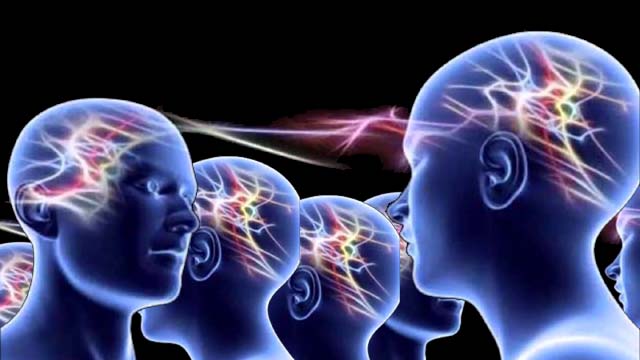
Have you ever felt like yawning just because you saw someone else do it? Even if you don’t have this habit yourself, try talking to people you know—many will have noticed this tendency in themselves. Because I have a bad habit of dozing off in cars, I always try to avoid sitting next to the driver. Have we ever considered scientifically why romantic films or party music videos are so commercially successful, even though viewers don’t get to experience the romance or party themselves? Why is it that, in many cases, seeing someone else cry or feeling another’s sorrow makes us feel sad ourselves? Religious texts often teach us to be compassionate towards other living beings and fellow humans—to feel others’ happiness, to share their sorrow—in short, to experience another’s condition in our own minds. The ability to feel another’s state as our own is known as “empathy,” which exists in varying degrees in all humans but can be further developed. The source of this ability in living beings is the brain, which is made up of countless nerve cells or neurons. Among these are some special types called “empathetic mirror neurons,” or simply “mirror neurons,” which are distributed throughout various regions of the brain.
The Appropriateness of the Name
Studies on macaque monkeys have shown that when a monkey performs a task, or observes another monkey or human doing the same task, certain specific neurons in the monkey’s brain become active in both situations. Needless to say, these neurons are examples of “mirror neurons,” which seem to erase the distinction between doing and observing. Using these neurons, the feelings of one individual are reflected in another. In other words, the activity in a specific part of one person’s brain is “simulated” in the same area of another’s brain, like “virtual reality”—hence the use of the term “mirror.”
The Role of Mirror Neurons in Mutual Understanding Between People
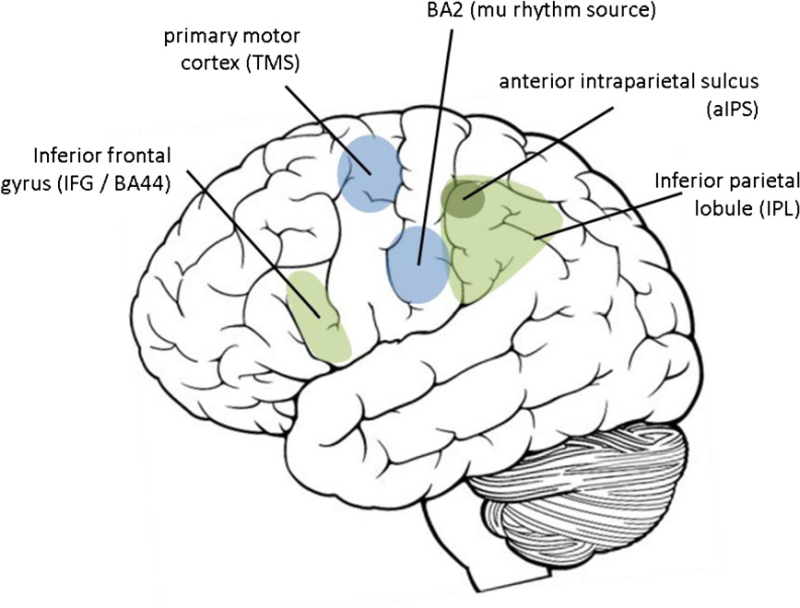
Our movements, gestures, and various emotional facial expressions—all of these are selected and planned by the neurons in the brain’s premotor cortex and inferior parietal cortex, depending on the situation. When we reach for and grab an object, or when we push, pull, or make a particular facial expression, different groups of neurons from these two parts of the brain become active. Each of these groups of neurons excites certain motor neurons, which then trigger a sequence of contractions in various muscles, resulting in our expressions or limb actions.
When we watch someone else perform a task without doing it ourselves, among the aforementioned groups of neurons in the premotor cortex and inferior parietal cortex, only the mirror neurons become active. The mirror neurons in the premotor cortex and inferior parietal cortex help our brain to understand, remember, and compare the ways in which others speak, act, and express emotions.
 Language and Mirror Neurons
The “Broca’s area” in our brain plays a key role in learning and using language. Interestingly, this area also contains some mirror neurons. The mirror neurons in the Broca’s area aid in learning language and may also play a role in the evolution of languages—through the borrowing of words from one language to another during conversations between speakers of different languages.
How Do Mirror Neurons Help Share Joy or Empathy?
They say that sharing sorrow makes it lighter, while sharing joy only increases it. But why is it that both happiness and sorrow can spread among people like a contagious disease?
Scientists at the Netherlands Institute for Neuroscience in Amsterdam first discovered through experiments on rats that not only do mirror neurons enable us to imitate others’ movements and gestures, they also allow us to experience another’s physical pain. Amazingly, the same part of the brain in both rats and humans—the “anterior cingulate cortex”—is activated both when physical pain is experienced directly and when observing another in pain. The mirror neurons in this region become active in both cases, but during direct physical pain, some non-mirror neurons are also involved.
Beyond physical pain, we can share in others’ sorrow or joy thanks to the mirror neurons present in the brain’s insular cortex.
Autism and Psychopathy
Symptoms of autism in humans include motor disorders (where certain involuntary movements of limbs occur beyond the person’s control), difficulties in language or conversation, and inability to understand others’ feelings. In such cases, a lack of mirror neurons, structural problems, or inactivity of mirror neurons is suspected as one of the causes.
Similarly, in psychopaths, problems with mirror neurons in the anterior cingulate cortex mean that even when they see someone in pain, this area of their brain does not become significantly active.
The overall takeaway from the above discussion is that empathetic mirror neurons play an important role behind the social nature of humans.
Diganta Pal
Profession: Information and Technology Professional
Address: Howrah, West Bengal
Subscribe to receive more updates on science and technology.
[mc4wp_form id=”3448″]