Every day, new discoveries emerge in the world of technology and life sciences. Whether it’s identifying new species, understanding the behavior of birds and animals, or observing the environment—these tasks require research. It’s easy to think that scientific research can only be conducted in large laboratories, but a young Bangladeshi, Md. Fahad Husain, has proven otherwise. He has shown that, even with limited resources, one can become a citizen scientist through curiosity, perseverance, and self-education, and that such work can gain international recognition.
Fahad was born and raised in Pabna. He studies at Shaheed Bulbul Government College, which is affiliated with the National University. In the context of Bangladesh, such colleges generally lack quality laboratory facilities and have very limited opportunities for experimental research. But Fahad’s story takes a different turn here. He didn’t give up. Instead, he turned nature itself into his laboratory. He ventured into the field to observe the behavior of birds and fish, collected data, and shared his findings on citizen science platforms. Gradually, he built his own world of research.
His main research areas are species identification and ecological behavior. In the water bodies of Pabna, he scientifically documented the presence of a species known as Mirror Carp. This finding is significant not just locally, but also for international research. Additionally, he conducted a study titled “Feeding Behavior of Garden Birds in Pabna City: A Preliminary Study,” where he observed the dietary habits of urban garden birds. This work shed new light on understanding urban biodiversity, especially in analyzing how birds are adapting to changing city environments.
Importantly, none of Fahad’s work has yet been published in peer-reviewed journals. But he hasn’t been discouraged. Instead, he has openly shared his research on ResearchGate. Remarkably, these studies have been read by researchers at Stanford University (USA), Jahangirnagar University, and the University of Dhaka. This means that an independent researcher without access to advanced laboratories can still attract the attention of the global research community. If you search Google for “Species Documentation of Mirror Carp” or “Feeding Behavior of Garden Birds in Pabna City,” Fahad’s work appears right at the top. This proves that becoming a scientist does not always require a foreign degree or a fully equipped laboratory—what truly matters is unyielding curiosity and a creative outlook.
Initially, Fahad’s work was more theoretical or documentation-based. But over time, he has become skilled at gathering and analyzing observational data. In his own words, “It’s partly true that modern laboratories are necessary for research. But nature itself is our greatest laboratory.” This perspective is what sets him apart.
What qualities are most essential for an independent researcher? Fahad believes that curiosity is the greatest strength. An insatiable desire to learn is the driving force behind research. Patience is equally important, as perseverance is necessary to succeed despite any limitations. Critical analytical skills—the ability to deeply analyze observations—have propelled him forward. Additionally, communication skills with the scientific community and integrity—a strong sense of ethics in data and research—have taken his work to another level.
Fahad’s message to the youth of Bangladesh is clear—Citizen Science is a platform where you can make scientific contributions even with limited resources. A lack of academic facilities should not stop anyone from pursuing research if they have curiosity and perseverance. Speaking to young people, he says, “Science isn’t limited to the pages of a book. It’s a path of exploration, discovery, and problem-solving. Anyone can become a researcher—if they possess curiosity and perseverance within.”
Fahad’s story carries an important lesson for our country. Research infrastructure at the university level in Bangladesh is still not strong enough. Yet, there is immense research potential hidden all around us—in nature, water bodies, rural and urban environments. Fahad has shown that even a little initiative can yield scientific contributions that attract the attention of world-class researchers.
Md. Fahad Husain has proven that research is not confined to institutional boundaries. It is a journey—one where nature, curiosity, and perseverance walk hand in hand. His success story is an inspiration for the youth of Bangladesh who dream of becoming scientists, but may be discouraged by a lack of opportunities. Fahad reminds us—a true scientist is not just someone who makes discoveries, but also one who spreads the light of discovery even amidst limitations.
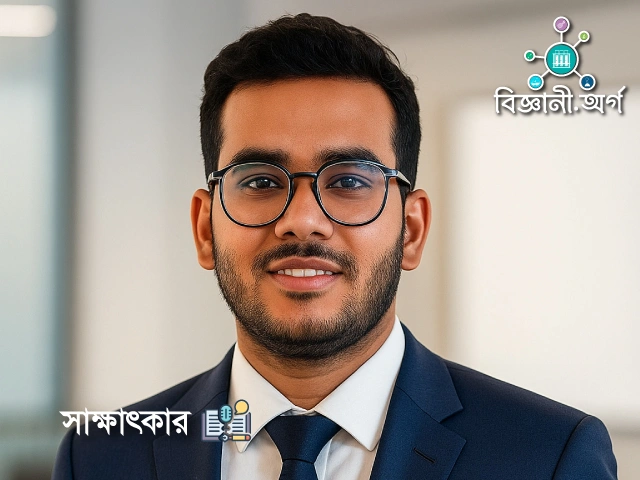
Md. Fahad Husain
Student, Department of Zoology
Shaheed Bulbul Government College, Pabna.
(Affiliated with National University, Bangladesh)