


Dedicated to: Inventor Sir Jagadish Chandra Bose – whose touch blessed the world!
Collected from Prothom Alo
Agriculture
Farmer Scientists of Bangladesh
Recently, I was invited to a modest event held by the farmers of Sadhupara village in Fulbaria Upazila, Mymensingh. The president’s speech at the event was delivered by farmer Abul Kashem Rizvi. He is certainly not under seventy. Whenever I visit the farmers’ fields, I am amazed by their skills, scientific mindset, and words. My heart fills with pride.
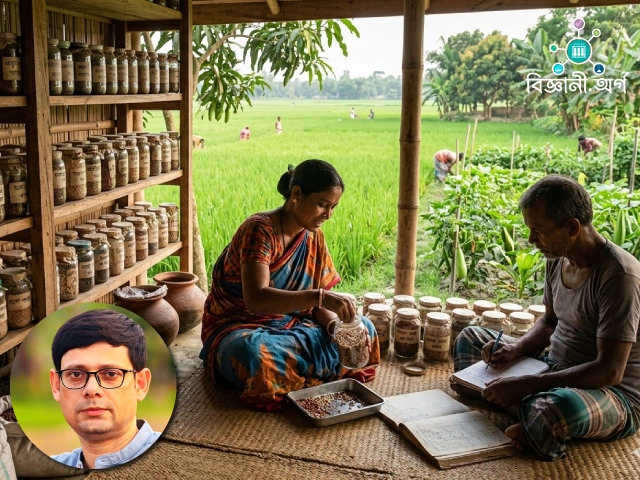
Every day, I talk to farmers from different parts of the country by mobile phone. For the past four years, the farmer I have spoken to almost daily is Humayun Kabir from Sadhupara village in Fulbaria Upazila, Mymensingh. He is in his forties. Whenever he sees any sign of hardship or distress among farmers, he calls me. He shares updates about the farmers’ situation in the local dialect. However busy I am, I am fascinated by Humayun Kabir’s words. How does a farmer, while managing his own cultivation, so carefully analyze the problems of thousands of other farmers? He pays close attention to agricultural news on TV or in newspapers, can spot exaggerated reports, and knows which issues require deeper attention. On my countless trips to Mymensingh and Netrokona, I’ve met Humayun Kabir in person several times. Yet, when we meet face-to-face, he prefers to stay in the background—speaking over the phone seems to be his comfort zone. For quite some time, Humayun has been urging me to visit Fulbaria to witness a new success story. The farmers are conserving and exchanging local varieties of seeds. They have even formed a farmers’ organization called Sadhupara Krishak Oikko (Sadhupara Farmers’ Unity). There are 42 members. Recently, I visited Shyamnagar, Satkhira, where I interviewed farmer Sirajul Islam and other members of the Haibatpur IPM Irrigation and Environment Association. I also made a program featuring them. They have generated immense local buzz by collecting, preserving, and multiplying many extinct indigenous rice varieties. Notably, they have managed to conserve 14 salt-tolerant old local varieties of rice, which are even more salt-resistant than those bred by the Bangladesh Rice Research Institute. I am truly impressed by their thinking and the methods they use to collect seeds. This time, prompted by Humayun, I went to Fulbaria. By the farmers’ field was a black signboard with shaky handwriting: ‘Farmer-managed variety research, 25 varieties, Season: Aman’, ‘Sadhupara Krishak Oikko, Mymensingh.’ Have farmers now reached a level where they can conduct institutional research on their own? The answer is yes. I gathered the farmers in the field and spoke with them one by one. Listening to Abdul Hakim, Abdul Jabbar, Md. Shahidullah, Abdul Wadud Khan, and Humayun Kabir and witnessing their scientific spirit once again left me in awe. How deep are the farmers’ thoughts? It’s as if science itself has landed in their hands driven by necessity. This Aman season, they have cultivated 25 nearly extinct indigenous varieties in divided field plots. Among these are Chinishail, Tulshimala, Kalajira, Binny, Abdul Hai, Dhekimala, Bashful, and many more. All the names are right on the tip of the farmers’ tongues. Since transplanting the seedlings into the research plots, they have observed every detail: after transplanting three clumps, how many panicles develop per plant, what is the height, when exactly does booting occur, how long until milky stage in the boot, how many days to full ripeness, how many grains per panicle—they are not just observing but also documenting the comparative data between high-yielding and indigenous varieties. Through this research, they have become strong advocates of cultivating local varieties alongside high-yielding ones. Their logic is simple: while cultivation costs for high-yielding varieties are higher due to fertilizers and pesticides, indigenous varieties, though they yield less, cost much less to produce and thus are more profitable overall. They emphasize the importance of restoring soil health. Ever since high-yielding varieties added a new dimension to food security for both farmers and the nation, the soil has been saturated with chemical fertilizers and pesticides. It’s like you have to give something to get something. But with continued overuse of fertilizers and pesticides, we ourselves have depleted the soil’s strength. These farmers are well aware of this arithmetic. They wish to reduce production costs and, at the same time, restore soil fertility. I thought the event would end there. But later, on the veranda of farmer Abdul Hakim’s house, I saw three separate rice plants in soil-filled tubs, each tied to a tall stick, the panicles covered with plastic bags. It was immediately clear—this was an attempt at breeding. Work typically done by scientists, and at a highly advanced stage of modern agricultural science. I recalled the sights at the International Rice Research Institute in Los Banos, Philippines, and the Bangladesh Rice Research Institute, where I have seen institutional rice research. The farmers are following the same procedures to develop new rice varieties. They have already tasted a measure of success in hybridizing local and high-yielding varieties. They have crossed local varieties with BR11, BR32, and BR41 during the Aman season. Farmer Abdul Hakim has not received much formal education, but he is thoroughly acquainted with all the steps from F1, F2 up to F7 in developing new rice varieties. Just like the rice scientists, they explained the processes perfectly. For them, gene transfer, testing gene resilience and tolerance, and selecting a variety’s attributes are now as clear as water. They have already made significant progress toward developing several varieties. When I asked farmer Hakim Ali where he learned these things, he mentioned another farmer, Saeed Ahmed Khan Bacchu, who lives in Atpara, Netrokona. He was also present. Bacchu’s formal schooling went only up to the seventh or eighth grade, but his knowledge is remarkable. Through the non-governmental organization Caritas, he once went to the Philippines. There, IRRI scientists taught farmers from various countries the basic rules of rice variety selection and innovation. Now, these processes are as easy as water for our farmers. They have adopted science as a simple medium, as a vital technique for life that they can easily apply. Many, like Abdul Hakim, have learned about artificial hybridization and the functions of seeds’ internal components from Bacchu. Things that even years of academic study can’t master are now literally at the farmers’ fingertips. He said they have already completed work on F1 and F2 lines to develop new varieties. At this pace, within the next two to two and a half years, they will be able to achieve unprecedented success in rice variety development. He also mentioned that women in Atpara are even more meticulous in the breeding tasks. Already, numerous women from Atpara, Netrokona, are engaged in developing new varieties by crossing genes of local varieties with high-yielding ones.
There are no words enough to thank science, but all accolades go to those scientists who are wise in the ways of the soil, for they have mastered so much of formal science. If they are allowed to keep working in their own way, there is no doubt that it will open the door to great potential in the future.
Shaikh Siraj: Agricultural development and media personality; Director and Head of News, Channel i.
[email protected]
There are no words enough to thank science, but all accolades go to those scientists who are wise in the ways of the soil, for they have mastered so much of formal science. If they are allowed to keep working in their own way, there is no doubt that it will open the door to great potential in the future.
Shaikh Siraj: Agricultural development and media personality; Director and Head of News, Channel i.
[email protected]
Collected from Prothom Alo
Source: Prothom Alo: http://www.prothom-alo.com/detail/date/2010-11-13/news/108762
2010 November 13. Added from Canada :: 2010 November 13.
You may also enjoy BBC's featured interview link:
Pioneer of innovative agricultural programming
Courtesy of BBC Bangla :: 2010 October 27.
Added from Canada :: 2010 November 16.
Shafiul Islam
Email: [email protected] :: Website: textek.weebly.com :: Canada :: www.linkedin.com/in/shafiul2009




Thanks a lot to add this article.
Necessity knows no law proves once again.
This comment has been sanitized for the English site.
This comment has been sanitized for the English site.
This comment has been sanitized for the English site.