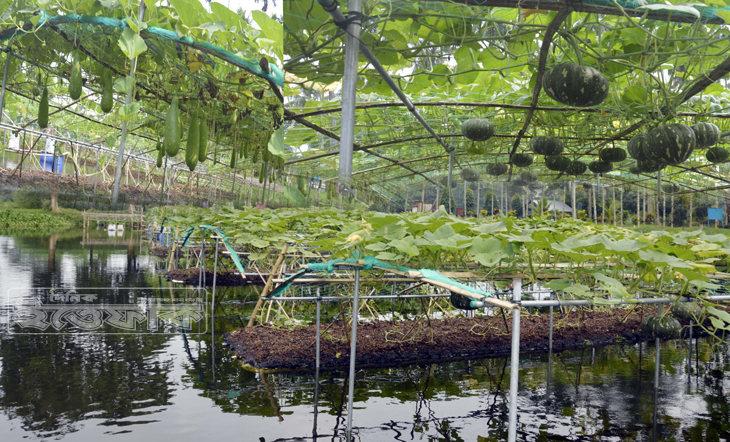
Bangladesh is an agriculture-based country, but as most of the land is low-lying, it remains submerged during the monsoon due to waterlogging. In the haor regions of the north, the land remains flooded even during the dry season. As a result, the production of cereal crops and vegetables is hampered. This leads to vegetable shortages in some parts of agricultural Bangladesh during the monsoon. Considering this, agricultural scientists in Bangladesh began research. In one such study, scientists from the Rahmatpur Regional Agricultural Research Center in Babuganj, Barisal, have achieved remarkable success.
At the Rahmatpur Regional Agricultural Research Center in Babuganj, Barisal, agricultural researchers have achieved impressive results by cultivating various types of vegetables using the floating method on an experimental basis. Although vegetable cultivation started experimentally with this method, the Rahmatpur Regional Research Center now sees great potential if it is adopted commercially.
Dr. Md. Alimur Rahman, the chief researcher of the floating agriculture research program, said that scientists at this center started cultivating vegetables using this method in 2014. Already, promising yields have been obtained from creeper-type vegetables such as cucumber, bottle gourd, sweet pumpkin, ash gourd, snake gourd, yardlong bean, and bitter gourd cultivated using the “floating bed and trellis method” in the research field. However, the yield of hybrid vegetables on floating beds is much higher than that of local varieties.
Dr. Md. Abdul Ohab, Principal Scientific Officer at the Rahmatpur Regional Agricultural Research Center, said that due to the construction of houses, roads, and factories, arable land is decreasing every year. In the past three decades, about 3 million hectares of agricultural land have been lost, and this trend is continuing. Alongside ensuring food security, vegetables also face intense competition to survive. As agricultural land diminishes, successful vegetable cultivation through alternative methods is possible.
According to Bangladesh Agricultural Research Council (BARC) data, the country has approximately 3 million hectares of medium-low to very low land, making up about 21 percent of total land area. Climate change, excessive monsoon rainfall, and sudden coastal floods cause vast areas across the country to remain inundated. The southern and haor regions are most affected.
Through research, the development and expansion of modern and appropriate floating agricultural technology can bring submerged or fallow land under cultivation. This will increase overall crop production, playing a vital role in ensuring food and nutritional security for the poor population of waterlogged areas amid changing climatic conditions.
News & Picture Source: http://www.ittefaq.com.bd/wholecountry/2017/08/19/124481.html
Subscribe to get more new updates on science and technology.
[mc4wp_form id=”3448″]