


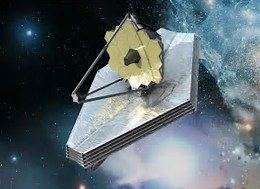
It is possible to observe space with ordinary telescopes from Earth. However, the main problem with such telescopes is that the images of space they provide are somewhat blurry. This is because Earth’s atmosphere lies between the telescope and space. For this very reason, on April 24, 1990, the 2.4-meter-long Hubble Telescope was placed in outer space, 600 kilometers above the Earth’s surface, beyond the atmosphere. Initially, the images obtained with this telescope were also somewhat blurry. As a result, after it was serviced in December 1993, even galaxies several billion light-years away became clear through the telescope. Named after American astronomer Edwin Hubble, the installation of this telescope marked a new era in space research. However, scientists are now waiting to enter yet another new era. That’s because NASA researchers have already constructed the James Webb Space Telescope, abbreviated as ‘JWST’, named after NASA’s founding administrator James Webb. This telescope, which cost four and a half billion dollars to build, is 24 meters long and 12 meters high and is planned to be stationed 1.5 million kilometers from Earth. If all goes well, the Hubble Telescope, known as the ‘window to the universe’, will be retired in June 2013 and the age of the James Webb Space Telescope will begin.
This new space telescope is being built by NASA, the European Space Agency (ESA), and the Canadian Space Agency (CSA). Initially, it was called the Next Generation Space Telescope. Later, on September 10, 2002, it was named the James Webb Space Telescope in honor of former NASA administrator James Webb. Notably, James Webb served as NASA administrator during the Apollo missions.


Image | JWST (from the internet)
This project is managed by NASA’s Goddard Space Flight Center. More than a thousand scientists and engineers from about seventeen countries are working on this project. Northrop Grumman Space Technologies is working as NASA’s commercial partner in building the telescope. After the telescope is deployed in space, the Space Telescope Science Institute will be responsible for its operations and maintenance. The primary mirror of the James Webb Space Telescope will be much larger than that of the Hubble Telescope. The huge primary mirror, composed of eighteen small hexagonal mirrors each 51 inches wide, is made from beryllium to reduce weight. The main reason for choosing beryllium, a light gray and brittle metal, is that it rarely tarnishes when exposed to air. When mixed with a slight amount of alloy, it becomes heat and corrosion resistant. Additionally, because of its low weight, beryllium is also used in various supersonic aircraft components. However, as the metal is toxic, special precautions must be taken when working with beryllium. To control light entry, the telescope features 62,415 holes, similar to a camera shutter. Each hole measures 100 × 200 microns. As a result, it will be easy to capture clear images of electromagnetic spectra.
To shield it from the intense heat of the Sun, a special kind of cover has been added. This cover, coated with aluminum and silicon, is about the size of five tennis courts.
A key component of this telescope is the Integrated Science Instrument Module, or ISIM. This module houses the essential scientific instruments for space research. Four types of instruments will be included in this module:
1. Mid-Infrared Instrument (MIRI): Jointly built by the European Space Agency (ESA) and NASA’s Jet Propulsion Laboratory (JPL)
2. Near-Infrared Camera (NIRCam): This part of the telescope is built by the University of Arizona.
3. Near-Infrared Spectrograph (NIRSpec): The European Space Agency (ESA) is playing the main role in building this instrument.
4. Fine Guidance Sensor (FGS): This part of the telescope is made by the Canadian Space Agency (CSA). It includes a filter camera that can be tuned as needed.
To properly control these instruments, researchers at Goddard Space Flight Center are developing temperature controls, data management, navigation controls, power generation, and all necessary control systems.
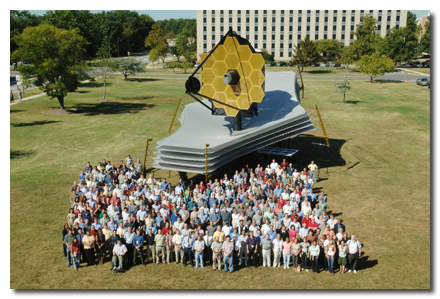
Image | JWST team (from the internet)
The Hubble Telescope orbits Earth from roughly 600 kilometers away. In contrast, the James Webb Space Telescope will orbit the Earth from about 1.5 million kilometers away! This point, situated 1.5 million kilometers from Earth, is known as the second Lagrange point (or L2 point). Researchers have found that this spot is the most suitable place for observing space from Earth. It will take nearly three months to position the telescope into its orbit. However, unlike the Hubble Telescope, it will not be possible to repair the James Webb Space Telescope in the same way. The main reason is its great distance from Earth. Even if repairs were possible, researchers say it would not be economically feasible.








Leave a comment