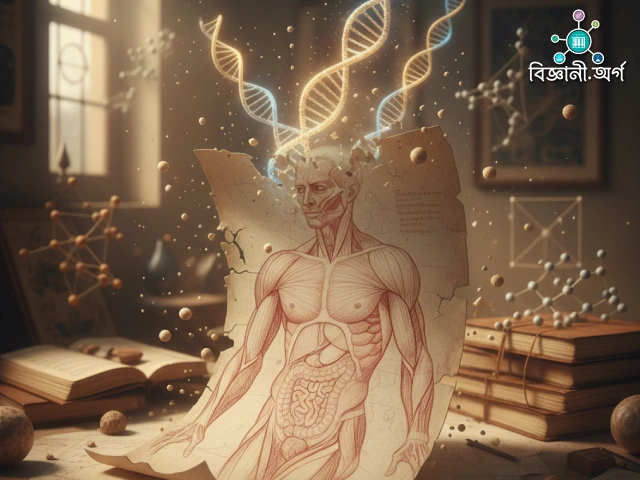
Born five centuries ago, the hand behind Mona Lisa, The Last Supper, countless scientific sketches and notebooks—could any biological trace of Leonardo da Vinci remain in his artwork even today? While it sounds like a fairy tale, modern genetic science says—possibly yes. According to recent research and reports in international media, extremely minute traces of DNA linked to Leonardo have been identified on certain Renaissance-era artworks and letters associated with him.
This research is part of a long-term initiative called the Leonardo da Vinci DNA Project. The goal is simple—to search for the biological fingerprints of history’s most enigmatic genius.
This emerging field of research is called “Arteomics”—where artwork is seen not just as creations of color and line, but as a “molecular archive” or biological document. In other words, a painting might contain not only the artist’s creative vision but also invisible biological traces from their body.
What Have They Actually Found?
Researchers claim that from a red-chalk sketch, Holy Child, associated with Leonardo, and from some historic family letters, they have identified Y-chromosome DNA sequences. This DNA belongs to a particular haplogroup—E1b1b—which is relatively common in Italy’s Tuscany region. Notably, Leonardo was born in Tuscany.
The samples have been collected with extreme care, using a non-invasive swabbing method—ensuring that the artwork remains unharmed. Microscopic particles are collected by gently touching the surface with cotton or special fibers, and then they are analyzed with advanced genetic technology.
The research is being led by microbiologist Norberto Gonzalez-Huarbe and his international team. They emphasize that this is not definitive proof, but it is an important step forward.
So Can We Say For Certain—This Is Leonardo’s DNA?
This is where scientists are being very cautious. Because there is currently no confirmed DNA reference for Leonardo da Vinci. He had no direct descendants, and his burial site in France was disturbed centuries ago. As a result, there is no reliable “gold standard” DNA sample to compare to.
Additionally, over the past 500 years, these artworks have been touched by countless people—collectors, curators, conservators, researchers, even tourists. So, the DNA found could very well belong to someone else.
This is why researchers are saying—it’s not “Leonardo’s DNA,” but DNA that is “compatible with Leonardo.”
This distinction is extremely important.
Why Is DNA in Artwork Important?
The answer to this question lies in future possibilities. If an artist’s biological trace can truly be reliably detected in their artwork, then—
- It will be easier to verify the authenticity of disputed artworks
- Fake art can be scientifically detected
- Insights could be gained into the artist’s working life, habits, or even health
In a sense, the age of DNA-based evidence might begin in art history.
This is the revolutionary edge of arteomics.
“Leonardo’s Genius Was in His Genes”—How True Is This Claim?
Some popular reports have claimed that Leonardo carried special features in his genes that helped him analyze visuals faster than ordinary people—able to perceive movement at “almost 100 frames per second”!
It must be stated clearly—these claims are entirely speculative and not scientifically proven.
Current genetics has not identified any specific “gene of genius” that could explain the kind of multidimensional talent Leonardo possessed. Human creativity and intelligence are shaped by many genes, environment, education, curiosity, and experience combined.
In Leonardo’s case, his extraordinary powers of observation, unceasing curiosity, deep attention to nature, and multi-disciplinary practice were his real strengths.
Science vs. Romanticism
One major risk in such research is that we may end up turning science into romantic stories. “The secret to Leonardo’s genius was hidden in his genes”—though lines like this are captivating, they remain scientific fantasy for now.
Here, science proceeds slowly and carefully. Every sample, every sequence, every interpretation is checked at multiple levels.
That is the beauty of science.
So Where Do We Stand Now?
Based on current information, we can say—
Ancient DNA has been found on artworks associated with Leonardo da Vinci—that is true.
This DNA could be his—that is possible.
This DNA is definitely his—that has not been proven yet.
This research is ongoing and still at a relatively early stage. If in future, strong matches are found by analyzing the DNA of his family line, then things could move to a new dimension.
Final Words
Leonardo da Vinci was not just an artist—he was an explorer of nature, mapmaker of the human body, engineer, philosopher, and visionary. If, indeed, molecules from his body are hidden in his art today, then it reminds us—humans leave their mark on history not just in thought, but in the body itself.
This research teaches us that science and art are not rivals—but rather, they complement each other.
Just as beauty can be hidden within a line, so too can a molecule.
And perhaps those very molecules will one day help us rewrite our history.