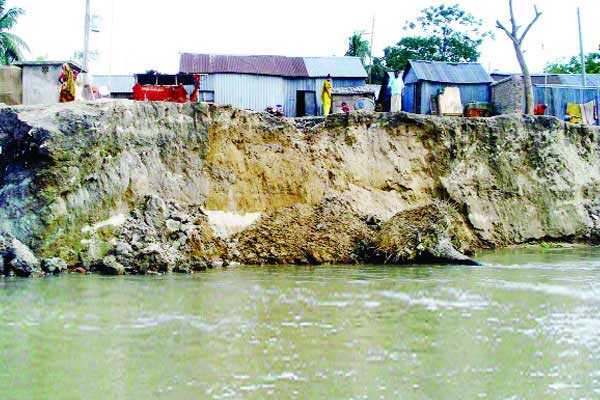
Afal in the Haor Region
Recently, following the devastating floods in the haor area, the phenomenon known as Afal has begun. As a result of Afal (meaning nor’wester or regular storms), large waves—locally called Tafaling or Afaling—are formed in the waters of the haor, and these waves are now eroding the homesteads of villages. Generally, this happens every year, making it even worse for the people already devastated by floods. In the eastern region of Bangladesh—namely the former greater Mymensingh and Sylhet districts—a vast area contains a unique freshwater wetland called Haor. During a recent visit to the haor areas, I directly witnessed the soil erosion and riverbank erosion suffered by many villages, and, based on that, I present my analytical opinion and engineering solution for preventing this soil erosion and its consequences.
Haor is a remarkable and unique wetland in Bangladesh. No other region in the country shares its environmental and ecological characteristics, making the haor truly exceptional. The haor is a continuous source of freshwater fish and, at the same time, a vast rice-producing granary. The haor not only gives, but it also takes away. During the peak monsoon, the main water bodies and paddy fields of the haor become submerged, turning the area into a vast, wave-filled water reservoir. This immense expanse of water not only floats away crops, but also demolishes houses and washes away the homestead soil completely. Every year, the floodwaters subject the residents of the haor to endless suffering.
The villages and settlements of the haor region are generally built on naturally elevated land. During the peak monsoon, when the haors are filled to the brim, the villages appear like floating islands of trees and bushes. At this time, the soil of the home-yards and homestead lands falls prey to erosion and is washed away. In some places, agricultural lands are also affected by soil erosion. To prevent this soil erosion, one must first understand the reasons behind the erosion and its mechanism or process. Only by knowing these can effective measures be taken to stop the soil loss in the haor areas.
There are generally two main forces responsible for soil erosion in the haor: waves and current. In some places, these two forces act together, while in others, they operate separately. The immense body of water in the haor constantly creates waves, which in turn relentlessly strike the elevated land or homesteads. During each impact, the soil endures intense pressure and becomes compacted. However, as soon as the wave recedes, the pressure drops to zero. According to Newton’s third law, the compacted soil reacts equally and oppositely; without opposing pressure, the soil loosens. This process is repeated, and eventually the soil breaks apart. Afterwards, as the next wave strikes and retreats, it carries away the loosened soil. At such times, the prevailing current helps to sweep away and transport the eroded soil far from the original site. During the Afal phenomenon, this process occurs very quickly in the haor region.
Many rivers and canals run through the haor region to convey its waters. In the peak monsoon, massive volumes of water flow through these rivers and canals, creating strong currents. As a result, lands and villages located along riverbanks and canal banks experience erosion. When the intense current hits the lower part of the bank, soft soil breaks away and is washed away by the flow. If this process continues unchecked, the bank loses its stability. As the base of the bank is eroded, the ‘angle of repose’ of the soil changes. At this point, the passive earth pressure equilibrium is lost, causing further collapse. Simply put, erosion at the base of the bank causes instability, and the entire bank eventually collapses, taking with it any houses and homestead lands located there. This process repeats in the haor every year, perpetuating the suffering of the local people year after year.
Many of us have seen or are aware of various river or water control methods described in textbooks and used by the Bangladesh Water Development Board. These include sandbag placement, using boulders, concrete block installation, filling wire mesh cages with stones, placing slabs for slope control, and more recently, expensive geotextile blocks. I do not advocate the use of any of these methods for the haor region because they do not offer permanent solutions. While these methods may work in emergencies, they are not sustainable in the long term. I support approaches that will provide durable, long-lasting outcomes in the haor. If a method needs to be applied every year, or repairs are required annually due to new damage, it may not always be possible to get the required budget. Moreover, future administrations may not prioritize haor development as highly. That is why my preference is for solutions that, once implemented, will remain effective for a long time.
My preferred solution for preventing soil erosion and land loss in the haor is the construction of retaining walls. The use of buttressed, cantilever, or piling types of retaining walls should be considered. For villages located on riverbanks, piling retaining walls might be the best option, while for other villages, buttress or cantilever retaining walls can be used. Why should retaining walls be constructed to prevent village erosion in the haor? Because retaining walls will hold the homestead soil in place, causing incoming waves to strike the wall and rebound. A piling retaining wall, built deep into the soil below the river’s scouring level, will prevent the current from reaching and eroding the land. Thus, the village will be protected and remain intact.
I have specific suggestions and guidelines for the construction and application of retaining walls. Every village, along with nearby fallow land, should be surrounded by a retaining wall. Afterwards, controlled dredging should be done from adjacent rivers to collect silt, clay, and sand and fill the area up to a specific height. This will transform the entire village into a secure and elevated habitat. People will no longer need boats to travel from one house to another within the village. Only traveling between villages encircled by retaining walls will require a boat. By filling up land that remains submerged during the monsoon, extra space can be gained, which can be used for schools, markets, playgrounds, health centers, official housing, mosques, cemeteries, and similar purposes. This system offers numerous benefits. There will be no need to cut and raise homestead land every year, and proper sanitation can be provided. Consequently, water pollution due to open latrines will be eliminated, safe drinking water will be made available, and there will be opportunities for small businesses or cottage industries to flourish.
Before constructing a retaining wall, a proper engineering design is essential. Factors such as earth pressure, surcharge load, drainage arrangements for rainwater, weep holes and filter drains for removing percolated or seepage water, soil consolidation or settlement, and durability must be considered during the design phase. When filling with dredged material, existing ponds used for bathing, household purposes, and natural reservoirs needed for rainwater drainage within the village should be preserved and excluded from filling. The local residents can assist by providing necessary information in this regard. Retaining walls should be constructed to last 100 or even 200 years. To ensure this, high-grade concrete must be used. During the dry season, gentle ramps should be provided all around the village for access, agricultural machinery, and vehicles. In the monsoon, there should be stairs for boat anchoring and convenient boat movement around the secured village.
Building retaining walls to prevent erosion is not a new technique. Such walls are used in many countries around the world. However, applying this method in the haor is innovative, effective, durable, and appropriate for the specific location. While there may be concerns regarding costs, if the administration or government wishes, the villages can be divided into phases and the process of building retaining walls can be completed within ten years, protecting them from erosion. If these long-neglected people can enjoy a little extra benefit and live free from the yearly anxiety of losing their homes, it will be a blessing for the country itself. Free from worry, they will be able to dedicate themselves to the nation’s advancement. This should be the collective aspiration. I am hopeful the administration, government, and wider society will come forward on this issue.
Dr. Md. Anwar Hossain
Author: Agricultural and Environmental Engineering Specialist
Professor, Bangladesh Agricultural University, Mymensingh
Source:
http://bonikbarta.net/bangla/news/2017-08-29/129434/preventing-soil-erosion-and-land-restoration-in-the-haor-region-due-to-afal/
Picture Source: Taken from Google.
Subscribe to get more news on science and technology.
[mc4wp_form id=”3448″]