


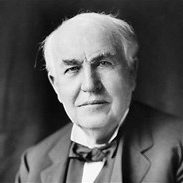
[1847–1931]
Perhaps we have all heard of a man who was known for experimenting with and researching many things around him. Once, with the intention of hatching eggs like a chicken, he arranged some eggs in a corner of his room and sat there, hoping to see chicks hatch. That man was none other than the famous scientist Thomas Alva Edison. After his death, a New York newspaper wrote about him: “In the history of mankind, Edison’s brain was the most valuable. Such creative power has never been seen in another person.”
Some of his major contributions:
1. Invented a device for measuring voltage
2. Invented the duplex telegraph system
3. Invented the dynamo and generator for electric power supply systems
4. Invented the kinetograph, the first camera for recording motion pictures
Thomas Alva Edison was born on February 11, 1847, in Milan, Canada. His father was of Dutch descent. At that time, his family was financially comfortable, so Edison’s childhood days were pleasant. When Edison was seven, his father moved to a new town called Port Huron in Michigan and started life anew. Edison was enrolled in school. He was incredibly intelligent, but he found the structured classroom learning dull and monotonous. He lacked interest in studies, which upset his teachers. Therefore, his parents pulled him out of school. And so ended Edison’s three-month school life—he never returned. From then on, his mother became his teacher.
Since childhood, Edison experimented with everything he found in his surroundings, especially with objects used in daily life. He once arranged eggs in a room to see if he could hatch chicks like a chicken. A few years later, he built a small laboratory at home for his experiments. Soon, he bought the necessary tools and equipment for hands-on experiments. Around this time, his father’s financial situation worsened, so Edison decided to earn his own money by working.
A thirteen-year-old working! Both his parents were truly astonished. But Edison was determined to get a job. With little choice, his parents agreed. After much searching, Edison found work selling newspapers. To increase his earnings, he also sold chocolates and nuts alongside the papers. Within a few months, he had saved some money.
During this time, Edison learned that a small printing press was being sold at a low price. Using his savings, he bought the printing equipment and started publishing his own newspaper. He collected the news, edited, printed, and sold the paper—all by himself. Soon, the number of copies sold increased drastically, bringing him a profit of one hundred dollars. He was only fifteen at the time.
One day, Edison noticed a boy playing on the railway tracks. A wagon was approaching from a distance, but the boy was unaware. Realizing the imminent danger, Edison dropped his papers and leaped onto the tracks, rescuing the boy. The boy happened to be the only son of the station master. The grateful station master wanted to reward Edison, so Edison asked if he could learn telegraphy. The station master agreed gladly. Within a few months, Edison became proficient in telegraphy, as well as understanding and interpreting Morse code.
Edison was extremely hardworking. Once, at Stafford Junction, he got a night job signaling the departure of trains. He stayed up all night for this job, and during the day, he managed to snatch brief periods of sleep while pursuing his research. During this time, he invented a clock that could automatically give signals at specified times. Later, while working in Boston, he noticed the office was overrun with rats. Suddenly, he invented a machine that could easily exterminate rats.
In 1869, while working in Boston, Edison invented a device that could measure voltage. Recognizing the quality of the device, he was awarded a patent as its inventor. This patent marked the beginning of a new chapter in Edison’s life. After this, he moved from Boston to New York. He had no money at all and had not eaten for two days. There, he met a telegraph operator who lent him a dollar and arranged for him to stay in the Gold Indicator Company’s battery room. After two days, on the third day, Edison noticed that the transmitter was broken. With the manager’s permission, he quickly repaired it. As a result, he was given a job as the factory foreman, earning a salary of $300. Soon, by virtue of his abilities, he was promoted to the position of manager.
Edison used this money to buy the equipment he needed for research. The Gold Indicator Company made a type of device for telegraphy that printed messages on a tape. At that time, Edison thought it might be possible to make a better device than the one currently used. This required continual experimentation. So he resigned from his job. After months of intense labor, he invented a new machine, which was not only much improved over the previous version but also cheaper to produce. He took this device to the owner of the Gold Indicator Company, who was delighted. When the owner asked Edison at what price he would sell it, Edison, somewhat nervously, said, “If five thousand dollars is too much and three thousand dollars is too little, let the company decide what it’s worth.” The owner handed Edison forty thousand dollars and said, “I hope we have satisfied you now.” Edison was stunned!
This large sum dramatically changed Edison’s life. Until then, he had always worked under others, without any personal freedom. Now, after a few months of effort, he established his own factory in New Jersey. There, he worked day and night, resting only a few hours each night. This factory was essentially a research laboratory. Within a few years, Edison had patented more than one hundred new inventions, earning a great deal of money from their sale.
While working at his own factory, Edison was again drawn to telegraphy. Soon, he developed the duplex telegraph system, which allowed two messages to be sent simultaneously in opposite directions through the same wire. Later, he managed to send multiple messages at the same time through a single wire. Not only did this greatly improve the telegraph system, it also reduced costs several times over.
In 1876, he established his new factory at Menlo Park. Here, one side was his research laboratory, while the other was a factory. The first major invention Edison made at Menlo Park was the modernization of the telephone system. Alexander Graham Bell had invented the telephone, but it had many practical problems. After months of effort, Edison invented the carbon transmitter, which allowed every word spoken by customers to be heard loud and clear. Edison’s reputation spread everywhere.
For many years, Edison worked on devices to assist people with hearing loss. Then he decided to use electric current to produce light. At that time, electric lighting existed, but it was not suitable for widespread use. First, he searched for a metal that, when a current passed through it, would emit a bright light. He conducted 1,600 experiments with different metals. At long last, after considerable effort, he invented the carbon filament.
His investigations were not limited to just the light bulb. He recognized the need to improve the entire power supply system, so he created a new type of dynamo, generators for electricity supply, and lamps. The first power station in New York was established under Edison’s leadership.
Edison then left his famous Menlo Park lab and moved to West Orange. This was in 1847. At this time, he began wide-ranging research on how to bring motion to pictures, just as there is motion in sound. In just two years, he invented the ‘kinetograph,’ the first camera for capturing moving images. In 1922, Edison invented the kinetophone, which connected to the cinema camera—thus, the era of sound films was born.
This tireless scientist finally passed away on October 18, 1931. After his death, a New York newspaper printed: “In the history of mankind, Edison’s brain was the most valuable.” Such creative power has never been seen in another person.









Genius is 1% inspiration and 99% perspiration. ~ Thomas Edison.
Thomas Alva Edison was born on February 11, 1847 in Milan, Ohio, U.S.
This comment has been sanitized for the English site.