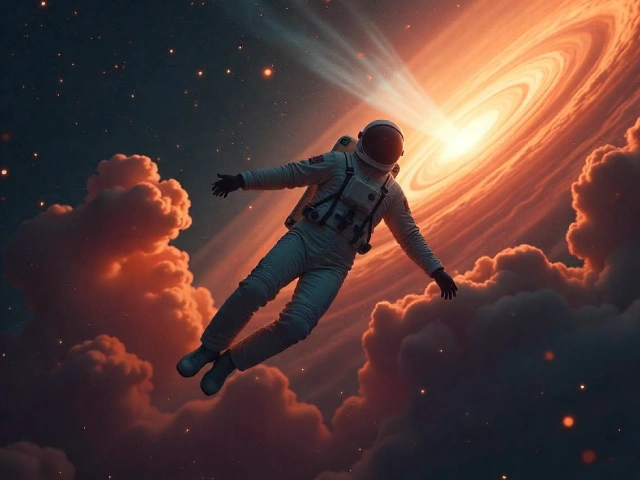
“In space, no one can hear you scream.”
This famous slogan from the world-renowned science fiction horror movie Alien reminds us of how empty space is. But is it really true? Is space truly silent? If we dig a little deeper, we’ll see the story isn’t quite that simple.
How Does Sound Work?
Sound is essentially vibrations that travel through a medium. For example, if you’re listening to music right now, your computer or speaker’s magnets vibrate the air, which then reaches your ears and your brain interprets these as music. For sound to exist, there must be a medium—be it air, water, or a solid object.
Now, the question is, if there’s no medium anywhere—like in a complete vacuum—how will sound travel? That’s why it’s often said there’s no sound in space. However, in reality, space isn’t completely empty!
How Empty Is the Vacuum of Space?
Even in the most advanced vacuum chambers on Earth, there are about a trillion particles per cubic centimeter. In contrast, in space—especially in the regions between planets—there are only a few dozen particles per cubic centimeter! That means it’s millions of times thinner than the air on Earth.
In even more distant regions—the “interstellar medium” between stars—it’s even emptier. There, on average, there are only about 100 particles per cubic meter. And in the center of a galaxy, in “intergalactic space,” it’s even more extreme—just 1 particle per meter!
In such empty regions, even if you scream, sound won’t reach anyone. But not all areas of space are the same. In some regions—like nebulas or dense clouds of dust and gas—the density of particles is much higher. For example, in the famous Orion Nebula, there are about 10,000 particles per cubic centimeter, and in a molecular cloud like Barnard 68, it can be up to a million.
Where Is Sound Created in Space?
If sound really is created in space, it happens most often during massive cosmic explosions—such as supernovas. When a giant star explodes, the matter ejected at tremendous speed crashes into the surrounding gas and dust. This collision creates shock waves—a kind of sound wave.
These sound waves spread out at a speed of 10 kilometers per second! On Earth, sound travels at about 0.33 kilometers per second, so in these nebulae of space, sound travels far beyond the limits of our imagination!
Would Earth Exist Without Sound?
It may sound strange, but the existence of sound in space is also crucial to our own existence. When a molecular cloud (a cloud of dust and gas) collapses to form a new star, a disk-shaped structure forms around it. Even within this disk, sound waves move. Without sound, the gas and dust would never have come together to form planets. Which means Earth wouldn’t exist either!
So, sound not only brings music to our ears, but it has also played a kind of silent role in our creation.
Final Words
Yes, space is mostly silent. But, if you could shout loud enough in just the right place, and if there were enough particles, your scream really could be heard—though not by a human ear, but by the great cosmic ear!
Such a mysterious role of sound makes the universe even more fascinating. It’s truly amazing to think how deeply sound is intertwined with our own existence.