


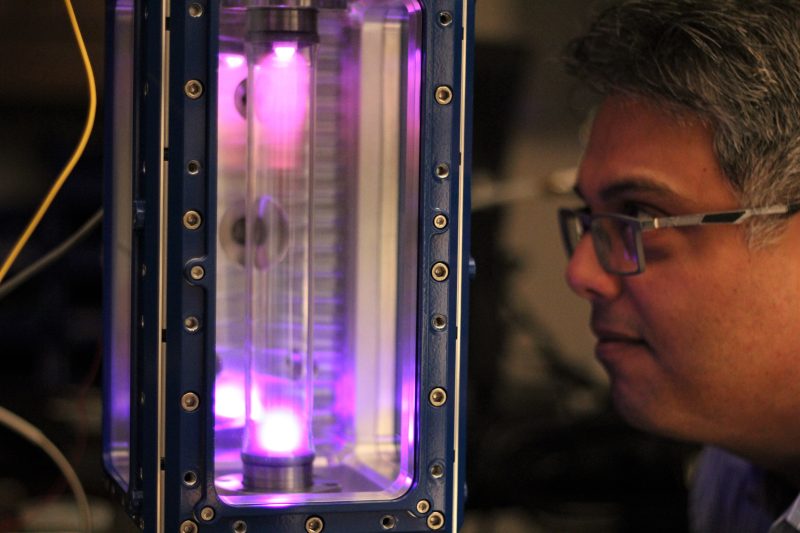
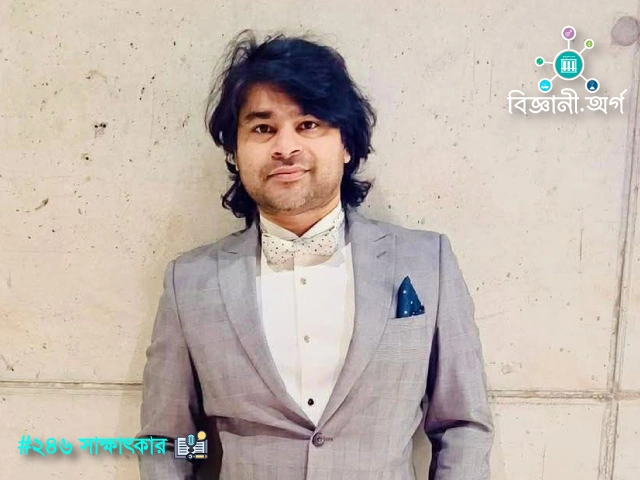
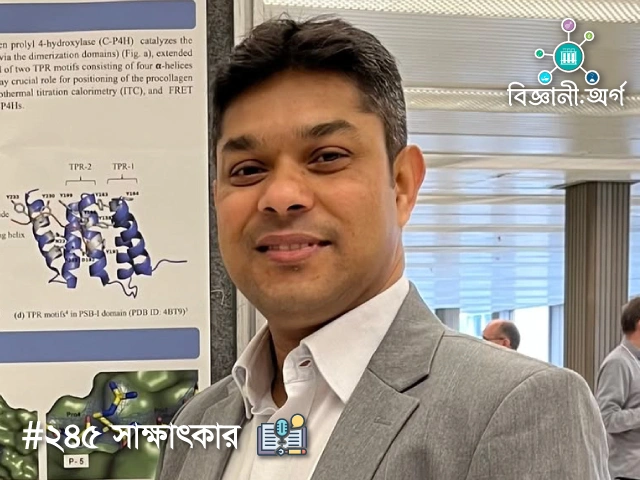
Dr. Tanvir Faruk is a mechanical engineer and researcher. He earned his bachelor’s degree in mechanical engineering from BUET in Bangladesh, then completed a master’s at the University of Toronto, Canada. In 2009, he obtained his PhD in plasma research from Drexel University, USA. After completing his PhD, he joined Princeton University for postdoctoral research and scientific work. He is currently an Associate Professor at the University of South Carolina.
Dr. Faruk’s main research area is energy—particularly high-power energy sources, alternative and green energy, pollution control, and mitigation. He works on plasma technology, combustion processes, and the control of NOx, SOx, and soot emissions. He is also experienced in research on biofuels, cool flames, and nuclear fuel storage. His research helps introduce more efficient and environmentally friendly solutions in the energy systems of developing countries.
💬 Q&A Session:
Question: Please tell us a bit about yourself.
Answer: Talking about oneself is perhaps the hardest. My father was a radio journalist and was active at the Swadhin Bangla Betar Kendra. Due to his career, I spent part of my childhood in Cologne, West Germany. Upon returning to Bangladesh, I started my schooling at Maple Leaf School and later completed my education at Adamjee Cantonment School/College and Mirzapur Cadet College. The teachers at the cadet college influenced me deeply.
In 2001, I graduated in mechanical engineering from BUET and later joined as a lecturer. I completed my master’s at the University of Toronto (2004) and my PhD at Drexel University (2009). Afterwards, I pursued postdoctoral research at Princeton University, and am currently working as an Associate Professor at the University of South Carolina.
Main research topics: high-power energy, alternative energy, pollution control, plasma and combustion processes.
Question: What was your PhD research about?
Answer: My PhD research was on “Plasma Discharge,” specifically the “Stability of high pressure plasma discharge and maintaining their non-equilibrium state.” Plasma is the fourth state of matter, consisting of free electrons, ions, radicals, and neutral particles. My research developed methods to keep high-pressure plasma stable for extended periods, used micron-scale measurements of electron and gas temperature, and applied emission spectroscopy. It also involved simulation on multi-physics modeling platforms. The results of this research led to two patents.
Question: What differences have you observed between research in Canada and the United States?
Answer: Canadian universities emphasize fundamental research more, and the technology industry provides little competition. In the United States, both fundamental and applied research are equally valued, and industries guide research directions through University-Industry Partnerships. Researchers also receive funding by competing in programs from various federal agencies and the National Science Foundation.
Question: What are you working on at the University of South Carolina?
Answer: Currently, three main projects are ongoing:
- Cool flame – stable combustion at 600–700 Kelvin and emission reduction.
- Plasma in liquids – purification of polluted water without chemicals.
- Nuclear fuel – safe storage and remote sensing.
Question: What has been your experience with biofuel?
Answer: I became involved in biofuel research in 2010–11. I tested the quality of bio-ethanol, butanol, methylbutanoate, and methyldecanoate. Research showed these are equivalent to regular fuel and have no harmful effects. Making biofuel from corn impacted food supply; the real goal was to produce biofuel from agricultural waste.
Question: What areas will you research in the future?
Answer:
- Stabilizing supersonic combustion RAMjet using plasma.
- Improving the fuel quality of landfill gas.
- Working with supercritical water oxidation technology.
Question: Any advice for young students?
Answer: You should foster an interdisciplinary research mindset. Build a strong foundation in fundamental physics, chemistry, and mathematics. Develop the ability to analytically solve engineering problems. Analytical thinking and multitasking are important skills.
Dr. Tanvir Faruk’s research is making significant contributions in the fields of energy, plasma, and biofuel. His work inspires young scientists toward environmentally friendly and highly efficient energy solutions. The Biggani.org team wishes him continued success in his research.
Dr. Tanvir Faruk on High-Power Energy and Plasma Research
Dr. Tanvir Faruk is a mechanical engineer and researcher. He completed his bachelor’s degree in mechanical engineering from BUET, Bangladesh, followed by a master’s degree from the University of Toronto, Canada. In 2009, he earned his PhD in mechanical engineering from Drexel University, USA, specializing in plasma research. He then conducted postdoctoral research at Princeton University and is currently an Associate Professor at the University of South Carolina.
His research focuses on energy, particularly high-power and efficient energy sources, alternative and renewable energy, and pollution control. Dr. Faruk works on plasma technology, combustion, and emission reduction of NOx, SOx, and soot. He has also conducted significant work in biofuel, cool flame combustion, and safe storage of nuclear fuel. His research aims to provide sustainable energy solutions and reduce environmental impacts, especially in developing countries.
💬 Interview Q&A:
Question: Please tell us about yourself.
Answer: Talking about oneself is always challenging. My father was a radio journalist and was actively involved with the Independent Bangladesh Radio during the Liberation War in 1971. I spent part of my childhood in Cologne, Germany, due to his work. Returning to Bangladesh, I studied at Maple Leaf School, Adamjee Cantonment School/College, and Mirzapur Cadet College, completing my SSC and HSC. Teachers there deeply influenced my outlook.
I graduated in mechanical engineering from BUET in 2001 and joined as a lecturer. I then received a scholarship to the University of Toronto for my master’s (2004) and completed a PhD at Drexel University (2009). I conducted postdoctoral research at Princeton University and currently work as an Associate Professor at the University of South Carolina. My research focuses on high-power energy sources, alternative energy, pollution control, plasma, and combustion.
Question: What was your PhD research about?
Answer: My PhD research focused on “Plasma Discharge,” specifically “Stability of high-pressure plasma discharge and maintaining their non-equilibrium state.” Plasma is the fourth state of matter, consisting of free electrons, ions, radicals, and neutral particles. I studied how to maintain high-pressure plasma stable over time. This involved measuring electron and gas temperatures at the micron scale, emission spectroscopy, and multi-physics simulation in virtual environments. My work led to two patent applications.
Question: How do research experiences in Canada and the USA compare?
Answer: Canadian universities generally emphasize fundamental research with limited guidance from industry. Competition for funding is lower, and graduate coursework involves fewer subjects. In the USA, universities balance fundamental and applied research and actively collaborate with industry. Research funding is competitive and provided through federal agencies like the Department of Energy, NASA, and the National Science Foundation.
Question: What are you currently working on at the University of South Carolina?
Answer: Currently, my lab works on three main areas:
- Cool flames – maintaining stable combustion at 600–700 K while reducing emissions.
- Plasma in liquids – potentially purifying contaminated water without chemicals.
- Nuclear fuel – safe storage and remote monitoring of quality.
Question: Can you describe your experience with biofuel research?
Answer: I began biofuel research around 2010–11, exploring alternatives to conventional fuel after the 2008–09 global energy crisis. We tested bio-ethanol, butanol, methylbutanoate, and methyldecanoate blends. Our studies confirmed that these biofuels are comparable in quality to conventional fuels and have no harmful effects. Corn-based bioethanol posed challenges because it diverted food resources to fuel. Ideally, lignocellulosic biomass from agricultural residues should be used.
Question: What research do you plan for the future?
Answer: I am exploring plasma-stabilized supersonic combustion RAMjet engines and improving the energy potential of landfill gas. I also plan research on supercritical water oxidation, a technology with transformative potential for water purification.
Question: Any advice for young students interested in science?
Answer: Students should develop an interdisciplinary mindset. Strong foundations in physics, chemistry, and mathematics are crucial. Learn how to formulate engineering problems analytically rather than just solving equations. Be prepared for unexpected results and cultivate multitasking skills.
Dr. Tanvir Faruk’s work in energy, plasma, and biofuel research provides valuable contributions toward sustainable energy and environmental solutions. His dedication inspires young researchers to pursue interdisciplinary scientific studies. Biggani.org wishes him continued success, and hopes his research motivates future generations of Bangladeshi scientists.




This comment has been sanitized for the English site.