


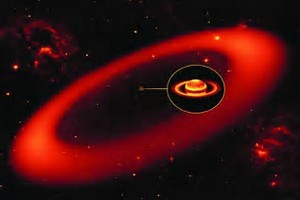
{mosimage}For many years, people only knew about five planets in the solar system, with Saturn being the last of these five. Of course, the other planets were discovered later. Among the planets visible to the naked eye, Saturn is the most distant, and the gap between Mercury and Jupiter is just as vast as the gap between Saturn and Jupiter.
Saturn is the most beautiful planet in the solar system, mainly because of the ring that surrounds it, making Saturn so stunning. This ring can’t be seen with the naked eye, which is why many ancient astronomers, though familiar with Saturn, were unaware of its ring. The ring was first seen through the telescope of the famous astronomer Galileo, but at that time, he thought it was a planet. Forty years later, astronomer Huygens discovered that a thin ring encircles the planet (it is worth noting that Saturn, viewed from Earth, is seen in different positions, so the ring doesn’t always appear the same). Saturn’s rings reflect one and a half times more sunlight than other objects.
When we can clearly see Saturn’s rings, they are angled up to 28 degrees with our line of sight. At that time, both the rings and Saturn appear bright, and sometimes we see the upper side of the ring, while other times the lower side; the difference between these two positions spans 15 years. At certain times, the rings are angled at their lowest with our line of sight, and because of the planet’s position, only the edge of the rings is visible.
It was initially believed that three rings encircle Saturn. But the Voyager spacecraft provided important new information: these rings are not just three, nor only 50 or 100—there could be hundreds of thousands. Each ring’s structure is fine, and many are interlinked like a chain. The thickness of Saturn’s rings is about 1 km, but their width extends up to about 420,000 km from Saturn’s surface.
Based on density variations, Saturn’s rings can be divided into seven segments. As each ring was discovered, they were labeled with letters such as A, B, C, D, E, F, etc.
The closest ring to Saturn is the D ring, followed by the C ring (also known as the Crepe Ring), which is about 17,500 km wide and connected to many other rings. Next is the B ring, which is about 25,340 km wide. The gap between the B and A rings is called the Cassini Division, named after the astronomer Cassini. The A ring is about 13,900 km wide, and the gap within the A ring is called the Encke Division. The brightness of these rings is not the same—D, E, and G rings are quite faint, the F ring is very bright, and the A, B, and C rings are the brightest of all.
Saturn’s rings are quite mysterious. For example, each ring is actually a collection of many concentric rings. The Cassini Division is made up of many smaller rings. Though generally circular, several eccentric rings have also been found. The structure of Saturn’s rings is somewhat like the grooves of a gramophone record. There are also markings on the rings, which are connected to Saturn’s magnetic field. When sunlight falls on the rings in a favorable position, they cast shadows on Saturn’s disk—the outermost ring creates a particularly dense shadow.
Saturn’s moons, orbiting around it, sometimes get covered by the rings and at other times become fully visible.
According to the famous scientist Maxwell, if these rings were solid, they would not remain stable and would soon break apart. On the other hand, if they are made up of tiny particles, they would remain stable, and it is therefore believed that the rings are a mixture of dust, rock, and ice fragments.
The creation of Saturn’s rings is attributed to physical causes. The French astronomer Roche showed that a planet’s gravitational force can, at a certain distance, break apart a small object. Perhaps at some point, one of Saturn’s moons broke apart in this way and formed the rings. The arrangement and formation of the rings are influenced by Saturn’s outer moons.
Doppler shifts observed in the spectrum of Saturn’s rings reveal that the inner parts of the rings orbit the planet much faster than the outer parts. The outer edge of a bright ring completes a revolution in 14 hours and 27 minutes, while the inner edge takes only 7 hours and 46 minutes.
With advances in science, the doors to these mysteries are opening, and in the near future, we will learn many more unknown facts about Saturn.
{mosimage}









Greetings Nebula Morshed. Many thanks for your interesting article. Keep up the good work.
This comment has been sanitized for the English site.
hi
This comment has been sanitized for the English site.