


Many of us have computers at home, right? But do we use our computers all the time? Probably not. At the very least, we turn them off when we go to sleep. But now, scientists are calling on you to let them use your computer during those idle times—for running calculations and solving problems in their research. And this initiative started with a project called SETI. Today, we’ll hear the story behind this project named SETI.
Space – A Universe Full of Mysteries
Are we alone in the universe? Is there no one else on any other planet in this vast cosmos except for humans? We’ve been facing these questions since ancient times. With so many planets and stars out there, hasn’t intelligent life like us appeared anywhere else? Humanity has often found itself pondering these questions, gazing at the distant sky. The more science and technology have advanced, the harder we’ve tried to answer them.
Have you ever thought about this? Is there really no one else in this universe but us? These are questions we’ve been facing for ages. With such an immense cosmos, with billions of stars and planets, hasn’t intelligent life emerged somewhere else? Alone, humans have stared at the distant sky, searching for these answers. The progress of science and technology has only increased our efforts to find out.
With today’s technology, it isn’t possible for humans to go beyond a certain distance in space. Among all possible means, radio waves are the most talked about. Scientists wondered: isn’t it possible that someone from another planet might try to contact us? And if anyone does, it’s likely they would use radio waves. So, by observing the radio waves coming from space, we might catch such a signal. With this purpose in mind, the Search for Extraterrestrial Intelligence—SETI—was launched. The first discussions on SETI began in 1959, when Drs. Philip Morrison and Guiseppe Cocconi published a paper titled “Searching for Interstellar Communication” in Nature magazine. That article sparked the beginnings of SETI. If you’d like to read that paper, you can find it here.
In the movie “Contact,” Ellie Arroway and her fellow researchers use large telescopes to observe radio waves from the sky, and ultimately, they detect a signal from another planet and build a spacecraft based on that. While this is fiction, in reality, scientists are trying to do exactly the same: searching for signals sent from another planet. You can see how unusual the work of scientists can be! Still, despite sounding odd, many top scientists are actively involved in this field.
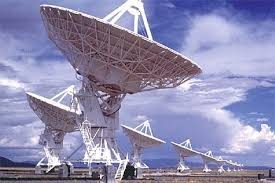
If intelligent beings from another planet send us messages via radio waves, then somewhere among these waves, we might find those messages. Another big challenge is not knowing how many channels such a signal could be transmitted over, since countless channels are possible. It’s a bit like tuning a regular radio: we keep turning the dial to find the right station. But to observe radio waves from space, you need massive radio telescopes and supercomputers to analyze the data. No single institute or research center could possibly handle all this enormous computation alone. The biggest problem is that most of the radio waves from space are filled with noise—unwanted or jumbled signals. In the image above, you see an Arecibo radio telescope. Though it looks small in the picture, it’s actually enormous in real life.
The Beginning of SETI
In 1999, at the University of California, Berkeley, scientists Dan Werthimer and David P. Anderson were working on the SERENDIP project. They realized that a large portion of the data collected by the Arecibo antenna—which the project used—wasn’t actually being reviewed. The reason was that processing all this information would require enormous supercomputers, which they simply couldn’t afford. So, the scientists sought an alternative: what if they divided the data into smaller chunks and analyzed them using ordinary computers? When regular computer users weren’t using their machines, those idle computers could be harnessed for calculations. That’s how they created a screensaver called Seti@home.
Have you ever used this screensaver on your computer? It’s a simple program that automatically runs when your computer is idle, displaying various images. By downloading this screensaver from Berkeley’s Seti website, ordinary users could donate their computers’ idle time to the project. And thus began a massive collaborative effort.
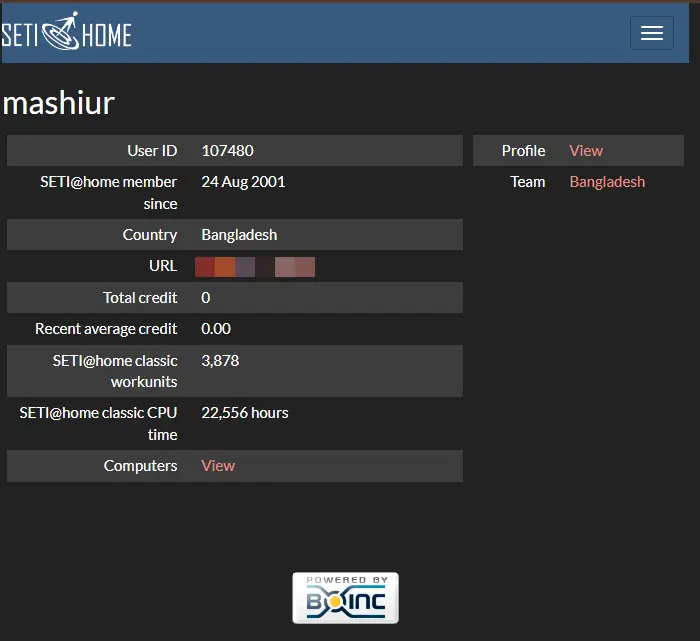
Photo: By joining the SETI project, the author of this article donated 22,000 hours of their computer’s time to science.
SETI in Action
The SETI@home project started in 1999, and nearly 2 million volunteers donated their computers’ processing power. To date, the project has used the equivalent of 2.2 million CPU years of processing power. In other words, if a single CPU had worked nonstop for 2.2 million years, that’s how much computing was done by SETI@home in a short time. Isn’t it amazing to think about? What a massive undertaking this was.
Is SETI Still Running?
Since 1999, SETI@home collected enormous amounts of radio data. Due to the massive dataset, researchers decided to focus on analyzing all the data they had already gathered. After collecting so much, they felt detailed analysis of the old data was more important than gathering new information. Running SETI@home and organizing public participation was time- and resource-intensive. By pausing the project, they chose to redirect those resources to improving research in other areas—such as developing advanced methods for searching intelligent radio signals. In 2020, they announced that SETI@home was being suspended.
The SETI@home project is currently in “hibernation,” meaning it hasn’t been completely shut down and could restart in the future. If new data needs to be collected or the next stage of research begins, SETI@home could become active again.
Are you disappointed that you didn’t get to participate in such a project? Don’t worry; good news is coming up for you below.
Using Our Computers for Science
Although the main SETI@home project is currently on hold, ordinary people can still contribute their computers’ processing power to scientific research, especially in astronomy and space studies, through the BOINC (Berkeley Open Infrastructure for Network Computing) platform. BOINC was the foundation of SETI@home and now supports distributed computing for a variety of scientific projects. While SETI@home is not currently active, BOINC still hosts several projects that focus on analyzing astronomical data or carrying out space-related simulations. Here are some alternative projects where you can contribute your computer’s processing power:
AstroPulse
This project is related to SETI@home and analyzes radio signals and pulses. It searches for radio pulses (such as those from rapidly spinning neutron stars or other sources). Its current activities may vary, but you can check for updates on the BOINC project list.
Einstein@Home
This project searches for gravitational waves from spinning neutron stars (pulsars) and finds pulsars in radio and gamma-ray data. It is one of the most active astronomy projects on the BOINC platform and lets volunteers contribute their computer’s power to search for these cosmic events. Website: einsteinathome.org
MilkyWay@Home
This project works to create a highly accurate 3D model of our Milky Way galaxy using data from the Sloan Digital Sky Survey. It simulates the motion of stars in the galaxy to provide insights into the structure and formation of the Milky Way. Website: milkyway.cs.rpi.edu
How to Participate in BOINC
To take part in these projects, you’ll need to download and install the BOINC software from their official website. Then, you can select and join your preferred project, such as Einstein@Home or MilkyWay@Home, to let your computer’s idle time be used for science. The BOINC software will automatically download work units and start computing when your computer is not in use. You can also control how much processing power you want to dedicate.
In Conclusion
The price of computers is dropping every year. We use our computers for only a short period each day, but during idle times, we can put them to better use by joining these projects. So even if the price of your computer goes down, you can at least find comfort in knowing your computer contributed to science.
Some, however, consider SETI a waste of time and money, since so far the project hasn’t produced any definite hopeful results. All we’ve found in the data so far is noise—no signals from extraterrestrial civilizations. But personally, I believe that even if we don’t detect any messages, at least we can clearly say that there’s no incoming data from others. If we hadn’t investigated, we would never have known. It’s like a dark room: if you have a dark room next to you, and you turn on the light to see that nothing’s inside—it may seem pointless. But if you’d never looked, you’d never know what was in there. By checking it out, you can confidently say there’s nothing. SETI is just like that.
The SETI@home project has achieved meaningful scientific results and valuable experiences that can be used in future research. SETI@home pioneered a new trend in scientific computing by enlisting the participation of the public, letting ordinary people worldwide dedicate their computers’ unused power to advance research. By donating your computer’s idle processing power, you too can contribute to science—and maybe one day, you’ll grow up to be a great scientist.










Thanks.
This comment has been sanitized for the English site.
This comment has been sanitized for the English site.