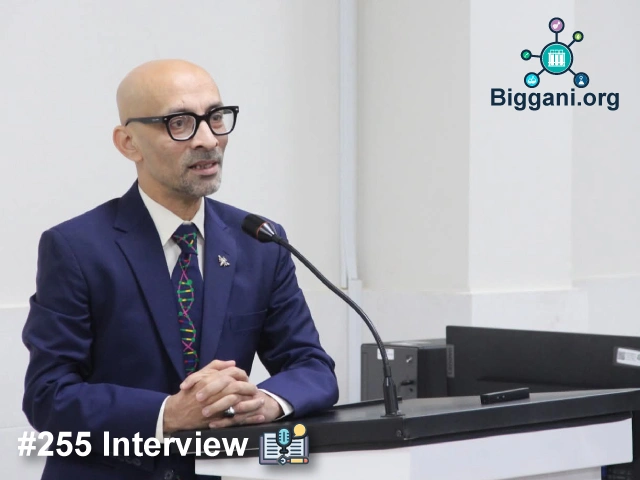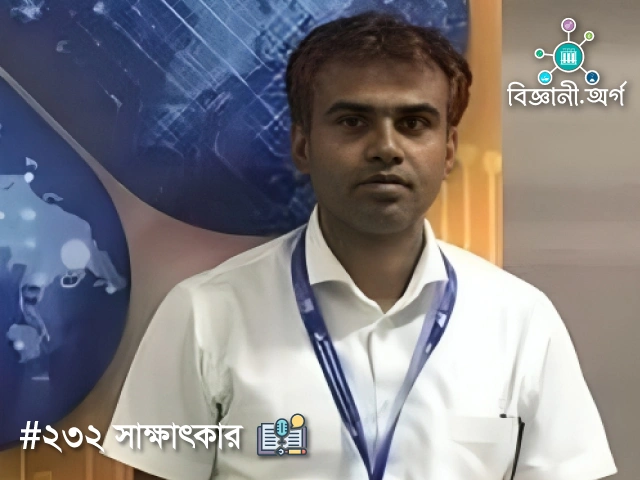
In an intimate gathering titled “The Story of Becoming a Scientist” organized by Scientist Org, a researcher, teacher, and visionary—Professor Abdul Hamid from the Department of Information Technology at King Abdulaziz University—sat down for a discussion. On one side of the screen were the faces of young Bangladeshis, and on the other, a teacher seated in a room in Jeddah, whose voice kept echoing two words: responsibility and gratitude. Even with a bright career abroad, he never seemed to forget where he began—his roots in a riverside school in rural Bangladesh, a journey that has now brought him to one of the Middle East’s leading research universities.
From Village to Global Lab: A New Chapter of Bangladeshi Science in Professor Abdul Hamid’s Story
The journey from a Bangladeshi village to the world’s research laboratories sounds romantic, but in reality, it is equally harsh and challenging. Uncertainty in education, financial limitations, lack of infrastructure, and above all, a crisis of self-belief—all of these shape a researcher’s path. In a recent discussion, Professor Abdul Hamid, a professor in the Department of Information Technology at King Abdulaziz University in Jeddah, Saudi Arabia, vividly illustrated these realities—becoming a scientist is not a tale of a lone prodigy, but rather a long and unbroken saga of perseverance.
From Santhia, Pabna to Rajshahi Cadet College—A Dream is Born in a Young Mind
Growing up by the river in Sonatala village of Santhia, Pabna, science wasn’t a big concept for a young boy. Childhood dreams meant playing in the fields, fishing, and enjoying a free rural life. But fate suddenly brought him to the strict discipline of Rajshahi Cadet College. In his own words, “It was at cadet college that I first discovered—there’s no end to being a ‘good student’ in Bangladesh.” Surrounding him were Bangladesh’s top SSC scorers, future doctors, engineers, and scholars. That’s where an understanding formed—this country is far ahead of me, and I too must advance.
This realization later propelled him to the International Islamic University Malaysia. After completing his honors there, he returned to Bangladesh for a few years of teaching, and then moved to Korea for his Master’s and PhD. What followed was a history of constant movement: a few years as Assistant Professor at a South Korean university, then teaching in the Computer Engineering department at Taibah University in Medina, another stint in Bangladesh working at Green University, AIUB, and finally the University of Asia Pacific under the late Professor Jamilur Reza Choudhury. It was here that another important person entered his life—Dr. Firoz Mridha. Together, they began planning computing-based research focused on the Bengali language. The reason: while native language computing was advancing rapidly worldwide, research on Bengali was still sparse, scattered, and nearly invisible in the tech ecosystem. After completing his PhD in 2009, Abdul Hamid taught for a few years as Assistant Professor at a South Korean university, then worked in the Computer Engineering department at Taibah University in Medina, returned to Bangladesh, and worked sequentially at Green University, AIUB, and ultimately at University of Asia Pacific under the late Professor Jamilur Reza Choudhury. It was here that another important person entered his life—Dr. Firoz Mridha. Together, they started to design computing-focused research for the Bengali language. At that time, they faced a stark reality: while native-language computing saw major advances globally, research for Bengali was still scant, fragmented, and practically invisible in the technology ecosystem. In his words, “My life keeps flowing between my country and abroad.”
Bangla Computing: The Fight to Introduce Our Language to Technology
One of Professor Abdul Hamid’s most significant fields of work is Bangla computing. Simply put, this is a research area where technology is taught to understand our language—to read, transcribe speech, and even identify errors. But behind this ‘simple’ idea lie complex linguistic and mathematical challenges.
Bengali is not like English. The structure of sentences works one way in English, but differently in Bengali. In English, “I eat rice”; in Bengali, it’s “Ami bhat khai (Ami bhat khai).” Word order shifts, different meanings are created with similar pronunciations—“onno (other) (onno)” and “onno (rice/food) (onnô)”—which sound alike yet mean worlds apart. This ambiguity poses a major challenge for computers. That’s why Professor Hamid’s team is working in complex areas like speech-to-text, text retrieval, spell correction, and natural language processing (NLP).
Through their initiative, the Advanced Machine Learning Lab has been established in Bangladesh. This lab is not just a research hub, but a center training a new generation of students to bridge the Bengali language with technology. In his words, “We’re not just learning to type in Bangla—we want computers to actually understand Bangla.”
From Covid to Cancer: Artificial Intelligence Along the Research Path
In discussing artificial intelligence and machine learning, Professor Abdul Hamid turns to real-world examples. In 2020, as COVID-19 brought the world to a halt, his team pondered: how strict must a lockdown be to save the economy, and at what point does it save lives? Searching for real-world solutions had many governments stumbling in the darkness of politics, health policy, and economics. Collecting data is tough; privacy issues make it even more complicated. So, what Professor Hamid’s team did was build an imaginary country—say, with a population of 10,000, where infection, recovery, death, and types of lockdowns could all be modeled and simulated.
With this “imaginary country,” they used reinforcement learning to train computers to find which lockdown cycle would minimize deaths, control disease spread, yet avoid a total economic collapse. Lockdowns every two weeks versus every month, or every 45 or 60 days—each scenario was modeled. The findings were later published in Nature Publishing’s Scientific Reports journal. The study showed that neither perfect “fully open” nor “completely closed” is optimal; rather, implementing well-timed ‘cyclic lockdowns’ can in many cases maintain a better balance for both the economy and public health.
The results were published in an international journal. It appeared that strictly prolonged lockdowns cripple the economy, while lax controls put lives at risk. The most effective approach was a periodic, cyclical lockdown—where infection remained under control and the economy stayed afloat.
This experience led his team toward research in agriculture and medical science. Precision agriculture—identifying plant diseases by leaf color, recognizing crop types, and determining fruit quality—can now all be done with the help of machine learning. Similarly, in cases like breast cancer, his team is also engaged in research applying image processing for rapid diagnosis. The underlying intent is always the same: turning technology into a tool for saving human lives.
A Simple Message to Youth: Make Math Your Friend
In reply to a college student’s question, Professor Abdul Hamid issued a message for an entire generation—“If you want to learn machine learning, first hold tight to mathematics.” Learning from YouTube is good, learning to code is good—but if you don’t grasp the underlying mathematics, everything will remain superficial. Calculus, probability, algebra—these are the true backbone of future artificial intelligence.
He advises the youth not to think of technology merely as a job tool—it can be a weapon for social transformation. Whether it’s the passport office or a hospital, a farm or a classroom—wherever there are problems, technology has a role to play.
Charity, Poverty & Mathematics: Outlining a Humanitarian Dream
In the midst of all these “technical” discussions, another facet of Professor Hamid’s thought stands out—his deep concern with poverty and inequality. He acknowledges that global wealth is increasing, but extreme poverty hasn’t been eradicated—in some countries, inequality is even growing. In a recent conference paper, he envisioned a sort of “mathematics-based welfare model”—where charitable giving moves beyond occasional compassion and becomes a planned investment. For example: establishing a small noodles factory in a region with extreme poverty would allow even illiterate or less educated people to work as laborers. Driving for transportation, retail shops for distribution—each step creates new jobs. By converting charity into investment and using mathematics to calculate how many families can meet basic needs for food, education, and healthcare within a certain period—this is the model his research seeks to develop.
Behind this idea lies a crucial ethical question—are we truly ready to stand for humanity with our surplus wealth? Or are we only satisfied with seeing interest rates and profit graphs? Professor Hamid’s dream is for a future world economy centered on humanity, where the donations of the wealthy aren’t just photo opportunities to show off “good deeds,” but become effective tools to lift people out of poverty through organized, strategic action.
His research brings forth a new idea—treating donations as investments, not mere charity. If agricultural projects, small industries, or food production centers can be established in a region, people there won’t get just temporary help—they’ll gain work, education, and healthcare opportunities. If the distribution of charitable funds is planned through mathematical models, he believes an entire community can become self-reliant within a generation or two.
Personal Philosophy
Finally, when he speaks about his personal philosophy, you can sense the maturity that comes from traversing a long path. As a boy, perhaps he only wanted to study more, wanted to be a teacher, wanted to be with students. That essence of the dream hasn’t changed to this day. He still finds himself most at ease in the classroom, the lab, in discussion with students. But now, another layer has been added—a sense of responsibility. Responsibility, not just for his own career, but to do something for the youth of Bangladesh; responsibility to bring the Bengali language into the technological mainstream; responsibility to make the vision of a humane world free of poverty through science and mathematics a little closer to reality.
Conclusion: Science Is the Search for Humanity
In this technological age, a scientist’s story doesn’t just mean lab anecdotes, but rather the story of people. Professor Abdul Hamid’s story, in that sense, represents our era. His story leaves young people with a courageous call—prepare yourself, keep learning, learn to think, and never forget—your knowledge is not just for you; it is a responsibility, a promise, to all of society.
Professor Abdul Hamid’s story is not just the career of a teacher—it’s a philosophy. From village to global university, from code to social policy, from research to humanity—for him, science is never something separate. To him, science means understanding people, working for people.
If young people in Bangladesh can internalize this perspective—then even if there are no lab machines in the country, science will not be stopped. Because science, then, will live within people themselves.
Watch the video interview of Professor Abdul Hamid on YouTube at the following link: 👇👇👇