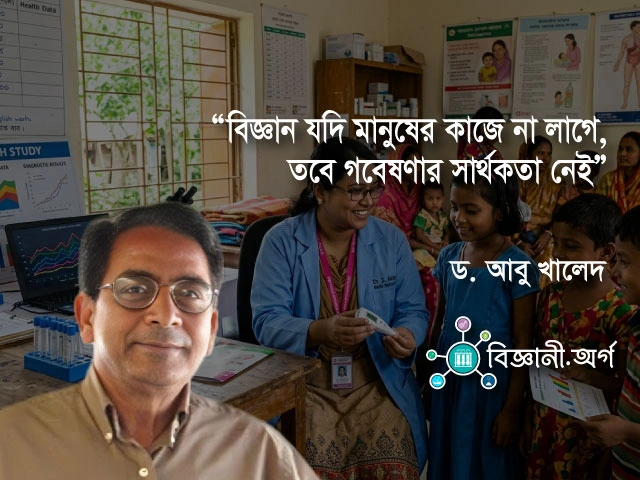
In the classrooms of educational institutions, science textbooks might seem like heavy and complex texts, but a true scientist knows—science begins with curiosity and finds fulfillment when you create something with your own hands and test if it really works. “Science is not just book learning; it’s proving something by making it yourself”— this statement comes from Dr. Abul Hussam, Professor of Analytical Chemistry at George Mason University and Director of Clean Water Technologies. His life and work illustrate the profound meaning behind these words.
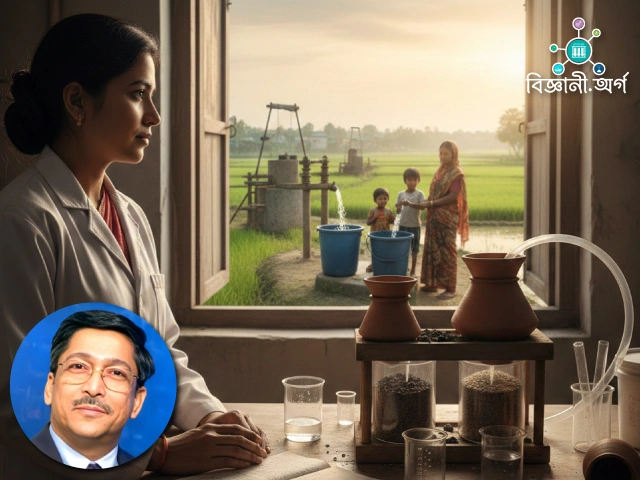
When arsenic contamination was ravaging rural Bangladesh, Dr. Hussam didn’t just sit with books to try to solve the crisis. Instead, he developed a technology that even ordinary people in villages could use—this is his invention, the Sono Filter. It’s not just a research paper or a technological innovation; it’s a practical device that truly works, capable of providing safe water in real life.
Although Dr. Hussam was born on Bangladeshi soil, he has considered science his closest companion since childhood. In the small town of Kushtia, his father was a physician, but it was wandering around his father’s pathology lab, seeing the colorful solutions and glass instruments, that first sparked his own interest in making devices. This curiosity took him to the University of Dhaka, where after completing his BSc and MSc, he never looked back.
During his higher education in the United States, he specialized in the field of analytical chemistry, where the main focus was “measurement”—how to accurately identify what is in water and how much of it is there. But Dr. Hussam understood that knowing how to measure was not enough; to truly tackle real-world problems, this knowledge must be applied in daily life. From this perspective, he built various devices himself—not just within books, but grounded in hands-on experience.
Today, as rural people in Bangladesh run in search of safe water, the value of technologies like the Sono Filter is immeasurable. This filter stands as a solution where arsenic in water poses severe health hazards. The filter is simple, inexpensive to make, and can provide safe water without specialized equipment—this is a true example of “hands-on science.”
Dr. Hussam’s outlook is particularly relevant for young scientists. Many students in our country see top marks, good grades, or studying at international universities as the main goals of studying science. But Dr. Hussam says, “Science is not just book learning…”—science is about creating a scenario where you can solve a problem with your own hands and demonstrate that your solution actually works.
Bangladesh’s education system puts a lot of emphasis on STEM, but offers few opportunities for practice or solving real problems. Dr. Hussam’s life brings this reality to the forefront—encouraging curiosity, questioning, and the urge to build something meaningful within every young mind. Learning from books is one type of education, but getting your hands dirty and tackling real problems is something entirely different and deeper.
This is why his words are not just a quote—they are a philosophy of education, a way of working. “Science is not just book learning; it’s proving something by making it yourself”— this statement is a call to rethink the culture of science in our country.
Read the full interview with Dr. Abul Hussam: