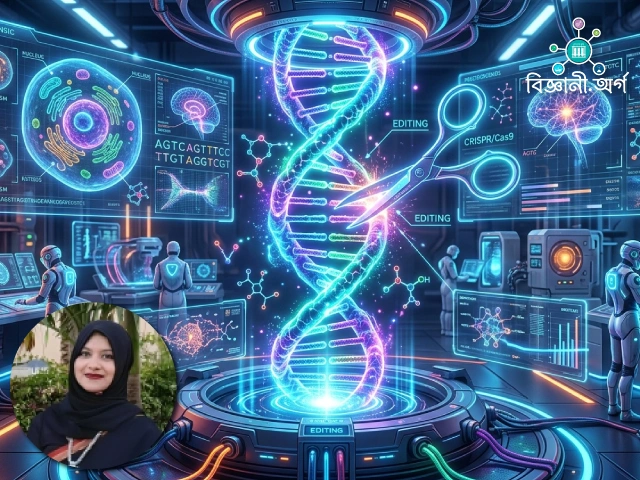
Dr. Tofazzal Islam
Published: Wednesday, November 12, 2025,
Dr. James Dewey Watson was a legendary figure in modern biology. In 1953, through his joint discovery of the double helix structure of the DNA molecule with Francis Crick, he opened a new horizon in the history of science.
Dr. James Dewey Watson was a legendary figure in modern biology. In 1953, through his joint discovery of the double helix structure of the DNA molecule with Francis Crick, he opened a new horizon in the history of science. In recognition of this groundbreaking discovery, he, Francis Crick, and Maurice Wilkins were awarded the Nobel Prize in Physiology or Medicine in 1962. His work was so fundamental that it is described as the dawn of the modern era of biology. He was born on April 6, 1928, in Chicago, USA and died at the age of 97 on November 6, 2025, in East Northport, New York. Today, the scientific world bids farewell to Dr. James D. Watson. He was one of the pioneering minds behind the discovery of the DNA double helix structure, which has forever changed the course of biology and medicine.
But Watson’s long and influential life of 97 years was not limited solely to the brilliance of his scientific achievements. His controversial remarks and ethical stances have repeatedly called his extraordinary legacy into question. Even so, James Watson—or “Jim”—remains among the most influential and prominent scientists of the century. His influence on the development of human civilization, and on future science as well, will be widely discussed and debated. With deep respect for the work of this great scientist, this article will shed light on James Watson’s glorious scientific contributions as well as some of his controversial statements and ethical stances.
From childhood, James Dewey Watson developed an interest in science and the humanities. He grew up on the South Side of Chicago and attended South Shore High School. As a precocious student, he was a contestant on the 1940s radio series Quiz Kids. Due to Robert Hutchins’ liberal policies, he was admitted to the University of Chicago at the age of just 15. There, he first encountered a popular science book on biology written by quantum physicist Erwin Schrödinger for lay audiences. The book ‘What Is Life? The Physical Aspect of the Living Cell’ convinced young Watson that genes are the essential components of living cells. He completed his undergraduate studies in zoology in 1947. After graduating in 1947, he entered graduate school at Indiana University, where he met two legends in the field: Hermann J. Muller (who had won the Nobel Prize in 1946) and Salvador E. Luria. Under the supervision of Dr. Luria, Dr. Watson received his doctorate in 1950. Afterward, he moved on to Cambridge and the road to fame.
One of the most significant chapters of his career began at the Cavendish Laboratory at Cambridge University, where he met Crick. At just 25, Watson, together with Francis Crick, proposed the beautiful double helix model of DNA. On April 15, 1953, they jointly published their groundbreaking one-page research paper titled “A Structure for Deoxyribose Nucleic Acid” in the journal Nature. April 15 is celebrated annually as World DNA Day. The two of them proposed that DNA has the shape of a twisted ladder, whose outer rails are made of sugar and phosphate molecules. Each rung of the ladder is formed by pairs of the four chemical bases in DNA—adenine, thymine, cytosine, and guanine. Adenine always pairs with thymine, and guanine always pairs with cytosine. They explained that enzymes inside the cell can split this twisted ladder in the middle, and that using the bases inside the cell, one DNA molecule can yield two new DNA molecules. This discovery revealed how genetic information is encoded, replicated, and transferred. It opened a new horizon for biology. As a result, revolutionary advances like understanding genetic inheritance, protein synthesis, and the development of monoclonal antibodies for cancer treatment have become possible. For this recognition, Watson, Crick, and Wilkins were awarded the Nobel Prize in Physiology or Medicine in 1962. Their discovery laid the foundation for modern genetics, genomics, and computational biology.
At that time, they said: We have discovered the secret of life. Although DNA was discovered in 1869, scientists did not learn until 1943 that it is the genetic material of the cell. However, the structure of DNA remained a mystery. This discovery opened the door to technologies such as detecting disease-causing genetic mutations, designing genetically modified crops, and today’s precise genome editing technologies like CRISPR-Cas. James Watson, known as Jim in short, made unforgettable contributions to the foundation of ongoing revolutions in industry, medicine, and agriculture—through genomics, genome editing, systems biology, and the application of artificial intelligence in rewriting the code of life.
Dr. Watson eventually moved from Cambridge, England to Cambridge, Massachusetts. There, in 1955, he was appointed assistant professor of biology at Harvard. He was known among his graduate and undergraduate students as a keen talent-spotter, and helped launch many notable research careers, including those of several women such as Dr. Hopkins. As Dr. Hopkins recalled, Watson was an inspiring teacher, though he had a tendency to mumble at the blackboard with his back to the students. She said being around him was a lot of fun, but he was easily irritated and, if annoyed, would turn and walk away in the middle of a sentence. From 1956 to 1976 he led advances in molecular biology research in Harvard University’s biology department.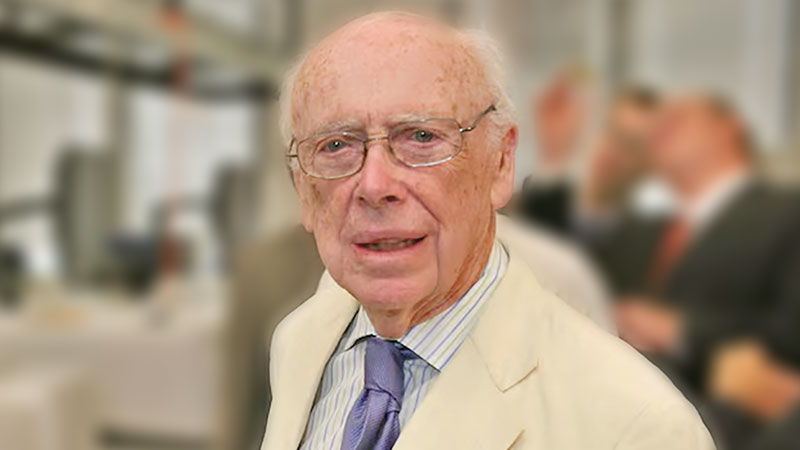
James D. Watson (1928—2025) Photo: Reuters
After that, beginning in 1968, he played a key role for nearly 35 years as director, president, and chancellor of Cold Spring Harbor Laboratory (CSHL), bringing the institution’s funding and research to world-class heights. Dr. Watson first visited CSHL in 1948. He would eventually help restore the institution’s scientific fame. There he participated in meetings with colleagues on the genetics of bacteriophages (phages). But when he was appointed to lead the laboratory in 1968, it had lost its renown. Bruce Stillman, president of Cold Spring Harbor Laboratory, has commented that the explanation of the double helix structure ranks alongside the discoveries of Mendel and Darwin as one of the three greatest breakthroughs in biology.
After discovering the structure of DNA, Watson wrote the molecular biology textbook ‘Molecular Biology of the Gene’ (1965), and his best-selling book ‘The Double Helix’ (1968), which depicts his personal experiences and conflicts. Yet the book was immediately acclaimed as a classic in the scientific literary world. The Library of Congress listed it among America’s most important literary works.
Watson is not only known for this revolutionary discovery; he also played a key role in starting and advancing the Human Genome Project. Between 1988 and 1992, he served a central role in establishing the project, which completed the human genome mapping in 2003. In 2000, a working draft of the human genetic code’s three billion letters was completed. This achievement was praised with television announcements from President Bill Clinton at the White House and Prime Minister Tony Blair at 10 Downing Street. Due to disagreements over gene patenting, Dr. Watson left the project in 1992. He was a staunch opponent of patenting the blueprint of life.
One of his sons developed schizophrenia in adolescence, which further motivated Watson’s research—both to learn more about DNA and perhaps help his son. In contrast to James Watson—nicknamed “Jim”—and his brilliant scientific achievements stand his serious ethical questions and controversial statements: 1. Injustice to Rosalind Franklin: In explaining the structure of DNA, Watson and Crick used data and insights gathered by Rosalind Franklin and her colleagues at King’s College London. It has been alleged that especially Franklin’s Photo 51 and her research progress reports were used by Watson and Crick without her permission or appropriate recognition. Franklin had died four years earlier of ovarian cancer at age 37 and could not be considered for the Nobel Prize. In his book The Double Helix, Watson portrayed Franklin negatively and downplayed her work. His “misogynistic treatment” of Franklin raised serious questions about his ethical stance—in both science and society. 2. Racist and Classist Remarks: The most infamous stains on Watson’s distinguished life are his racist and classist remarks. In 2007, he told London’s Sunday Times Magazine that he was inherently pessimistic about Africa’s future, as all testing suggested Black people were not as intelligent as White people. He insisted that the average difference in IQ between Black and White people was due to genetics. As a result of these remarks, the board of trustees of Cold Spring Harbor Laboratory suspended his administrative duties in 2007, and he resigned as chancellor.
Even after that, in 2019, when he reiterated his racist views in a documentary, CSHL revoked all his honorary titles and severed all ties with him. CSHL deemed these remarks offensive and unsupported by science, taking an extreme measure. It is rare and unprecedented in human history for any scientist to be so completely separated from an institution to which they were so established and intimately tied for a lifetime.
He also expressed opinions in favor of “curing” personal traits such as obesity and beauty genetically. He once remarked that whenever you interview fat people you feel bad, because you know you are not going to hire them. Such statements drew widespread condemnation and criticism around the world.
Amid controversy, Watson claimed he was “ostracized” and, to raise funds for research, put his Nobel medal up for auction in 2014. He was the first living laureate to sell his medal at auction. It was sold for $4.8 million. But, remarkably, the buyer—Russian billionaire Alisher Usmanov—subsequently returned the medal to Watson.
Judging James Watson reveals a sharp contrast between his scientific contributions and his ethical behavior. He is a founding father of modern genetics whose work has forever changed the trajectory of medicine and biology. Yet his arrogance, controversial nature, and especially his discriminatory remarks about race and gender have been toxic for society. These comments are seen as a reprehensible attempt to legitimize social discrimination through the authority of science.
Watson’s life shows us how a person can attain extraordinary heights in science, yet fail by society’s ethical standards. James Dewey Watson will be immortalized as the discoverer of the DNA double helix. But it is impossible to judge his legacy solely by scientific successes. A scientist’s social responsibility, ethics, and humanity must also be part of their overall evaluation. Modern science must learn from Watson’s mistakes, ensuring that in the pursuit of excellence, morality and empathy are not sacrificed along the way.
Dr. Tofazzal Islam: Professor and Founding Director, Institute of Biotechnology and Genetic Engineering, Gazipur Agricultural University, and Fellow, Fulbright, Bangladesh and The World Academy of Sciences
References: https://www.bonikbarta.com/editorial/q8OlrMIixek8jNa9