


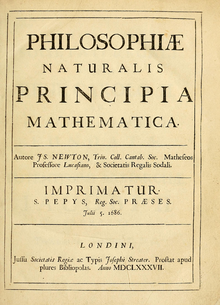
This article is actually an adapted translation. The original piece was written by Stephen Hawking, titled “Newton’s Principia.” A complete translation of that work would be much longer—and quite difficult, too. So, I have rewritten it in a concise and simple way so that all science enthusiasts can easily understand it.
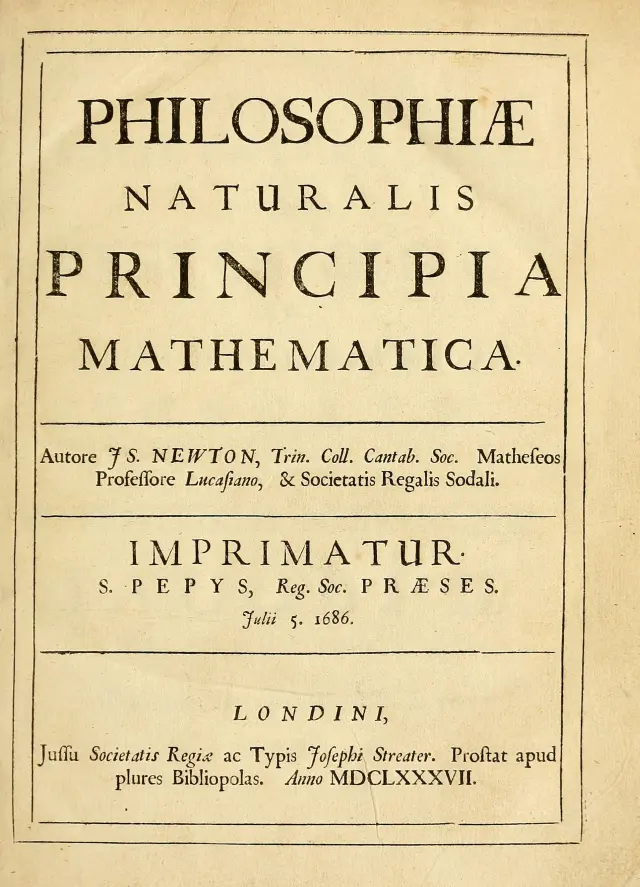
(Image: Collected from Wikipedia)
“Philosophiæ Naturalis Principia Mathematica,” perhaps the greatest single work in the history of physics, was authored by the eminent scientist Sir Isaac Newton. It was first published in Latin in 1687. The only comparison to this book could be “The Origin of Species” by Charles Darwin, which is a masterpiece in the field of biology. Newton’s drive to write the Principia came from his eagerness to answer a question posed by Edmund Halley: Was it possible, based on the concept of the inverse-square law, to explain the elliptical orbits of the planets around the Sun? Although Newton had researched this earlier, he had not published his results. To answer this question, he first had to formulate the principles of mechanics—now known as Newton’s laws of motion. While these laws easily explained the motion of objects in a straight line, describing the motion of the planets proved more challenging, as the magnitude and direction of the forces acting on them change constantly. To account for planetary motion, Newton had to invent an entirely new branch of mathematics—what we now know as differential calculus. However, for various reasons, he did not include this method in the Principia. As a result, he had to develop another approach with which he demonstrated that the orbit of an object revolving around a fixed point becomes elliptical due to an inverse-square attractive force toward that point. Thus, Halley’s question was answered. Additionally, Newton’s published theory aligned with Kepler’s laws of planetary motion. Unfortunately, after the publication of Principia, Leibniz independently discovered and published calculus. Though Newton would later publish his own method, he missed the chance to be the sole discoverer of this monumental achievement. Besides explaining the elliptical motion of the planets, Newton also showed that the moons of Jupiter and Saturn move in their orbits due to gravitational force, the Moon revolves around the Earth, and even phenomena like tides and apples falling from trees are results of this force. In short, gravity is a universal force. Naturally, it was assumed that light would also be subject to gravity. This was later confirmed when light rays passing near massive and extremely dense objects (such as black holes) observed from space were seen to bend, clearly an effect of gravity. The universe is vast and, in terms of time and space, is filled throughout with stars of nearly equal density. It would seem that the universe should contract due to the mutual gravitational attraction of the stars. But why does this not happen? In seeking an answer, Newton explained that since the stars are spread infinitely far, each one is equally attracted by all the others in every direction. Therefore, the net force on any individual star is so small that the distances between stars remain roughly constant, and the universe does not contract. This explanation also implied that the universe is static. However, in 1920, it was discovered that the universe is expanding. Thus, it became evident that failing to predict the expansion of the universe was a major limitation of classical physics. In Principia, Newton introduced the concept of absolute time and absolute space. Absolute time means that whether or not an object is moving, or whatever the event, the time on all clocks remains the same. Up until the discovery of relativity in the early 20th century, this idea was not questioned. But the theory of relativity rejected the concept of absolute time. Newton’s idea of absolute space also could not stand against relativity. The principles presented in Principia were the accepted theories of mechanics and gravitation for over two centuries—and even today they are applied in nearly all areas of physics. Only for extremely precise calculations must one consider Einstein’s special (1905) and general (1915) theories of relativity. In relativity, the ideas of absolute time and space are dropped. It states that the timing of events depends on the speed of the clock, and it is not possible to determine if events occurring at different locations happen at the same time. The timing also depends on the frame of reference. Both Newton and Einstein were creators of revolutionary theories. But examining the foundations of these theories, we see that Einstein’s general theory of relativity, concerning curved space, is mathematically based on the work of Riemann. On the other hand, Newton’s theory rests on a powerful mathematical method that he developed himself—in other words, Newton’s theory is entirely self-sufficient.
Thus, it can be said that Newton is the rightful claimant to supremacy in the realm of mathematical physics, and Principia is his greatest legacy.









I had hard time reading the materials in such a small letters. I do I chage it in regular format?
i liked the way you analyzed the whole story…but which i don’t like the comment at the
end.Where you(completely my thinking) deliberatety presented the einestein’s special theory of relavity and the general theory of relavity…in a way that it seems that nothing he did all the works already done by Riemann’s. Newton is great but don’t comare einestein’s volume of work and thinking with such a disgrace.
Very good blog
Fun,Bollywood,mp3,Gallery,Tamil,Natok,Download,Movie,Free Software,Tutorials,Screensavers,Wallpapers,
Computer Bazar Update,market,Latest Bollywood News, Star Interviews, Bollywood Chat, Hindi Songs, Movies
Reviews and Previews, Bollywood Gossip, Shop Online, Free E-mail, Chat with Bollywood stars,
Download hindi songs in Real Audio and mp3 format and much much more..
Visit http://www.moonbd.com
This comment has been sanitized for the English site.