


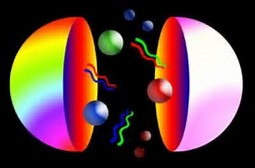
An object, whether it’s a block of ice or a piece of stone, can be broken down into smaller pieces. Based on this simple truth, about 2,500 years ago, the Greeks concluded that if you keep dividing matter, there must eventually come a point when it can no longer be broken down further. They named this smallest part the atom. But later it turned out that the atom is not the smallest or the most fundamental particle; inside the atom, there are even smaller particles. The atom is made up of a nucleus composed of protons and neutrons, and electrons orbiting around it.
For a long time, protons, neutrons, and electrons were considered Fundamental Particles; but in 1964, Murray Gell-Mann, a theoretical physicist at the California Institute of Technology, and in 1968, scientists at the Stanford Linear Accelerator Center, observed and proved that protons and neutrons are made up of even smaller particles. Murray Gell-Mann named these particles Quark. There is also a small story behind the name “quark.” It comes from a quotation in James Joyce’s book ‘Finnegan’s Wake’ — ‘Three quarks for Muster Mark.’
Of course, nowadays, the list of fundamental particles includes not only quarks and electrons but many others as well. Included are two particles called muon and tauon, which are believed to have existed in large quantities in the universe shortly after the Big Bang. Additionally, there is a particle called neutrino, which is capable of effortlessly passing through layers of lead trillions and trillions of miles thick. In any case, the main topic of discussion in this article is the quark; however, the lepton, a close relative of the quark, will also be covered!







This comment has been sanitized for the English site.